
About this series
The Globe is reporting from cities and towns in Ontario, Manitoba and British Columbia to hear from residents about the issues affecting their communities and their votes in the municipal elections.
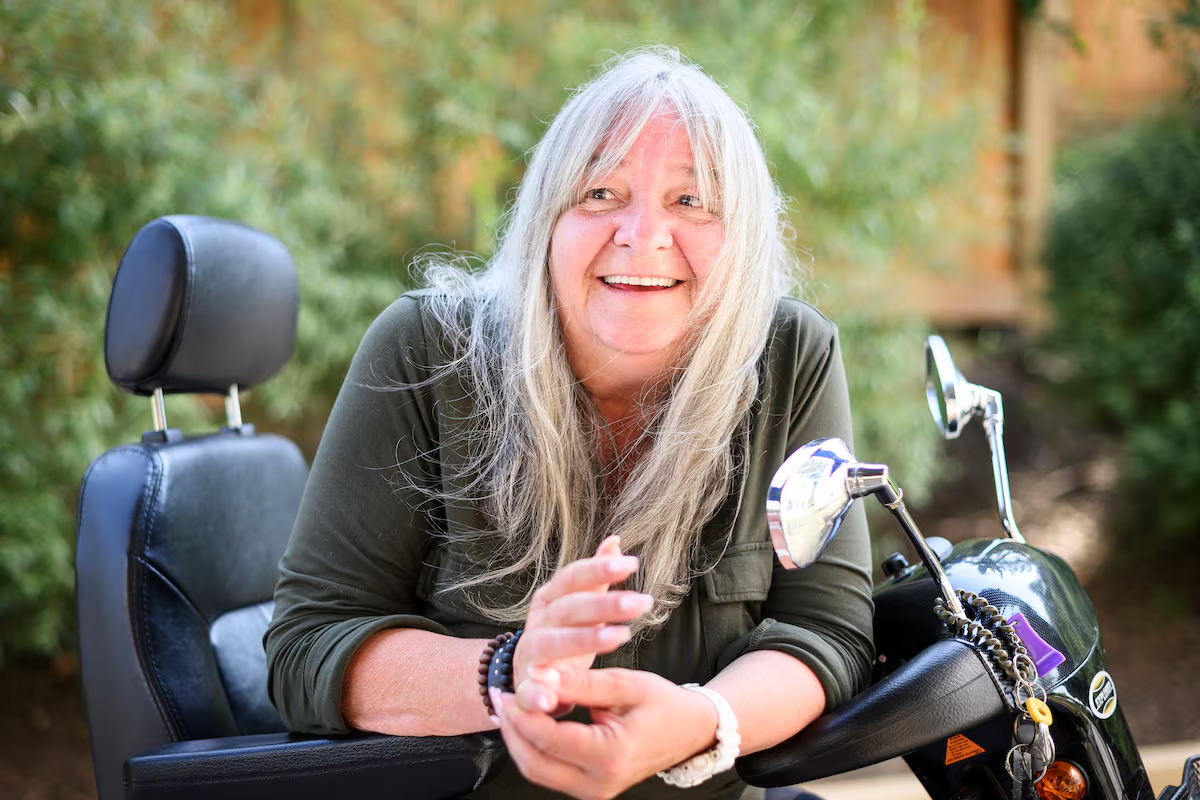
Julia Clissold and her husband had just settled into their new Maple Ridge, B.C., condo in the summer of 2022 when they learned that the residential development planned for next door would be supportive housing.
They had concerns: The 52-unit building, which would come to be known as Rivers Reach, would replace a nearby temporary modular housing project where drug use, fires and noise disturbances were common. Police were “constantly” at that site, as were people who loitered and camped out at the property, Ms. Clissold recalled.
“We’re like, ‘It’s just going to move over here,’” she said in an interview. “We wouldn’t walk our dogs down there, we wouldn’t drive by, because there were always people on the road in various states of what have you. So we were very scared at that point.”
Open this photo in gallery:
From her balcony, Julia Clissold can see the colourful mural of Rivers Reach, a supportive housing complex in Maple Ridge, B.C.Justine Beaulieu-Poudrier/The Globe and Mail
Many others in their new-construction condominium, located on a quiet residential street, were similarly apprehensive, said Ms. Clissold, who is president of the building’s strata council. Some felt deceived by the realtors and developers who sold them their homes along with the idea that a complex similar to theirs was planned for next door.
But a year and a half later, Ms. Clissold has become an unlikely champion of the supportive housing project. The fears she and others had never materialized; Ms. Clissold attributes its success to careful planning, attentive management and the operator’s responsiveness to community feedback.
The tensions that once gripped this community are hardly unique. Across B.C., disputes over homeless encampments and supportive housing have dragged on for months or years, in big cities, sleepy suburbs and northern communities. This year alone, proposed supportive housing projects in Abbotsford, Burnaby and the District of North Vancouver have been cancelled amid backlash.
The issue has also become a flashpoint in municipal election debates leading up to Saturday’s general vote.
In Richmond, fierce opposition to supportive housing has put mayoral candidates under pressure to make their positions clear, prompting some to explicitly declare their opposition. In Surrey, one candidate has taken the opposite approach, pledging to build 1,000 new units annually for four years and blaming the past council’s resistance to such projects for worsening street homelessness. Candidates in Vancouver’s contest have been grilled on whether they would reverse the incumbent administration’s freeze on net-new supportive housing.
The experience in Maple Ridge offers a case study in how local leadership can help overcome entrenched opposition to supportive housing projects – particularly as an incumbent provincial government that is seeking re-election signals it would rather direct limited funding to communities willing to embrace them.
In an interview with The Globe and Mail last week, NDP Leader David Eby said ahead of the Oct. 24 provincial vote that his government is done with overriding municipalities that oppose supportive housing. “If they’re happier with an encampment in their community, if they’re willing to live with that rather than to have the hard conversation with their community about the supportive housing that’s needed, I struggle to know why I wouldn’t dedicate that money to a local government that actually wants to close the encampment and open housing,” he said.
Efforts to address homelessness in Maple Ridge have stretched back more than a decade, marked by encampments, temporary shelters and contentious housing proposals that have galvanized residents, shaped elections and pitted local leaders against the province.
Former Maple Ridge mayor Nicole Read, who advocated for unhoused people and supported low-barrier options during her term from 2014 to 2018, was the subject of online harassment that became so heated she was forced to curtail public appearances as the RCMP investigated threats to her personal safety.
In May, 2017, people began erecting tents and makeshift shelters at a vacant downtown site slated for a neighbourhood park, creating an encampment that would become a highly visible indictment of the city’s shortage of affordable housing. The site, which came to be called Anita Place, persisted for more than two years. At its peak, nearly 200 people sheltered there, with many saying it offered more security than being alone.
But the encampment drew the ire of other community members and local officials who raised crime and safety concerns. People staying at the camp used portable heaters, propane tanks and electrical connections to stay warm, sparking numerous fires and creating significant safety risks, firefighters said. Police said they received dozens of calls about weapons and stolen items.
In response, B.C.’s NDP government announced a plan to move about 50 people from the camp into temporary modular housing on province-owned land nearby while permanent housing was being built. Coast Mental Health, a non-profit that operates housing and other social support services, would manage the site.
The move went against the wishes of the local council and was met with such fierce community opposition that the provincial government and BC Housing, the Crown corporation in charge of subsidized housing, had to seek a court injunction to clear community members who camped at the modular site in protest.
Open this photo in gallery:
The NDP government of the late John Horgan, visiting Maple Ridge in 2017, would draw flak for its efforts to set up temporary modular housing in the community.Darryl Dyck/The Canadian Press
The work-camp-style housing opened in October, 2018. Minutes from community advisory committee meetings around that time detailed neighbourhood complaints, including reports of people congregating at the site and visitors yelling to get the attention of tenants. Residents of a nearby seniors’ home said they didn’t like seeing people under the influence and were upset by their use of foul language.
The controversy over the new housing coincided with a municipal election. Just two days after the modular site opened, voters in Maple Ridge ushered in a new mayor, Mike Morden, and four new councillors. Mr. Morden, a two-term city councillor who campaigned on a tougher response to the homelessness and addiction issues that he said were driving crime in the city, won a decisive victory.
The new mayor and council feuded with the province over the site throughout their term, arguing that the B.C. government’s efforts to build supportive housing in the city undermined their local authority. They were also at odds about what that housing should look like; Mr. Morden said anything short of complex care with intensive health and social supports would be inadequate.
It was hard to deny that more support was needed. From 2019 to 2025, the temporary housing site was associated with 17 deaths – 15 from drug toxicity and two that were natural deaths, the BC Coroners Service said in response to a request from The Globe.
A BC Housing-commissioned review of supportive housing in Maple Ridge, released in 2023, would later note Coast Mental Health’s “challenging starting position” in supporting people who had come to the site from the encampment. Some residents were living with significant mental health and addiction issues, the report said, and the repurposed modular building was already “at the end of its useful life” when people moved in.
As the province forged ahead with a permanent housing site, which would also be operated by Coast Mental Health, some residents said they felt their concerns about safety and the capacity of emergency services were being ignored. The tension in the city became such that drivers began to pelt unhoused people with objects as they sped by. Coast Mental Health and local health authority employees who worked with the homeless population were advised not to wear identifying badges or clothing out of fear they could be targeted.
In November, 2021, the province announced that it would use its authority under B.C.’s Interpretation Act, also called statutory immunity, to bypass Maple Ridge’s usual bylaws and processes to fast-track construction of permanent supportive housing.
It cited the urgent need to replace the aging modular site, and its inability to find a “mutually agreeable site” with the city – a move that led to further acrimony between the two governments.
In an interview, Mr. Morden said the city had scrambled to put forth an alternate proposal that included a different site, operator and location, but received no response from the province before its announcement.
“I cannot tell you how angry I was,” he said.
The following year, Keir Macdonald was named CEO of Coast Mental Health. Mr. Macdonald, who had most recently led the Phoenix Society, a Surrey-based not-for-profit social welfare organization, recalled being onboarded as the housing project faced “complete and almost universal opposition.”
It was the first time Coast Mental Health planned for a new housing project with no involvement from the local council, Mr. Macdonald said in an interview. The provincial government’s use of statutory immunity also meant there would be no conventional public process through which it could formally engage with residents and respond to misinformation.
Mr. Macdonald said he was confident in the work of his new organization, but knew it would be an uphill battle trying to win over the community under such circumstances.
“I truly believe you need a social licence to operate, and that means leaning into discussions with your neighbours,” he said. “Sometimes it’s the business community, sometimes it’s local government.”
Open this photo in gallery:
Keir Macdonald, at left in 2017 with B.C. mental-health minister Judy Darcy, went on to become CEO of Coast Mental Health.Darryl Dyck/The Globe and Mail
The non-profit made its case for integrated health supports at the new building, laying bare to the Fraser Health Authority and the provincial government the significant health challenges its clients faced. It presented them with internal incident reports describing overdose deaths and concerning mental health episodes at the modular housing site.
Of roughly 160 people accessing Coast Mental Health programs in Maple Ridge at the time, only one-third were connected to health services, Mr. Macdonald said. They couldn’t do this alone.
The effort would eventually lead to Fraser Health funding the equivalent of four full-time positions in-house – a rarity in supportive housing, where nonclinical staff typically connect residents to off-site services.
In October, 2022, a municipal election again remade council. Dan Ruimy, a former MP for Pitt Meadows-Maple Ridge, unseated Mr. Morden as mayor and won control of city hall alongside four councillors from his A Better Maple Ridge team. Mr. Macdonald invited the new council to tour Coast Mental Health’s other Maple Ridge sites, finding a receptive audience and a “fresh opportunity to engage.”
In an interview, Mr. Ruimy said his administration was keen on helping to move Rivers Reach forward, knowing its completion would allow the troubled temporary modular site to close. Rather than fighting the province, he said his team engaged with it and Coast Mental Health, seeking assurances around security, staffing and building access, drawing on lessons from the earlier project.
“That was important, because I think when you’re fighting against governments to do any of this, a lot of that stuff gets lost in translation,” Mr. Ruimy said. “It ends up going against everybody’s wishes, and you lose the opportunity to actually collaborate.”
Open this photo in gallery:
Pitt Meadows-Maple Ridge MP Dan Ruimy, at right with Mr. Trudeau and some first-time homebuyers in 2019, would run for the Maple Ridge mayor’s job three years later.Darryl Dyck/The Canadian Press
In late 2024, with construction under way, Coast Mental Health struck a community advisory committee to solicit feedback and address concerns. Staff went door to door to distribute notices introducing their organization and the supportive housing project, inviting neighbours to join the committee.
By now, Ms. Clissold and her husband had lived at their new condo for about a year. They watched the construction of the building next door from their ground-floor unit – probably one of those that would be at the highest risk for break-ins, Ms. Clissold thought at the time. Her anxiety grew with every completed storey.
As Ms. Clissold wondered whether they would have to move again, an invitation to join the building’s community advisory committee landed in her mailbox.
“At that point,” she said, “I’m like, ‘Oh, hell, yeah.’”
The inaugural community advisory meeting was held on-site in the spring of 2025, as construction was completed and the first tenants moved in.
Ms. Clissold, unsure of what to expect, recalled being ushered through a “beautiful” facility and into a meeting room where she was met by representatives from the city, Fraser Health, BC Housing, the fire department and police, among others.
After introductions, program manager Donna McKenna explained the building’s vision and mandate, telling the group it was intended to be permanent, community-based housing for people who require supports.
The on-site team would include two nurses, a rotation of 11 mental health workers, a peer support worker, a clinical counsellor and two program co-coordinators. A psychiatrist would visit once a week.
Staff would work with tenants and community health-care providers to co-ordinate medication management and substance use treatment plans, Ms. McKenna said. Voluntary programs would include employment skills building, financial literacy and cooking groups.
The group also heard that operators had made changes to the design, operations and policy for this building with a mind to community cohesion. To deter loitering by outsiders, a complaint heard clearly at other sites, they installed a gated perimeter with an access control point. Guests were allowed, but must abide by rules. Room cleanliness, assessed through inspections, must be maintained.
A prohibition against in-room smoking – in place but not enforced at many supportive housing sites – would be enforced at Rivers Reach. Illicit drug use would be permitted only at a designated outdoor tent at the back of the property, or in an indoor supervised consumption room where staff could monitor for adverse reactions.
Rules were laid out to prospective tenants during an initial interview and again during intake, according to the operator. Those who couldn’t adhere to them were directed to other housing.
Open this photo in gallery:
Ms. Clissold’s first meeting with the advisory committee brought her together with city representatives, the fire and police departments and health and housing agencies.Justine Beaulieu-Poudrier/The Globe and Mail
When it was Ms. Clissold’s turn to speak, she told the group that she and others were worried that the chaos of the modular site would follow residents to the new building.
But she left the meeting feeling hopeful.
“The amount of thought that went into how they were going to operate this building, like from that first meeting, I remember it was very evident that they wanted this to be a success,” she said.
Over the next several months, Ms. Clissold continued to bring feedback from her building to the advisory committee, which met regularly.
In response to a complaint about garbage on the street, the building created a “clean team” that offered tenants an honorarium equivalent to minimum wage to don a Coast Mental Health reflective vest and collect litter. A gripe about the building’s unsightly dumpsters resulted in the construction of a wooden pergola to conceal them. Over several months, the initial chill began to thaw.
Ms. Clissold began to exchange pleasantries with her new neighbours, her dogs serving as an easy icebreaker. One resident from up north told her he used to have an Alaskan malamute that resembled her mini husky. Another had a little dog just like her miniature pinscher.
“It no longer felt like it was the building next door filled with people who have addiction challenges, or have experienced homelessness,” Ms. Clissold said. “It’s a building of neighbours.”
The designers of Rivers Reach hoped community gardening would give residents a project to be proud of, and a source of food for the building’s cooks.
Jennifer Gauthier/The Globe and Mail
Sylvie Hiekel, 61, moved into Rivers Reach from a nearby shelter, where she had stayed for nine months after fleeing an abusive relationship.
The former bakery manager and construction foreman, who receives provincial disability assistance, had her own reservations about supportive housing after hearing horror stories about other sites.
But despite her initial apprehensions, Ms. Hiekel said she’s found the building to be supportive and safe, crediting attentive staff. She has also embraced the cooking and crafting classes offered on-site, and enjoys aquatic exercise at a nearby recreation centre where tenants receive a discount.
As someone who does not use illicit drugs, Ms. Hiekel has mixed feelings about drug use being permitted on-site. Allowing it can potentially enable use, she said, though she also acknowledged that using at the building can be a life-saving alternative to using alone on the streets.
Tenants who do use drugs have been respectful, she said, and their use has not intruded on her daily life.
“We all look out for each other,” Ms. Hiekel said. “Everybody needs a family, and a lot of these people that live here don’t have a family. We’re family.”
Open this photo in gallery:
Sylvie Hiekel was apprehensive about supportive housing at first, but has found Rivers Reach to be a good place to live.Jennifer Gauthier/The Globe and Mail
In an interview, Ms. McKenna, the program manager, said building a community required intentional efforts to foster trust and communication among neighbours, tenants and staff.
They also sought to create a home that tenants would take pride in, she said, a goal reflected in the building’s colourful artwork, towering sunflowers and railing planters full of pansies. In the community garden, residents tend to zucchini, spinach, corn and other vegetables that the building’s two cooks prepare for meals.
Ms. McKenna said there are often preconceived notions about the people Coast Mental Health serves, and assumptions that its role as a recovery-oriented organization means most of its clients are recovering from addiction.
“It could be profound social isolation, struggling with mental health issues, finding a safe place to be, people who were injured at work,” she said, adding that tenants at Rivers Reach range in age from 25 to their early 70s.
The building hasn’t won everyone over. Mr. Morden, the former mayor, said he knows people at the building and believes that some are breaking the rules by using drugs in their rooms. He also continues to argue that anything short of 24-hour medical and social supports, along with addiction treatment on demand, is insufficient.
“People don’t get better; people don’t move along,” said Mr. Morden, who is seeking to return to city hall with a seat on council in this Saturday’s election.
Mr. Macdonald, the Coast Mental Health CEO, agreed that it remains difficult for many people to access timely substance use and recovery services. But he disagreed with the idea that everyone should follow the same trajectory, with independent living as the end goal. Instead, his organization seeks to provide stability through permanent housing and connect people to health and social services when they are needed, he said.
“I don’t think it’s a failure if someone requires that ongoing support and structure that a supportive environment brings.”
Mr. Ruimy, who is seeking re-election as Maple Ridge mayor, said the experience has shown how stigma can impede progress, and how important it is for local governments that are facing similar challenges to remain open to dialogue.
“I think we’ve shown what happens when you have a municipality that collaborates with other levels of government,” he said. “You end up with a better solution.”
Meanwhile, Ms. Clissold said negative perceptions of supportive housing persist, with some neighbours continuing to make snarky remarks about the project. Its most vocal critics, whose worst fears did not materialize, now seem more inclined to ignore its success than acknowledge it, she said.
The community advisory committee, left with few pressing issues to address, has shifted to meeting as needed.
Invited back to Rivers Reach over the summer to celebrate its one-year anniversary, Ms. Clissold later reflected on the journey in a social-media post. Despite the initial doubts of many, she wrote, operators showed that such projects can succeed by listening to the community, meeting tenants where they are and learning from past challenges.
“And the tenants have shown that, when given a chance, they form their own supportive community that beautifully integrates into the neighbourhood.”
Local Matters: More from The Globe and Mail
The Decibel podcast
In pockets of Vancouver and Toronto, the population has shrunk by up to 40 per cent over 50 years, even as the cities grow overall. Has the solution to the housing crisis been there all along? Architecture critic Alex Bozikovic spoke with The Decibel about the demographics and politics at play. Subscribe for more episodes.
Communities in focus
Brandon, Man.: The Wheat City has a problem with derelict buildings
Sault Ste. Marie, Ont.: Trade war and local elections spark a steel town’s conversations about change
North Bay, Ont.: plans to demolish birthplace of ringette take spotlight in municipal elections