Warning: This story contains graphic details about a murder scene.
When police responded to a 911 call at a home one winter day in Saskatoon, they didn’t find an emergency.
They did find a flimsily barricaded door that appeared to have been kicked in, a young man sleeping on a couch upstairs, and a jumbled pile of “suspicious” brown glass bottles with pink liquid on a bed downstairs.
Officers seized the bottles. They didn’t arrest or charge the man on the couch.
Two days later, when police returned with a search warrant for the same house, they found that man again.
In pieces.
His name was Lee Perkins. He was 25 years old.
He had been tortured, killed and mutilated. Officers found his remains stuffed into a large plastic tote.

Lee Perkins’s parents, brother and sister-in-law are seen outside Saskatoon Court of King’s Bench in September, wearing shirts with his photo on the front. On the back, the shirts say, “Justice for Lee.” (Hannah Spray/CBC)
3 people charged
Three people are accused in relation to his death, and because of the multiple court proceedings, almost all of the details about the case were subject to publication bans, to protect their rights to fair trials.
But this week, a jury in Saskatoon Court of King’s Bench delivered its verdict in one of the related trials. The remaining matters are being decided by a judge alone, so the details can now be shared publicly.
All three accused were initially charged with first-degree murder, although only one of them still faces that charge.
That is Edin Dion Vrazalica. His three-week trial is scheduled to begin on Nov. 9.
A second man, Dillon Singler, pleaded guilty to manslaughter. The Crown is seeking to have him designated a dangerous offender, and that hearing is scheduled for January.
The third accused was Chantal Lee McLaren. The Crown later discontinued the murder charge against her and instead charged her with being an accessory after the fact to murder and offering an indignity to human remains.
McLaren pleaded guilty to the accessory charge, admitting that she purchased supplies to clean up the murder scene. She was not present when Perkins died and she did not admit helping to clean up the scene.
The indignity charge is expected to be withdrawn when the judge gives a decision on McLaren’s sentence on Dec. 9.
At her sentencing hearing last month, an agreed statement of facts signed by the Crown and defence said McLaren was in an intimate relationship with Vrazalica “characterized by escalating and repeated physical, emotional and coercive abuse by Mr. Vrazalica towards Ms. McLaren.”
What was in the brown bottles?
Vrazalica and McLaren were also charged in relation to the liquid-filled brown glass bottles that police found when they responded to the 911 call on Feb. 1, 2024, two days before Perkins’s body was found.
Drug lab testing results in May 2024 showed the bottles contained remimazolam, a form of benzodiazepine — a class of drugs that are legal when prescribed, and are usually used to treat conditions like sleep disorders or anxiety.
It was the first time authorities in Saskatchewan had come across remimazolam in a liquid form, a police drug expert testified in court. The number of full bottles seized (43), plus hundreds of empty bottles found in the house, led police to believe the drug was being trafficked, which is illegal.
Vrazalica pleaded guilty to possession of benzodiazepine for the purpose of trafficking and is serving a two-year sentence.
McLaren pleaded not guilty.
Her trial on that charge started in Saskatoon Court of King’s Bench on Oct. 5 in front of a 12-person jury. It ended on Wednesday with a guilty verdict.
That jury was not told anything in court about the murder, or about Vrazalica’s guilty plea on the drug charge.
Now, more parts of the story can be told.
‘Brutal assault’
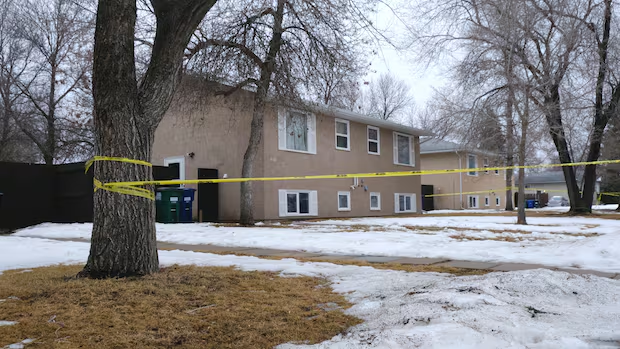
The home McLaren was renting on Feb. 1, 2024, where Perkins was sleeping on the couch upstairs and police found and seized the brown bottles downstairs, was at 610 Lisgar Avenue.
McLaren was not home when police came that day. She didn’t testify at her trial on the drug charge, so the jury never heard from her and she was not cross-examined under oath, but she did read a prepared statement at her sentencing on the accessory charge that referenced what she said happened.
“While I was away at a dentist appointment, police attended my residence and removed drugs that I was unaware were in my home,” she said. “To my knowledge, nothing was left informing me that the police had been there or explaining what had occurred.”
McLaren said Perkins was the only person in the home at the time.
“I am not raising this to blame the police for what happened to Lee, or to suggest that their actions caused his death,” she said. “I’m explaining it because it contributed to my state of mind. I was already frightened and confused and that experience added to my belief that I could not safely turn to the police.”

Chantal McLaren’s lawyer Zachary Carter speaks outside Saskatoon Court of King’s Bench on Wednesday. He represented her at both her trials this year — one where McLaren pleaded guilty to being an accessory after the fact to murder, and one where she was convicted by a jury of possessing benzodiazapine for the purpose of trafficking. (Don Somers/CBC)
The agreed statement of facts on her sentencing for the accessory charge talked about what happened next.
Sometime between Feb. 1 and Feb. 2, McLaren “was an unwilling witness to a brutal assault on Lee Perkins where he was beaten and in which four of Mr. Perkins’s fingers were cut off,” it said.
Those agreed facts named Vrazalica and Singler as the men who assaulted Perkins. While Singler has pleaded guilty to manslaughter, Vrazalica has not admitted any role and remains innocent until proven guilty.
“Mr. Perkins was thereafter murdered in circumstances not involving Ms. McLaren as a party or witness,” the agreed facts said.
McLaren went shopping twice on Feb. 2, “while fearful of Mr. Vrazalica.” The first trip was around 9:30 a.m., when she went to a Canadian Tire and bought items including disinfecting wipes, a scrub brush, cleaning gloves, bleach and garbage bags.
She made a second trip around 12:45 p.m. to a Home Depot and bought a “Husky 45 gal. latch and stack tote with wheels in black with red lid.”
Suspect shot by police
Police returned to the neighbourhood in the early hours of Feb. 3, with a search warrant related to an investigation into an aggravated assault “that was believed to have occurred.” That detail is in a report from the Saskatchewan Serious Incident Response Team (SIRT).
Officers “established containment” around the home as they prepared to execute the search warrant. Around 2:15 a.m., two women left the home, but when an unmarked police vehicle pulled up, they fled in opposite directions.
Police pursued and arrested both women, but as that was happening, a man “emerged from the north door of the residence, carrying a long cylindrical object.” The SIRT report doesn’t name the man, but court records show it was Vrazalica, and that one of the women was McLaren.
Vrazalica ran toward some officers “at a full sprint” before stopping “and raising the object to his shoulder,” SIRT said.
An officer fired two shots, striking Vrazalica once. He was taken to hospital with a single gunshot wound.
The cylindrical object was a “rolling cover, consistent with an SUV cargo cover,” the SIRT report said.
When police searched the home, they found Perkins’s body stuffed inside the black plastic tote. Vrazalica made his first court appearance on the murder charge by phone, from his hospital bed.
What did the jury hear?
Regarding those brown glass bottles, the jury at McLaren’s drug trafficking trial was asked to make a series of inferences, based on the limited evidence presented.
They heard testimony from the patrol officers who responded to the 911 call on Feb. 1, 2024. The officers said they found the jumbled pile of brown bottles on a bed downstairs, in the same room where they saw a suitcase with female clothes neatly folded.
Upstairs, officers saw school books and binders that they said were associated to someone named Chantal McLaren.
The jury also saw some of the photos police took of items in the home on Feb. 3.
Those items included an expired passport of McLaren’s and a letter from eHealth addressed to her at that address.
The defence didn’t call any witnesses, but did get an undated video admitted into evidence that showed two masked men dumping a pile of brown bottles onto a bed that police officers at the trial agreed appeared to be the same bedroom.
During closing arguments, Crown prosecutor Gregory Lyndon argued that the video looked like a marketing stunt, of people advertising a new product that was going to hit the market in Saskatoon.
He acknowledged the drug trafficking case against McLaren was circumstantial, but argued she was guilty through a legal concept called “constructive possession” — that if the jury inferred McLaren lived at the home and that was her bedroom, they could infer she had knowledge, access and control of the items in it.
Defence lawyer Zachary Carter argued there were other reasonable inferences the jurors could draw from the evidence. He reminded them of the unnamed man (Perkins) who was the only person in the home when police seized the drugs, and pointed to the video of the bottles being dumped as evidence that others actually handled the drugs.
The jury deliberated for three hours before returning with their unanimous guilty verdict on Wednesday afternoon.
“It’s always disappointing not to end up with the outcome you’re hoping for, obviously, but we in Canada trust jurors to fulfill their duties, and that’s what’s been done here,” Carter said outside court.
McLaren’s sentencing hearing on the drug trafficking charge is scheduled for March 1, 2027.