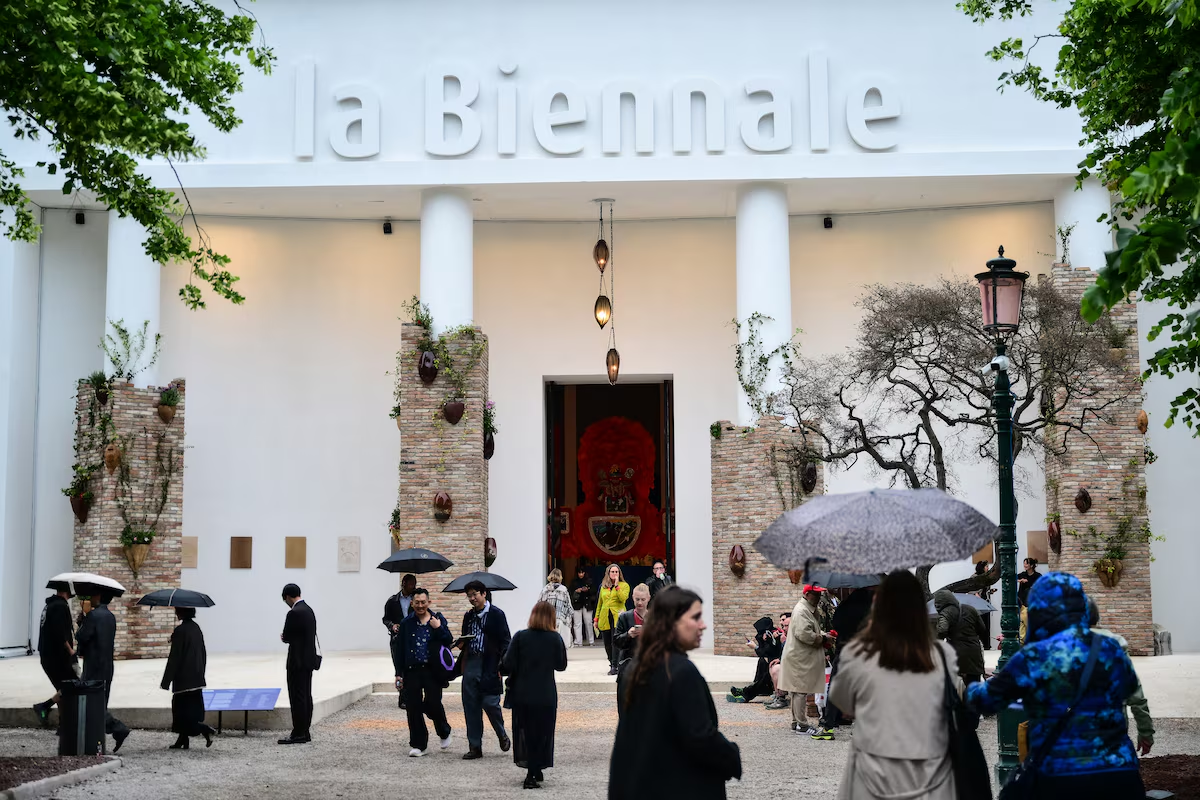

Open this photo in gallery:
People walk near the pavilion that hosts the exhibition In Minor Keys curated by Cameroonian-Swiss art curator Koyo Kouoh during the preopening press view of the 61st Venice Art Biennale on May 5.MARCO BERTORELLO/AFP/Getty Images
Canadian musician Sarah Davachi, a composer and organist who straddles the electronic and acoustic music spheres, has been awarded the Silver Lion award at the Venice Biennale.
On Monday the Biennale judges called Ms. Davachi, 39, who was born and raised in Calgary, “one of the most interesting and coherent voices in the contemporary musical landscape.”
The Silver Lion is considered the second-most prestigious award at the Biennale, the high-profile, cross-cultural exhibition hosted in Venice every two years. The award is usually given to promising young artists in film, architecture, theatre, dance and music, whereas the top award, the Golden Lion, is for best film, best arts pavilion or lifetime achievement.
Only a few Canadians have won the Silver Lion – Leone D’Argento in Italian – since it was first handed out in 1953. Among them are Quebec actor Micheline Lanctôt for best first film in 1984 and Ottawa-born Dana Michel in 2017 for dance innovation.
Meet the Canadian artists heading to Venice Biennale
“This is a prestigious recognition for an innovative Canadian artist in the midst of her career,” said Canada’s ambassador to Italy, Elissa Golberg, who was at the awards ceremony. “Few Canadians have received Biennale Lions.”
Ms. Davachi said she was thrilled to receive the sliver statuette at a ceremony Monday. “It was unbelievable for me,” she told The Globe and Mail. “Holding the award was so exciting.”
The award is particularly significant because it is for a body of work, not an individual composition, album or performance. “In that sense, it was for my career,” Ms. Davachi said.
The award recognized her long compositions known for their delicate, seemingly indistinct changes in tone and texture that allow listeners to immerse themselves in the music. “My music tends to be for people who like to have a quasi-spiritual experience,” she said.
The Biennale judges called her music structural, not decorative. “Davachi’s work occupies a territory in which the structures of minimalism, early music concepts of intervallic relation and affect, and the experimental production practices of the studio environment converge, often centred on the use of analogue electronic instruments and the pipe organ,” they said in their statement.
Ms. Davachi has been attracted to unusual sounds and instruments since her youth in Calgary. “I always like certain kinds of sounds. They intrigued me, like the sound of a vacuum cleaner,” she said.
Analysis: At the Venice Biennale, a clash of politics and art exposes the need for a rethink
She nurtured her love of what she calls “minimalist, reduced-form compositions” as a researcher and interpreter of the collection of acoustic and electronic keyboard instruments for a decade at the National Music Centre, a museum, performance venue and recording studio in Calgary.
After receiving a master’s degree in electronic music at Mills College in Oakland, Calif., and a PhD in musicology at UCLA, she turned her music approach into a career that involves concerts around the world. Some are solo performances, during which she plays the pipe organ; others are with large ensembles. She is performing at two concerts in Venice over the next week and in Montreal next month.
In 2020, she founded Late Music, her record label, which is an imprint of Warp Records. She has collaborated with some of the world’s best-known orchestras, including the Los Angeles Philharmonic, the BBC Scottish Symphony Orchestra and the Brussels Philharmonic.
She lives in Los Angeles and is working on a new album. “I never really stop,” she said.