
Open this photo in gallery:
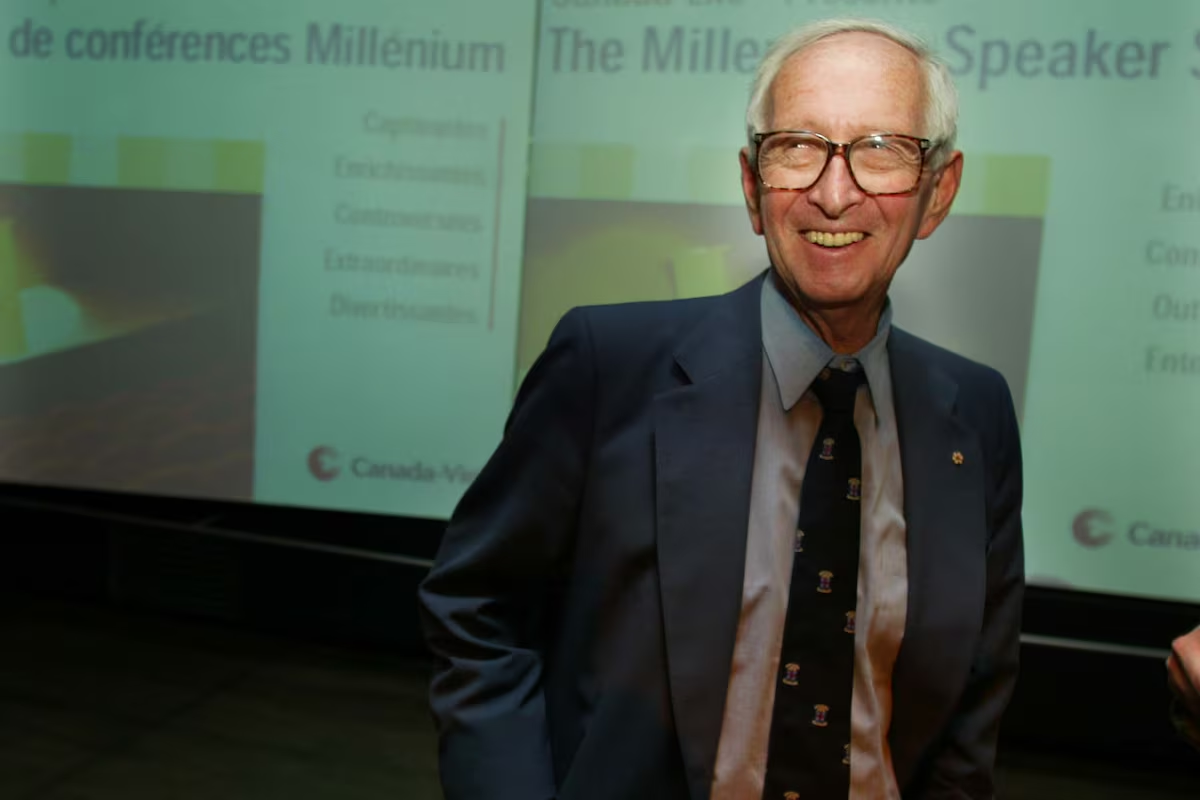
Stephen Jarislowsky, shown in 2002, advocated for shareholder rights in Canada during his lengthy business career.Andre Forget
Billionaire investor Stephen Jarislowsky, a champion of corporate governance and former spy, has died at the age of 101.
Mr. Jarislowsky co-founded what became of one of the country’s largest asset management firms, Jarislowsky Fraser Ltd., after moving to Montreal in the 1950s.
He made his name as a pioneer advocate for shareholder rights, embracing the concept long before it became trendy by engaging in public battles with CEOs, family businesses and boards of directors. Later in his career, he became a philanthropist who supported the study of democracy at universities and built one of the country’s finest private art collections.
In the 1970s and 80s, Mr. Jarislowsky fought against deals backed by Canadian corporate establishment, including the Billes family behind Canadian Tire, Montreal’s Bronfman clan, the corporate raider Conrad Black and auto parts magnate Frank Stronach.
On Thursday, Mr. Black, the former chairman and chief executive officer of media company Hollinger Inc., paid tribute to his onetime sparring partner.
“A German-Jewish fugitive from the pogroms of Europe, who became a breaker of Japanese codes for the U.S. Navy and ultimately the dean of money-managers in Canada, he was cantankerous, perceptive, and indomitable, but always a loyal and convivial friend,” Mr. Black said in an e-mail.
Obituary: Investment guru Stephen Jarislowsky was a crusader for ethical business practices
“His intellectual energy and originality will be remembered and missed by all who knew him,” he added. “He was unique.”
Mr. Jarislowsky frequently and successfully pushed foreign companies attempting takeovers in Canada to improve their offers, with the quiet support of his money-management peers.
“Steve was a renaissance man whose range of knowledge and expertise were extraordinary,” said former governor-general David Johnston, a long-time friend of Mr. Jarislowsky and a member of the Jarislowsky Foundation’s advisory council.
“Few people have had such an impact working to create a better Canada for all than Stephen.”
In 2002, Mr. Jarislowsky co-founded the Canadian Coalition for Good Governance, an influential lobby group. Catherine McCall, the coalition’s CEO, called Mr. Jarislowsky “a remarkable man whose impact those of us working in corporate governance today aspire to emulate.”
Stephen Jarislowsky was born in Berlin in 1925. His father was an industrialist and merchant banker, while his mother was a lawyer, and both were Jewish. When Stephen was 4, his father died from scarlet fever, and he and his siblings were sent to live near relatives in Amsterdam, then moved to Paris.
Opinion: Stephen Jarislowsky was a patriot and the Leonardo da Vinci of Canadian business
In 1941, the family left France for the United States. After he graduated from Cornell University with a mechanical engineering degree, Mr. Jarislowsky was drafted into the U.S. Army and served as an intelligence officer in Asia.
After the Second World War, Mr. Jarislowsky went to Harvard Business School. He then took a job at Alcan Aluminum Ltd. and moved to Montreal. In the 1950s, he teamed up with stockbroker Scott Fraser to launch a company that provided corporate research to investors. The service became money manager Jarislowsky Fraser.
Bank of Nova Scotia acquired Jarislowsky Fraser in 2018 for $950-million.
Kim Shannon, founder and co-chief investment officer at Sionna Investment Managers who served on the CCGG board of directors for nearly 20 years, said Mr. Jarislowsky was “known for watching his pennies.”
“His office was across the hall from a major Canadian broker, and rather than pay for his own current news feed, he would go over to the brokers’ offices and read their typed newspaper feed as it was emerging out of the machine,” Ms. Shannon said.
Maxime Ménard, CEO of Fiera Capital, worked at Jarislowsky Fraser for two decades and knew Mr. Jarislowsky personally for 25 years.
“He had a way of making you think harder, aim higher, and he had an impeccable sense of humour,” Mr. Ménard said. “He gave generously of his time and wisdom, and he expected a lot from the people he believed in.”
Open this photo in gallery:
Mr. Jarislowsky in 1988.John McNeill/The Globe and Mail
Mr. Jarislowsky remained the controlling shareholder in his asset management firm through his career. Some senior employees departed Jarislowsky Fraser to start rival platforms because they could not share in its ownership. Mr. Fraser left 20 years after the company’s founding.
In 2022, Mr. Jarislowsky’s family foundation donated $10-million to hire professors as “trust and political leadership chairs” at five liberal arts-focused universities across the country. The money went to Acadia University, the University of Quebec in Trois-Rivières, Trent University, the University of Lethbridge and Vancouver Island University.
“We’ve got schools to train doctors, engineers and lawyers. Why aren’t there degrees for aspiring politicians or civil servants?” Mr. Jarislowsky said in an interview at the time. The Jarislowsky Foundation is one of the country’s largest, with assets of $386-million at the end of last year.
Toronto-Dominion Bank deputy chair Frank McKenna called Mr. Jarislowsky “one of the most fascinating Canadians I’ve ever met.”
“His success in business is legendary but so should be his philanthropy,” said Mr. McKenna, a former premier of New Brunswick who served on the board of the Jarislowsky Foundation. “He was passionate about the study and promotion of democracy because he had witnessed its antithesis for much of his life.”
Montreal businessman Jonathan Goodman, who founded Knight Therapeutics, was Mr. Jarislowsky’s neighbour and visited him frequently in his later years. He said he never seemed bothered by his age and “acted like he was 20.”
The two men started a book club together during the COVID-19 pandemic. “I can’t remember the last five books we read. Stephen can remember the last 30,” Mr. Goodman said.
Denis Durand worked with Mr. Jarislowsky for 29 years at his money-management firm. He remembers a boss who didn’t fuss about his employees’ backgrounds – the workplace was full of people from different parts of the world who spoke different languages – but was demanding of his staff.
Later in his career, Mr. Jarislowsky often joined his wife on Vancouver Island in the summers only to return to Montreal soon after, Mr. Durand said. “We would laugh because, you know, he’d stay there for two weeks and then come back. … He’d say, ‘I’m coming back to the office. It’s more fun.’”
With reports from James Bradshaw