
Open this photo in gallery:
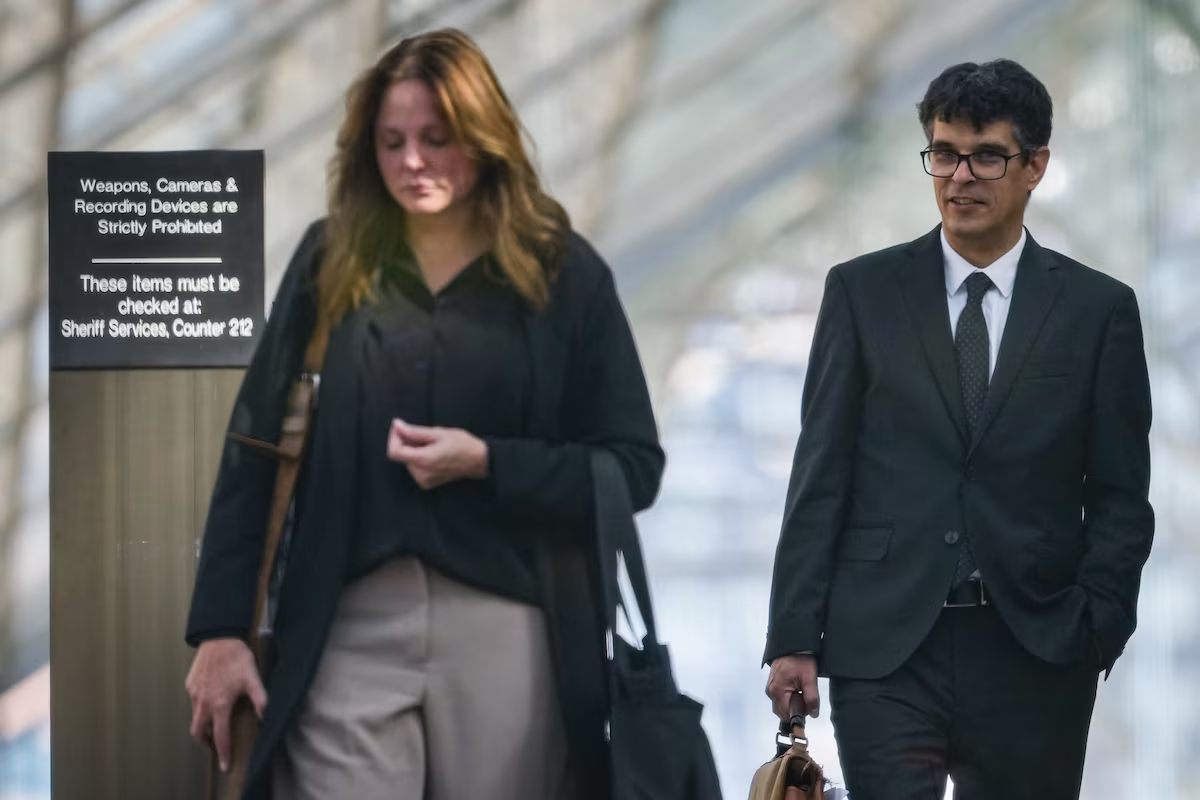
Author and former University of British Columbia professor Steven Galloway, right, and his wife, Katie Wagner, leave B.C. Supreme Court during a lunch break, in Vancouver, on Tuesday.DARRYL DYCK/The Canadian Press
The former creative-writing student who accused best-selling novelist and then-professor Steven Galloway of sexual assault threatened to sue the University of British Columbia for up to $3-million, claiming negligence by the school and other offences.
The B.C. Supreme Court heard Thursday that the university had already given the woman a bursary after graduating worth $30,000, money that Mr. Galloway testified Thursday the woman was not entitled to.
Mr. Galloway, who was the chair of the school’s creative-writing program, launched a defamation case against almost two dozen defendants. He claims that their allegations that he sexually assaulted and harassed the woman ruined his reputation, cost him his job and destroyed his personal life. Only the woman and three others are on trial. The rest have settled with Mr. Galloway.
The court heard about an April 7, 2016, e-mail from the woman’s then-lawyer, Joanna Birenbaum, to UBC’s associate vice-president of equity & inclusion, Sara-Jane Finlay. In it, Ms. Birenbaum thanks the school for its “very quick transfer of funds,” which Mr. Galloway said he found out in 2017 amounted to $30,000. The payment was first revealed during his arbitration with the school over his firing.
Marsha Lederman: The Steven Galloway trial demonstrates how hot takes can set fire to people’s lives
Mr. Galloway told the court he believed that the woman, his former lover, was not eligible for the money because she had already graduated.
“There’s no academic reason to have given this,” he stated during questioning from his lawyer, Daniel Burnett.
Court also heard that later in 2016, sometime in the middle of December, UBC’s general counsel Hubert Lai was involved in an e-mail discussion over the woman’s draft statement of claim to sue the school for up to $3-million for negligence, breach of contract and other reasons.
It was not revealed in court Thursday what happened with her lawsuit threat.
Arden Beddoes, lawyer for the woman who is known as A.B. because her identity is protected by a publication ban, objected to Mr. Galloway’s testimony about the internal UBC e-mails because he said it called for Mr. Galloway to speculate.
“The documents speak for themselves,” Mr. Beddoes said of the exhibits of internal UBC communications.
Steven Galloway says his accuser fabricated details of three sexual assault allegations
But Mr. Burnett was allowed by the judge to pursue the discussion of financial compensation for A.B. because – if his client is awarded damages − it could point toward her malicious actions.
“The communications by or on behalf of A.B. getting and seeking money out of UBC is arising from the very thing that is the defamation,” he said.
A.B. is not testifying and, at the start of the trial, Mr. Beddoes told the court that she was withdrawing her defences of truth and fair comment – but not admitting that she spread lies about her former romantic partner. Mr. Beddoes said she had tried to kill herself twice in recent months because of the stress of the ordeal.
After the woman’s allegations surfaced in 2015, Mr. Galloway was suspended and then fired as head of UBC’s creative-writing program without severance due to breach of trust. News of the incident spurred an online firestorm over the CanLit luminary’s rights to due process versus the rights of his alleged victim.
A retired judge hired by the university to investigate the complaint found that, on a balance of probabilities, it could not be established that he committed sexual assault or assault.
Mr. Galloway was never charged with a crime.
Steven Galloway tells court he was shocked by allegations
Earlier Thursday, Mr. Burnett asked his client about the up to $1.5-million in total royalties he made from his 2008 international bestseller The Cellist of Sarajevo. Court heard that the book had been optioned for a movie adaptation, which never materialized.
Mr. Galloway testified that he had signed a contract to produce three new books about a ventriloquist detective before the allegation surfaced and detonated his ability to continue as an author or be booked as a paid public speaker.
He said his income from book royalties had since “cratered” to about $5,000 to $10,000 a year “tops,” and that he hasn’t received any invitations for speaking engagements.
Mr. Galloway also testified that people who signed a letter criticizing the university’s handling of the misconduct case against him were subjected to “extremely hurtful” comments and suffered socially and professionally.
The letter, known as “UBC Accountable,” was published in November, 2016, with signatories from the literary community, including Margaret Atwood, but Mr. Galloway said many removed their names after a wave of vitriolic online criticism.
Gary Mason: Is Steven Galloway finally getting justice?
He said people lost jobs and friendships were ruined, and one signatory called him in tears, saying her daughter was never going to speak to her again.
A number of friends, even those who believed in his innocence, would not talk to him any more because being associated with him would be “career suicide,” he said.
Mr. Galloway said that after he’d won an arbitration award from the university, he “briefly had the hope” that the social-media storm would subside, but the posts continued.
He did not get his job back as part of the arbitration.
“I wouldn’t have gone back for a million dollars a year to that place,” Mr. Galloway said.
Mr. Galloway is due to be cross-examined by lawyers for the four defendants starting Friday.
With a report from The Canadian Press