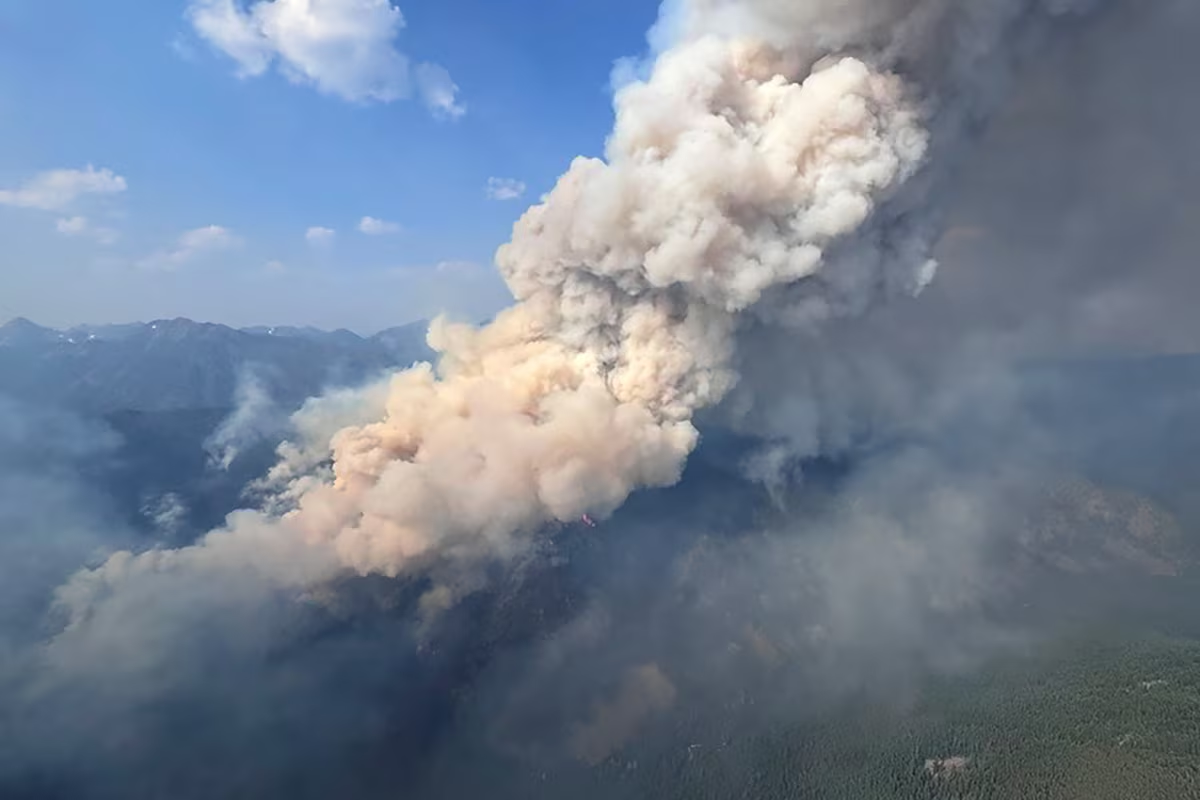

Open this photo in gallery:
Smoke rises from the Matthew Creek wildfire, believed to have been sparked by lighting, west of Kimberly, B.C., in July. Lighting accounted for 62 per cent of wildfires in the province this year.BC Wildfire Service/Reuters
A B.C.-based company developing technology aimed at reducing lightning strikes that spark devastating wildfires has done two years of field testing, with positive results.
Lightning caused 62 per cent of wildfires in British Columbia in 2026, according to the BC Wildfire Service. Nationally, lightning accounts for more than 80 per cent of the annual area burned. Across the country, wildfires have increased significantly in recent years, as climate change brings longer, hotter and drier summers.
Vancouver-based Skyward Wildfire Technologies has spent the past two years testing an AI-driven lightning-prediction platform to identify potentially dangerous storm systems, and an aircraft that can inject small amounts of aluminum-coated basalt fibres into thunderclouds.
The process is similar to cloud seeding, which is used to help shift rainfall patterns, but Skyward says that unlike traditional seeding, its own technology doesn’t trigger rain or impact precipitation. Instead, the basalt fibres are meant to disrupt and dissipate the electrical charge buildup within the storm clouds, reducing the amount of lightning that hits the earth.
Canadians are in the dark about their wildfire risk
Skyward says its research shows its predictive technology can accurately identify potentially troublesome thunderstorms, and its lightning-suppression flights reduced the amount of lightning generated by roughly 76 per cent compared with what would typically be expected.
To validate their research, Skyward said it partnered with lightning researchers at the New Mexico Institute of Mining and Technology, and the Applied Statistics and Data Science group, a research consulting group at the University of British Columbia.
“This is the first time ever, to our knowledge, that we now have statistical proof that cloud-to-ground lightning can be disrupted and abated,” said Nick Harterre, Skyward’s director of business development and government partnerships.
In May, the B.C. government awarded Skyward up to $1-million to test its technology in the province, and said the BC Wildfire Service would evaluate it to see whether it met the rigorous operational standards required for deployment.
The company has previously faced criticism for a lack of transparency over where it conducted testing and the potential environmental impact of spraying its material into storm clouds.
Skyward previously declined to answer questions from The Globe and Mail about where its lightning-abatement methods have been tested.
According to Environment and Climate Change Canada, Skyward filed notices of intent and subsequent reports referencing test flights in B.C. and Alberta in 2025, and said it told the ministry it planned to continue tests in both provinces in 2026.
Testing this year in Canada was unable to proceed because of an unexpected Transport Canada regulatory change that affected the aircraft the company planned to use, Mr. Harterre said.
In a statement, Transport Canada said the regulatory change did not involve Skyward’s technology, but was a broader change that limited the use of former military aircraft for civilian purposes.
Instead, Skyward tested its technology in the United States last summer, though it did not say where, citing “commercial conversations.”
Adonis Leal, a professor at New Mexico Tech who studies high-energy lightning strikes, reviewed Skyward’s work and said he found it convincing. The company’s claims are “very reasonable, and I believe in the results,” he said.
Dr. Leal’s research focuses on understanding the strongest and most intense cloud-to-ground lightning strikes, which generate intense heat and are most likely to trigger wildfires.
Introducing conductive material into thunderclouds increases the conductivity of the clouds themselves, Dr. Leal said, making it easier for electrical buildup to discharge inside the clouds, instead of building to the point that it strikes the ground.
Opinion: As wildfires rage, it’s a moment for carbon removal technology to shine
Another New Mexico Tech professor, Richard Sonnenfeld, was more cautious. He said that Skyward’s combination of lightning detection and suppression “probably works.”
Dr. Sonnenfeld said New Mexico Tech’s role was providing highly accurate lightning-detection instruments that can be mounted on aircraft. The amount of research that the company conducted, he said, was impressive. “They really did a lot of work.”
Skyward said it conducted 58 test flights, targeting 182 storm cells across the 2025 and 2026 wildfire seasons. It also tracked the behaviour of 2,505 comparable reference storms to examine the lightning output from treated versus untreated thunderclouds.
However, Dr. Sonnenfeld also said he was broadly skeptical of geoengineering – large-scale human interventions meant to influence climate – as a solution to climate change, calling such efforts a “horrible idea.”
Skyward’s tech, he said, is “sort of focused geoengineering” and raises questions about the amount of money and time being invested in treating the symptoms of climate change, such as devastating wildfires, instead of focusing on the root causes, including the burning of fossil fuels.
Mr. Harterre said Skyward’s tech has advanced early attempts at lightning suppression from the 1960s and 70s in two key ways. First, one of the biggest challenges researchers of the past faced was figuring out which clouds had the potential to cause the most damaging lightning.
That’s where Skyward’s predictive tool Vista comes in, Mr. Harterre said.
Vista uses machine-learning to ingest weather-forecast modelling, historic lightning data and wildfire behaviour science – the same information that’s used to generate the Canadian Fire Weather Index. It produces reports that predict not just where lightning is most likely to strike, but that give a more accurate picture of the potential damage a fire could cause at a particular location and time.
The goal is not to stop all fires from occurring, Mr. Harterre said. It’s to figure out which potential fires might have the most devastating consequences, and give fire agencies another tool to prevent them.
“There’s good fire and bad fire. And we need a lot more good fire on the landscape,” Mr. Harterre said, referring to the beneficial role wildfires can play in maintaining the landscape.
Many of Canada’s ecosystems evolved to rely on wildfire and require occasional low-severity fires to remain healthy. Letting those fires burn can also help prevent larger, more devastating fires in the future by reducing the amount of forest fuel available.
The metrics that reveal the human cost of a wildfire season
The company is working on “making sure that we have all the right tools in the forecasting toolkit to go after only the highest-risk storms,” Mr. Harterre said.
“We can predict the Jaspers, we can predict the Fort McMurrays, and agencies use that to preposition aircraft, preposition resources,” he said.
Mr. Harterre said Skyward’s tech has also refined the material that lightning-abatement flights need to disperse in order to work. The material itself is about the size and feel of short human hair. By using the Vista platform to more accurately target the right storm clouds, Skyward can reduce the amount of material that it needs to spray, Mr. Harterre said.
Mr. Harterre said their research shows that at the deployment volumes necessary, the material is expected to have no measurable impact on the environment.
“Even at full scale, in the most conservative assumptions across an entire season, you’re talking about way less material than you’d use in even one drop of [fire] retardant from a plane,” he said.
Mr. Harterre said the Vista platform can also be used as a stand-alone predictive tool for agencies, without the lightning-abatement process.
The B.C. Wildfire Service said that because of the transition period between governments after last month’s provincial election, it was unable to respond to questions.