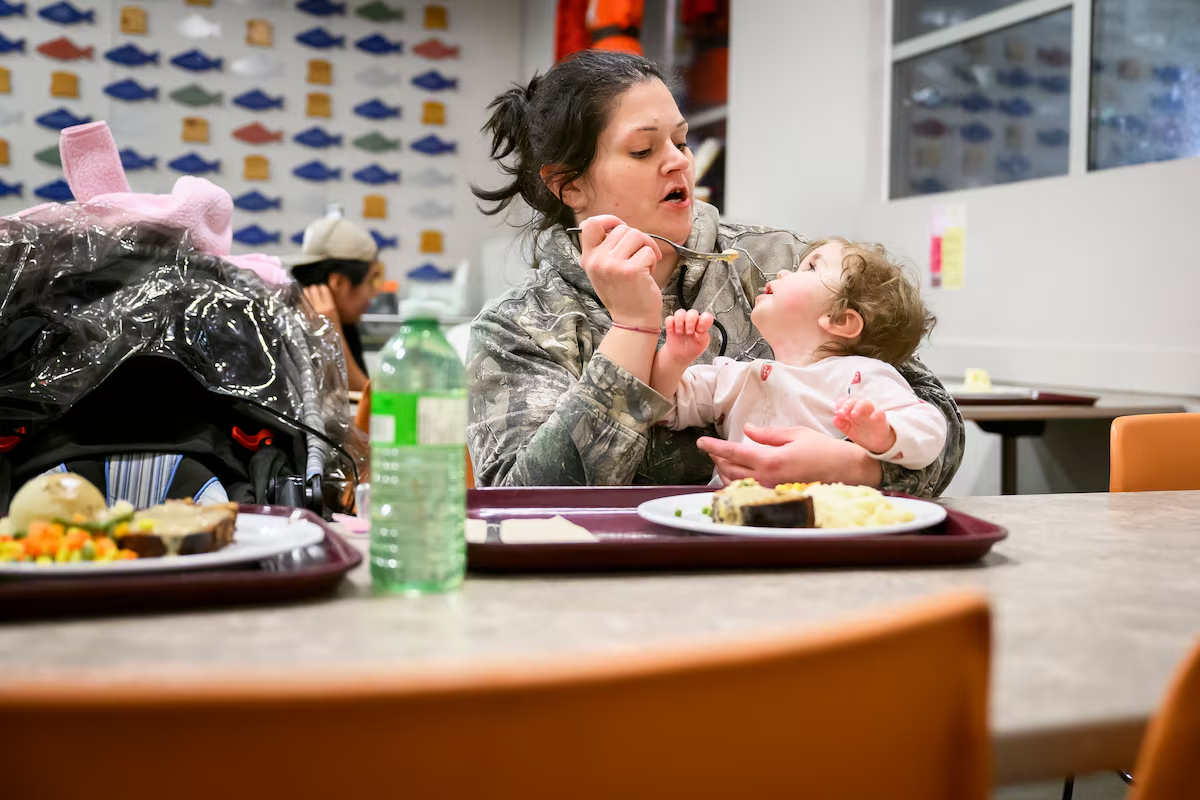

A Vancouver-based charity is sounding the alarm over a sharp increase in the number of children attending its hot meals program, warning that more families are struggling to put food on the table as the costs of living rise.
The Union Gospel Mission says the surge reflects a broader food-insecurity crisis, as charities across the country face growing demand from people increasingly unable to afford basic necessities.
“This is an urgent cry for help,” said UGM spokesperson Nick Wells. “If this is what we as one organization are seeing, think about what all the other organizations are witnessing. We really need all levels of government to prioritize funding for programs to address food insecurity.”
Since opening its doors in 1940, the East Vancouver-based non-profit organization has served daily hot lunches and dinners at no cost. Children took part so infrequently that outreach workers never tracked their attendance – until this year.
Open this photo in gallery:
Cook Ayoub Haidi and volunteers Junji Kobayashi and Bill Gorlay plate food during the hot dinner service.Jennifer Gauthier/The Globe and Mail
In June, shift supervisor Abraham Oparinde began tallying the increase he observed. That month, 37 children accessed either a lunch or dinner service. That climbed to 115 in July, 150 in August, 160 in September and 199 in October. To access a meal, a child must be accompanied by an adult.
Mr. Oparinde brought the issue to his supervisor. In response, the organization dedicated staff to serve families so they wouldn’t have to line up for meals, formalized its recording of young visitors and set aside donations of candies and chocolates for them.
Mr. Oparinde said he’s happy to help provide a safe and dignified space for those in need. But as a father of three adult children, he thinks of the many lively conversations and secrets shared over family dinners at home and said it’s heartbreaking that some families can’t always do the same.
“Seeing them coming out here, it kind of pains me,” he said.
Food bank use in Canada more than doubles since 2019, report shows
Grocery prices in B.C. have increased by about 25 per cent between 2021 and 2025, according to Statistics Canada’s Consumer Price Index. Nationally, grocery prices were 32-per-cent higher in October 2026 than in October 2020. Meanwhile, Canada’s Food Price Report 2026, produced by the Agri-Food Analytics Lab at Dalhousie University with partner universities, estimated that a family of four would spend $17,572 on food this year, an increase of $995 from last year.
In addition to its meal service, UGM provides food hampers with pantry staples, produce, baby supplies and necessities. The organization has distributed an average of 820 hampers a month this year, up from 250 in 2022.
A UGM dinner service earlier this week was at capacity, with 300 meals of meatloaf, mashed potatoes and mixed vegetables served over the course of an hour. As doors opened at 6 p.m., several mothers pushing their babies in strollers were led to an area of the cafeteria reserved for families, with longer tables, a couple of white plastic high chairs and sparse children’s drawings adorning the wall. Behind them followed a few other families with toddlers and tweens – 10 children in all this evening.
Open this photo in gallery:
Roxane Welles, who gave up her employment to care for her children full-time, packs leftovers for her family.Jennifer Gauthier/The Globe and Mail
Among them was Roxane Welles with her two daughters, aged six and nine. In an interview, Ms. Welles said she gave up her employment as a peer support worker to care for her children full-time and now relies on provincial disability assistance.
UGM’s meal service has allowed her to spend her limited income on cat food, snacks for her girls and occasional treats such as yogurt and cheese, she said.
“This makes a big difference, because we’re just making ends meet as much as we can,” Ms. Welles said as she cut her daughter’s meatloaf into bite-sized pieces.
“And the way that they address and acknowledge you, you feel like an extended family. It’s really important to have that community connection, because we can feel like a burden when we’re in need.”
Open this photo in gallery:
According to Statistics Canada, grocery prices in B.C. have increased by about 25 per cent between 2021 and 2025.Jennifer Gauthier/The Globe and Mail
A surge in need has been seen at food banks across the country, as well. The HungerCount 2026 report, prepared by Food Banks Canada, said food banks saw about 2.4 million visits in March, the most ever recorded. About one third of those visits were from children.
The report cited rising housing costs, insufficient housing supply, food inflation driven by global economic shocks and inadequate investment in income-support systems as factors that have eroded the financial buffers many households once relied on, forcing people into “impossible trade-offs.”
In B.C., the proportion of children under 18 accessing food banks has remained consistent at about 30 per cent since at least 2019. However, the number of individual clients served has climbed to about 113,400 a month this year, up 62 per cent from 2019, according to a Food Banks BC survey of 126 hunger relief agencies across the province. Total visits climbed to about 250,500 a month in 2026, doubling from 2019.
Adults aged 18 to 64 have consistently made up about 60 per cent of B.C. food bank clients since over the same period, and seniors 65 and older about 10 per cent.
Open this photo in gallery:
Dinner service earlier this week was at capacity with 300 meals served over the course of an hour.Jennifer Gauthier/The Globe and Mail
In the Food Bank BC survey this year, 35 per cent of clients cited the cost of food as a reason for accessing a food bank, followed by cost of housing (12 per cent), low wages (9 per cent), social assistance or benefits being too low (8 per cent) and unemployment (4 per cent). The cost of food as a reason has nearly tripled in proportion since it was first added as an option in 2021.
Dan Huang-Taylor, executive director of Food Banks BC, said there has been a notable shift in food bank clients’ income sources over the years. In 2019, the largest income sources among clients were provincial disability support (29 per cent) and social assistance (24 per cent), compared with 14 per cent from employment. This year, 21 per cent of clients said their main household income was from employment, compared with 20 per cent from social assistance and 18 per cent from disability support.
“We’ve really seen a concerning growth among that demographic, where people are working full-time and they’re not able to make ends meet,” he said.