
Open this photo in gallery:
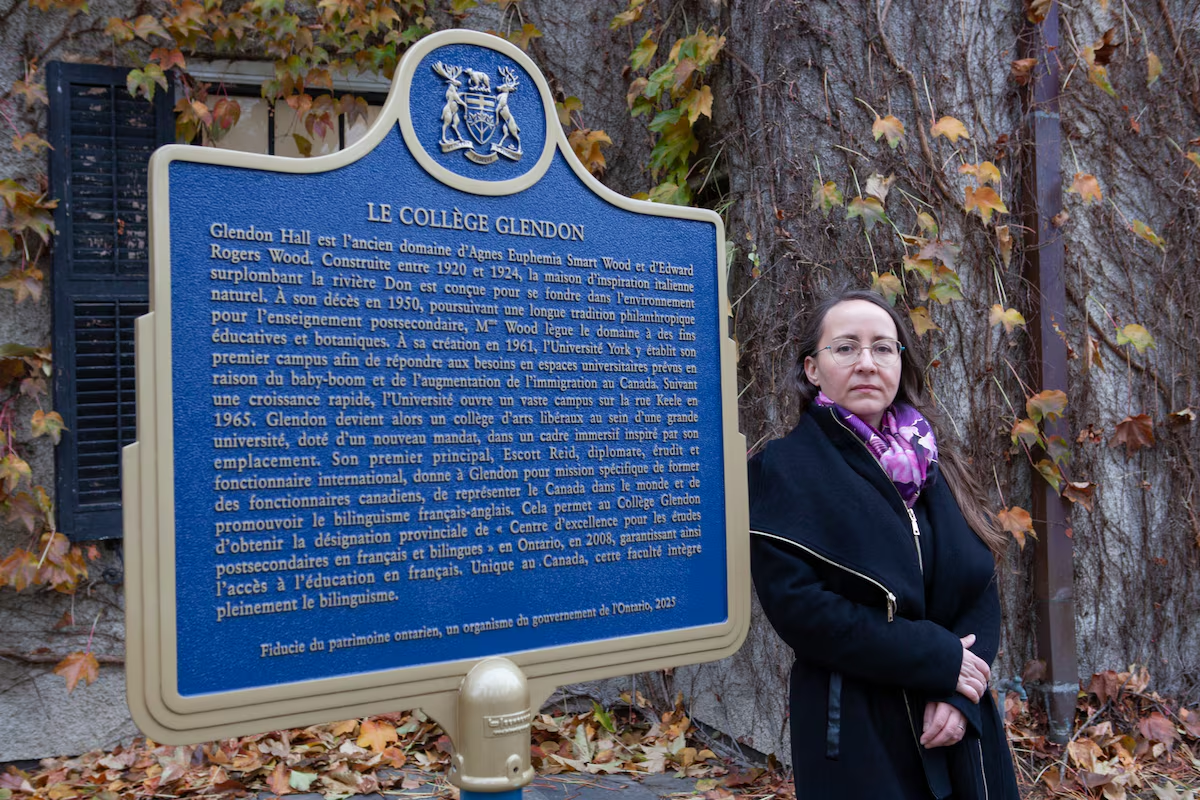
Imola Ilyes, a philosophy professor at York University’s Glendon Campus, opposes the proposed relocation of Glendon to the university’s Keele Campus.Azad Amin/The Globe and Mail
When it came time for Samuel Nieva to pick a university, maintaining the French language skills he worked hard to master in elementary and high school was a top priority.
So he felt fortunate to find a bilingual haven not far from his home in Pickering, Ont., at York University’s Glendon Campus, a small liberal arts college tucked into one of the poshest neighbourhoods in Toronto.
At Glendon, Mr. Nieva was able to pursue a double major with economics courses taught in English and history courses taught in French. He also had plenty of opportunities to practise his French in casual conversations with classmates, professors and campus staff.
“I’ve met a lot of people who said they studied French in high school, but then once they graduated, they weren’t able to continue their French, so they lost their language,” Mr. Nieva said. “I chose Glendon for that reason.”
Mr. Nieva, now 22 and the president of the Glendon College Student Union, wants the same choice to be available to future students. That is why he and his organization, along with some professors and Glendon alumni, are fighting a York University proposal to move Glendon’s bilingual academics and activities to the sprawling main Keele Street campus on the outskirts of the city.
The Glendon Faculty Council is scheduled to vote on the plan Friday. Their choice hinges on a question that matters beyond the bucolic setting of the Glendon campus: What is the best way for a major university in an anglophone province to carry out a bilingual mandate?
If they reject the proposal, their decision will be final.
York’s proposal, which was submitted to Glendon Faculty Council in September by interim provost Laina Bay-Cheng, pitches the move to a dedicated building at Keele as a means of revitalizing York’s bilingual academic offerings and activities.
Open this photo in gallery:
Enrolment at Glendon is down nearly 50 per cent from a peak of 2,770 in 2016-17.Azad Amin/The Globe and Mail
As it stands, enrolment at Glendon has been declining. The student head count fell to 1,419 in 2025-26, down nearly 50 per cent from a peak of 2,770 in 2016-17. Glendon’s accumulated deficit hit $52.4-million at the end of the last academic year, a heavy burden for a university trying to claw its way out of the red by 2028-29.
The written proposal argues that more students would be willing to take classes in French at the main campus, which has many more program offerings and is easier to access by public transit than Glendon. An estimated 70 per cent of York’s francophone students are already in Keele-based programs.
“This transition would allow for meaningful growth and new possibilities: the development of bilingual pathways in a wider range of academic programs; the expansion of students’ postgraduate prospects; and granting over 52,000 students at Keele Campus access to French-language courses, services and community,” the proposal says.
Critics of the move counter that students are less likely to improve or maintain their French in a sea of English at Keele. They say students are better off staying in a small bilingual pond at Glendon. More than 2,800 people have signed a petition opposing the move.
Glendon provides “a really wonderful academic ecosystem,” said Imola Ilyes, a contract philosophy instructor at the college. Glendon’s classes are small and welcoming, she said. The library, café and administrative offices offer services in both official languages.
“I think that bilingual part of the ecosystem is super important, and that would be completely lost if these changes went ahead,” she added.
Jérémie Séror, a professor in the University of Ottawa’s Official Languages and Bilingualism Institute, agreed that students are more likely to use their French at an avowedly bilingual campus such as Glendon.
“The advantage of creating an environment that really celebrates it and makes it normal to use French, hear French, see French, is that it does encourage the language to be used in this real, natural way – which is what we know is the key for a language to be vital and preserved,” he said.
Open this photo in gallery:
Bilingual signage is seen at York University’s Glendon Campus in Toronto.Azad Amin/The Globe and Mail
People involved in a campaign to preserve Glendon say enrolment at the campus has declined because York hasn’t adequately marketed the bilingual liberal arts college.
“I think recruitment is probably the key issue,” said Marcia Macaulay, a linguistics professor who has taught at Glendon for 35 years. “Students almost unanimously say that they sort of inadvertently discovered Glendon. Nobody was coming and promoting it.”
That isn’t the case, according to Yanni Dagonas, deputy spokesman for York.
“There has been a concerted effort in recent years to boost visibility and enrolment through dedicated, campus-specific marketing and integration of Glendon programs across advertising,” he said by e-mail.
Another concern that Prof. Macaulay and other Glendon supporters raised was that York’s motive for shifting the bilingual mandate to Keele could be to redevelop part of the Glendon site, which sits on a valuable swath of greenery near elite private schools and clubs on Bayview Avenue.
“I think they fully intend to redevelop in some way,” Prof. Macaulay said, adding that York recently commissioned a preliminary land use study of the Glendon site that has not been released in full.
Prof. Macaulay has filed a freedom of information request to obtain it.
Mr. Dagonas, the university’s deputy spokesman, said York has “no intention of ceasing academic activities at the Glendon site and is committed to maintaining an ongoing academic presence there.”
If the Glendon Faculty Council – which includes Glendon’s principal and associate principals, all full-time faculty and a mix of students, staff and contract faculty – votes in favour of the proposal, then new academic uses for the campus will be explored, Mr. Dagonas said.
“Decisions about the use of Glendon Campus lands are a separate matter and are not driving any academic proposal,” he said.