
Open this photo in gallery:
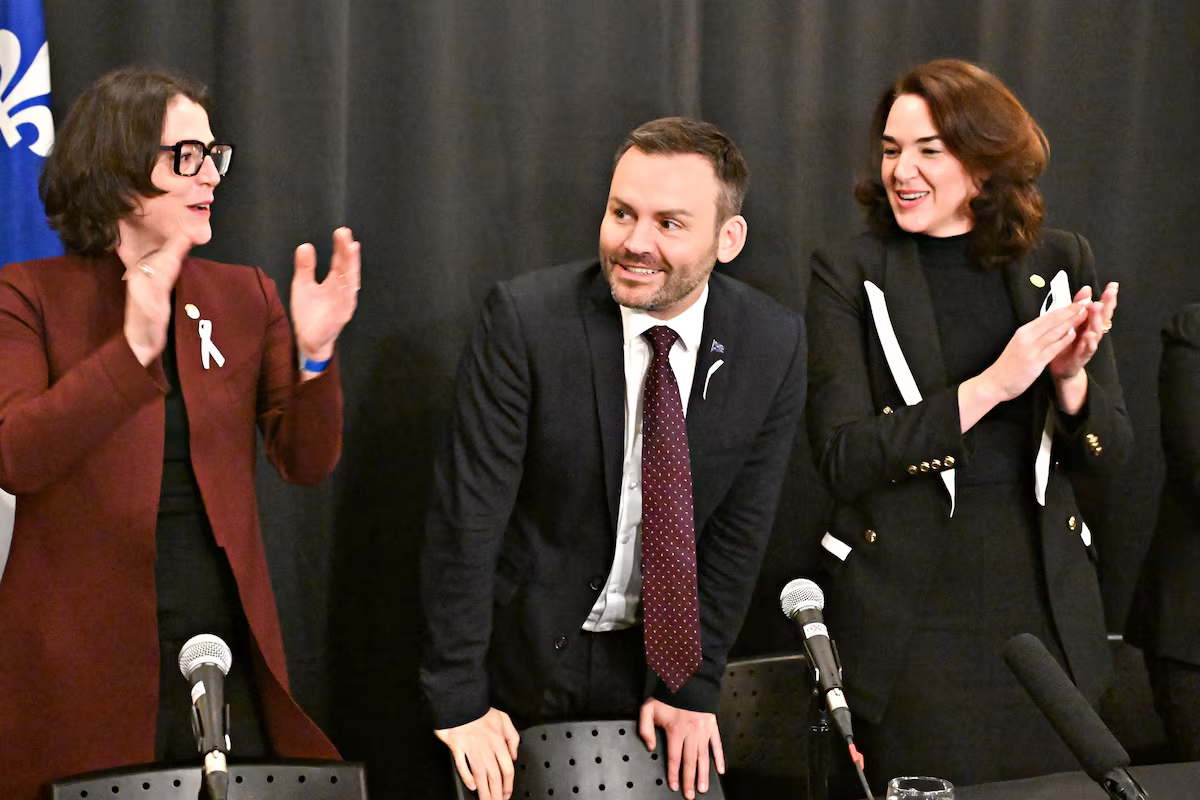
Quebec Premier Paul St-Pierre Plamondon, centre, is applauded by caucus chair Nadine Le Gal, left, Quebec Immigration Minister Catherine Gentilcore and other members of the government as he enters a pre-session caucus meeting in Quebec City on Thursday.Jacques Boissinot/The Canadian Press
The Quebec Premier says his government will sit in the National Assembly next week, despite a court ruling that declares legislators must take an oath of allegiance to King Charles III.
Premier Paul St-Pierre Plamondon said Thursday that the Quebec Superior Court decision does not prevent the provincial legislature from opening as planned on Dec. 1, though none of Quebec’s 127 elected members have sworn fealty to the Crown.
“We’ll be at the Salon Bleu next Tuesday, and we won’t take an oath to the King of England,” Mr. St-Pierre Plamondon told reporters in Quebec City, referring to the assembly chamber.
“It’s absolutely absurd to think we should be forced to do that just to carry out our duties.”
Andrew Coyne: Quebec’s legislators are shocked – shocked! – to discover they cannot vote to defy the Constitution
The court ruling, released Monday, has been met with exasperation in Quebec, where members of the National Assembly decided unanimously nearly four years ago that the oath to Canada’s monarch no longer applies.
It has thrown Quebec politics into disarray just as the Supreme Court of Canada is set to weigh in on another constitutional battle with major implications for the province. On Friday, the top court will issue its ruling on Bill 21, Quebec’s law banning religious symbols for certain public servants.
Mr. St-Pierre Plamondon, who led the sovereigntist Parti Québécois to form a minority government last month with a promise to hold an independence referendum, said both disputes are about “preserving the choices of Quebec’s democracy.”
A decision by the Supreme Court to limit the power of legislatures to “make their own democratic decisions will trigger, of course, a very strong reaction among all provinces,” he added.
Quebec braces for Supreme Court decision on Bill 21
In Monday’s ruling, a Quebec Superior Court judge suspended a 2022 law that had abolished the requirement for members of the National Assembly to swear loyalty to the Crown.
In the decision, Justice Ian Demers wrote that the suspension of the law means that lawmakers will now “be required to take an oath to the King before assuming their duties.”
The government has appealed that ruling and has asked the court to allow legislators to sit without taking the oath while the case proceeds. A hearing is scheduled for Friday afternoon.
But Mr. St-Pierre Plamondon said the court decision doesn’t explicitly order lawmakers to swear allegiance to the King.
“At the moment, there is nothing preventing us from sitting without being forced to humiliate ourselves and commit perjury as our first act in the National Assembly,” he said.
Ruling on oath to King does not prevent legislature from sitting, Quebec says
The Premier also accused opposition leaders of a “lack of consistency and loyalty” for refusing to sign a declaration stating their commitment to sit in the provincial legislature next week without taking an oath to the King.
“It speaks to them and their principles – or rather, their lack of principles,” Mr. St-Pierre Plamondon said Thursday.
Liberal Leader Charles Milliard and Conservative Leader Éric Duhaime have said they want the National Assembly to open as planned next week, but are awaiting the outcome of the appeal court hearing. They have not ruled out the possibility of swearing allegiance to avoid a delay.
On Wednesday, Mr. Duhaime raised doubts about the legality of sitting in apparent contravention of a court ruling.
Opinion: Quebec legislators must swear an oath to the King. Monarchists shouldn’t feel smug
The 2022 law was passed with the support of all parties after Mr. St-Pierre Plamondon and his caucus, then in opposition, refused to take the oath and were barred from entering the National Assembly.
Lawrence David, a lawyer who teaches at the University of Ottawa, launched a legal challenge in August, arguing Quebec has no authority to unilaterally amend the Constitution.
The substance of the case has yet to be heard, but Mr. David filed for an emergency injunction after the October election to force MNAs to take the oath before the legislature reconvened.
Justice Demers sided with Mr. David on Monday, ruling that if lawmakers did not swear allegiance to the Crown, “all laws passed by the National Assembly would be unconstitutional and would have to be re-enacted.”
Open this photo in gallery:
Lawyer Lawrence David speaks at a news conference in Ottawa on Wednesday on the constitutional challenge to the legislation abolishing the Oath of Allegiance.Justin Tang/The Canadian Press
The legal battle has prompted debate in Quebec this week, some of it tinged with frustration at the challenge to a unanimously adopted law that the federal government has shown no desire to fight. A column in La Presse dubbed it “a needless and ridiculous crisis.”
Other commentary has taken aim at Mr. David, and Mr. St-Pierre Plamondon also had words for the Ottawa lawyer on Thursday. “It is not Mr. Lawrence Whatever from the University of Ottawa who will stop me from dedicating myself to public service and to the people of Quebec,” he said.
Mr. David told The Globe and Mail in text messages that he has received “repeated hate mail and threats” over his role in the case. “This is unbecoming of a mature democracy, even if robust debate is one of its component parts,” he said.
Meanwhile, legislators have been firing shots at each other on social media, with one newly elected Conservative sharing a compilation of clips of current PQ MNAs swearing the oath to Queen Elizabeth II in years past.
“You see, it’s not that hard to pledge allegiance,” Marcos Archambault wrote on X. “It’s time to get to work!”