
We live in a world of screens. Ubiquitous and portable, they tie us to the swirling, meme-driven carousel that constitutes communication in the internet age.
But the screen-world of today emerged from something else, a world where printed books, papers and handwritten letters were the principal conveyors of human thought. Like fossils from another time, these archaic forms can be examined to reveal the evolving current of ideas – including ideas about evolution itself.
That is the key message from a trove of 19th-century documents recently acquired by the University of Calgary and now on public display. All are related in some way to the work of Charles Darwin and his contemporary, Alfred Russel Wallace. Though Darwin is better known, both men independently hit upon the theory of evolution by natural selection, the unifying principle that lies at the heart of modern biology.
Open this photo in gallery:
Charles Darwin is only the most famous of the 19th-century scientists who tried to explain the variety of living organisms.U.S. Library of Congress
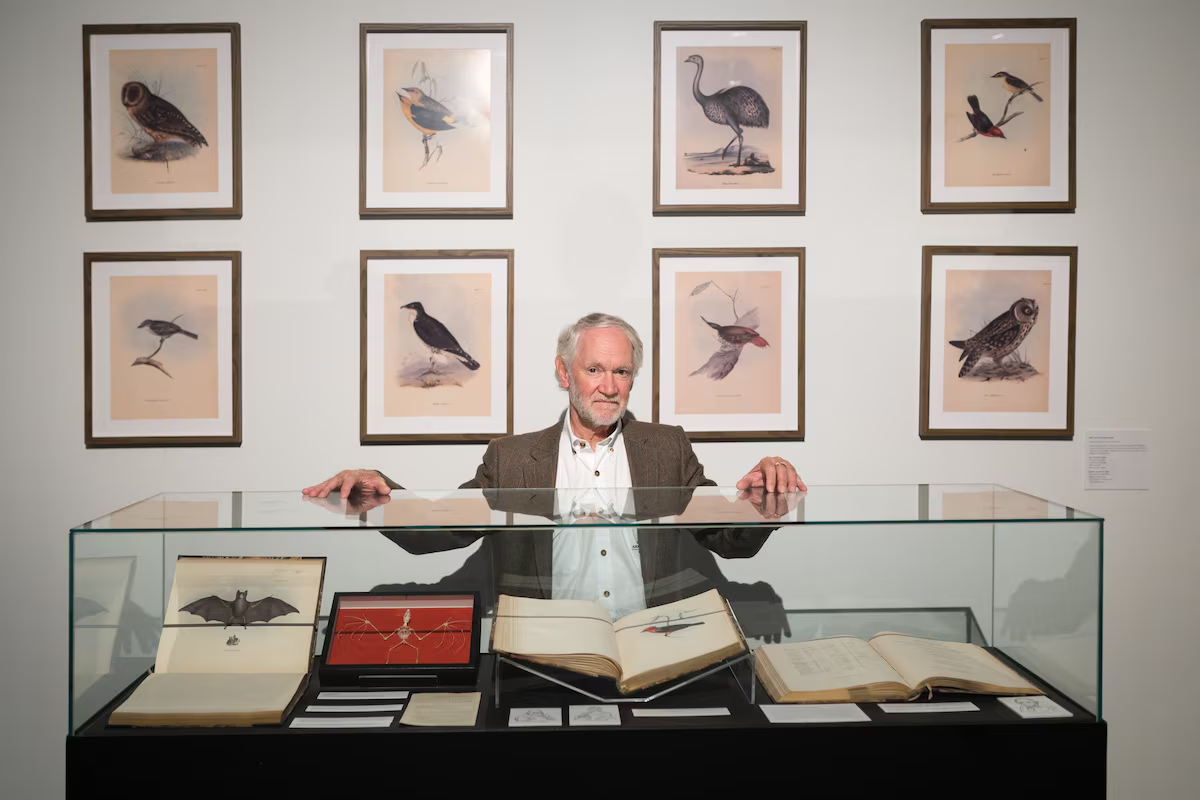
More than one hundred pieces – including rare editions of Darwin’s transformative work, On the Origin of Species – make up the collection.
Many are signed, with bookplates that reveal ownership history and professional connections. Together, the pieces illuminate the social network around Darwin and Wallace that allowed evolution to enter the broader public discourse.
“What we’ve done in the exhibition is really highlight these relationships,” said Annie Murray, the university’s rare books and special collections librarian. “You can see the exchange of items between people – Darwin inscribing his books to other scientists, Wallace inscribing his. Or a descendant of Darwin owning a copy of a Wallace book.”
The relationships highlighted in the collection extend to friends and influencers of the day that help lay the groundwork for the theory of evolution. That includes Darwin’s admiration for Charles Lyell, a champion of the view that Earth is far older than previously supposed. Darwin read Lyell’s three-volume Principles of Geology while he was aboard the HMS Beagle during its five-year circumnavigation of the globe. The journey, which brought Darwin to the Galapagos Islands in 1835, inspired his insight that species change over time because individuals best adapted to their environments are more likely to pass on their traits to succeeding generations.
Darwin called it “descent with modification.”
Another mentor and ally was the botanist and clergyman John Henslow, who recommended Darwin for the position of naturalist on the Beagle and then published extracts from the letters Darwin sent him while he was on the voyage. This served to raise Darwin’s scientific profile long before On the Origin of Species was published in 1859.
The collection includes a letter from Darwin to Henslow when he was back in England, grappling with poor health and with an exhaustive study of barnacles that would further help to boost his reputation among naturalists. While on a retreat to try a cold-water cure for his aliments, Darwin wrote to Henslow, “I have ceased to think even of barnacles!”
Open this photo in gallery:
John Henslow in 1849. The botanist, 13 years older than Darwin, had been a mentor to him.Lithograph by T. H. Maguire, via Wellcome Collection
An example of a less friendly correspondence is a 1871 exchange of letters between Darwin and St. George Jackson Mivart, an English biologist who at first supported natural selection before publishing a rival theory in opposition to Darwin.
“I have read your book quicker than I expected, and with very great interest, though not of course with pleasure,” Darwin writes to Mivart with icy Victorian restraint.
“Unhappily the acceptance of your views means the abandonment of belief in God and in the immortality of the soul together with future rewards and punishments,” Mivart says in his response, a draft of which is also part of the collection.
Wallace came to his ideas about evolution while Darwin was still working on Origins, and it was his communication with Darwin that hastened the latter to go public with this own thinking.
Lyell was among those who arranged a presentation of work by both men for London’s Linnean Society in July 1858. The Calgary exhibit includes the text of the presentation, published in the Society’s proceedings.
Also on display is a first edition of Wallace’s beautifully illustrated book documenting his field work in the Malay archipelago, which he dedicated to Darwin.
Open this photo in gallery:
Many of Darwin’s own observations had come on his expedition with HMS Beagle, the ship featured on the exhibition wall, resting on the sand in Patagonia.
Most of the artifacts that make up the exhibition are part of a private collection assembled by Dennis Hall. Mr. Hall attended the University of Calgary and he is a member of one its first graduating classes. He then began graduate studies in biology, but was ultimately called away to help run the family business in Alberta’s oil patch. The company did well, but Mr. Hall never lost his enthusiasm for biology and its early pioneers.
Years later his interest in collecting was kindled by a second edition of Origins that he saw at Calgary’s Aquila Books, a specialty store run by his friend Cameron Treleaven. He bought the book and soon decided it would be interesting to have a first edition. He was bitten.
Before long he and Mr. Treleaven were on a more ambitious hunt for books by Darwin and others in his world, looking for distinctive copies that could be tied to specific individuals and linked together to illustrate the makeup of the scientific community of that era.
Starting in about 2010 they began to assemble an impressive collection. One of the most valuable pieces is something that Darwin, in all likelihood, never knew existed. It is an offprint of an 1866 article written by Gregor Mendel, an Austrian biologist and monk who had spent years studying plant hybridization. Unbeknownst to Darwin, Mendel’s work, published in German in a small European agricultural journal, held the secret to how species pass on their traits in discrete units that would later be called “genes.”
The version of the article that Mr. Hall acquired includes handwritten corrections, quite likely made by Mendel himself.
“It gives you a shiver when you handle something with that kind of historic significance,” Mr. Hall said.
As his collection grew, Mr. Hall began to realize it had both educational and scholarly value that merited a permanent home. He met with Ms. Murray about donating the collection to his alma mater.
“Their level of enthusiasm in taking this on blew me away,” said Mr. Hall, who added that he was delighted that the transfer included a temporary exhibition to show off the collection.
While attending the exhibition’s opening in October, he said that listening to comments from those who were marvelling at the collection was an emotional experience.
Ms. Murray said that once the exhibition is concluded, the collection will become available for scholarly research.
Bernard Lightman, a professor at York University in Toronto who specializes in the cultural history of Victoria-era science, said that he welcomed the addition of the collection to the field, though it remains to be seen what it contains that is not available elsewhere, including in the principal collection of Darwin papers at the University of Cambridge.
He added that nonetheless, the Calgary exhibition makes an excellent introduction to an era when science was fighting to become secular as part of a broader social shift.
Open this photo in gallery:
The exhibition has a copy of 1874’s Darwin caricature in the London Sketch Book, where he offers an ape a mirror.
For those who took up the debate over evolution on Darwin’s behalf, the motivation was less about establishing how species emerge, but seizing “the perfect opportunity to put forward their naturalistic views of how science should be done,” Dr. Lightman said. It’s a battle that ultimately helped to remove religious leaders from the centre of Western intellectual life. Looking back more than a century and a half later, Dr. Lightman said that its striking to be reminded of science’s ascent at a time when its cultural authority appears to be eroding.
Ms. Murray said the collection has drawn interest from across the university community and beyond. One particularly memorable visit came after she was contacted by an Alberta man who turned out to be Alfred Russel Wallace’s great-grandson.
“So one night, 10 Wallaces came for a tour of the exhibition,” she said. “There was a family resemblance when we took pictures of the descendants next to a big vinyl image of Wallace.”
Descent with modification indeed.
Open this photo in gallery:
All Netted Together: Charles Darwin, Alfred Russel Wallace, and the Social Life of a Theory is on display at the Nickel Galleries, University of Calgary, until Dec. 1.