
Open this photo in gallery:
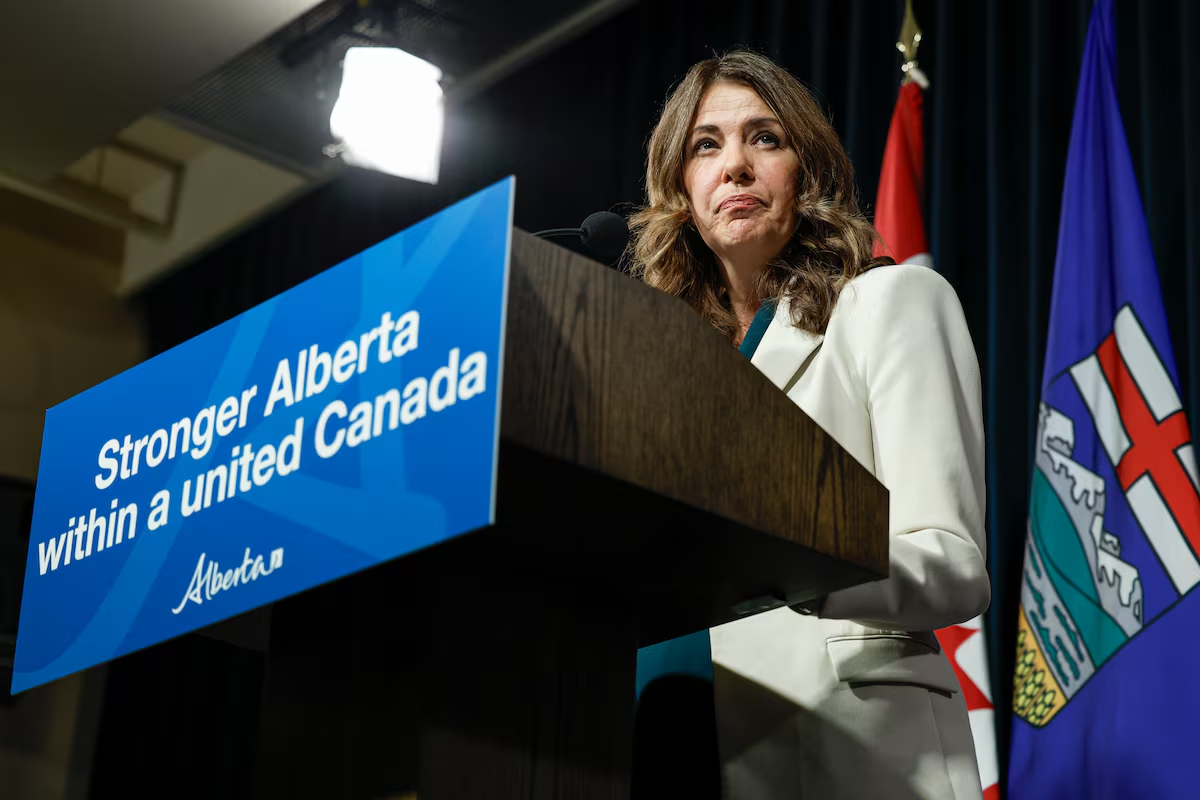
Alberta Premier Danielle Smith speaks to the media in Calgary on Oct. 21.Jeff McIntosh/The Canadian Press
Alberta Premier Danielle Smith is wielding her signature sovereignty act in a bid to shield her province from recent changes to Canada’s hate-speech laws that, until this year, allowed a person who quotes from a religious text to escape prosecution under the Criminal Code.
Ms. Smith’s Sovereign Alberta Within a United Canada Act is widely viewed by experts as constitutionally dubious and toothless. The motion, yet to be tabled, would not allow the government to subvert federal law, regardless of whether it is passed in the provincial legislature.
Instead, the motion asks Ms. Smith’s cabinet to “consider further lawful measures” in response to the change to federal law, Alberta Justice Minister Mickey Amery told reporters at a news conference on Tuesday.
“We do not want to create the chilling effect of dissuading people from expressing their political or religious views,” Mr. Amery said.
Ms. Smith has wielded the sovereignty act in symbolic moves to push back against Ottawa’s proposed environmental regulations, and last December, she invoked it again while directing provincial law-enforcement agencies to not enforce Ottawa’s gun buyback program.
The sovereignty act was the first piece of legislation Ms. Smith introduced as Premier in 2022 and was a key plank of her campaign for leadership of the United Conservative Party that year.
Her decision to use the act arrives almost a year since the proposed change was tabled in the House of Commons, triggering tense debate among federal legislators. It was contained in a suite of amendments to Canadian hate-speech laws that received royal assent in June.
Ms. Smith’s invocation of the sovereignty act also comes days before the UCP annual general meeting, where the Premier will look to shore up her support, even as a segment of the party refuses to heed her warnings that advocacy for an independent Alberta must be abandoned.
Opinion: Canada’s hate speech laws don’t need a rewrite. They need to be enforced
Separatists and free-speech absolutists in the UCP have been particularly frustrated by Ms. Smith’s demand that party leaders pledge to uphold the referendum result, in which 75 per cent of Albertans voted to remain in Canada.
The motion introduced on Tuesday targets recent changes to the Criminal Code that removed a long-standing religious exemption that allowed people quoting from religious texts to avoid prosecution for hate speech.
The change led to bitter disagreements in the House of Commons when the Bloc Québécois proposed it earlier this year.
Backers of the revised law have argued the exemption was a loophole that could be used as cover for promoting homophobia, racial abuse and antisemitism.
But the change has received significant criticism across the political spectrum and in faith communities.
The federal Conservatives vehemently opposed the move while it was being debated. At the time, Conservative MP Larry Brock said removing the religious exemption was a “direct attack on freedom of religion.”
Federal Justice Minister Sean Fraser and his colleagues with the governing federal Liberals supported the change. Last December, Mr. Fraser attempted to assuage concerns about the change, saying that it will “in no way, shape or form, prevent a religious leader from reading their religious texts.”
Joannie Fogue, spokesperson for Mr. Fraser, said in a statement to The Globe and Mail that the federal government agrees with Alberta that people should “be free to practise their faith, read scripture, and express their religious beliefs.”
Ms. Fogue said the new federal law doesn’t criminalize opinions, disagreement, criticism or religious teaching.
Consent from Alberta’s attorney-general – in this case, Mr. Amery – is required for hate-speech charges to proceed, she added.
Anti-hate bill that provoked bitter clashes over religious freedom poised to become law
Mr. Amery said the province isn’t planning to challenge the exemption removal in court.
He described the motion as Alberta “drawing a constitutional line.”
“The federal government, yes, has the constitutional authority to define what areas they believe should be in the Criminal Code,” he said. “We have the authority to decide which areas of priority we have for policing and which areas of priority we have for prosecution.”
Brian Dijkema, president of Christian policy think tank Cardus, said in an e-mail to The Globe and Mail that while Ottawa’s decision to remove the exemption “is ambiguous and creates uncertainty for Canadians,” he has concerns about the province attempting to override federal law.
“We need to respect the Constitution’s divisions,” said Mr. Dijkema. He added that he hasn’t reviewed the motion.
Outside of her use of the sovereignty act, Ms. Smith indicated interest in overriding federal laws in Alberta’s recent 10-question referendum, where she asked voters whether they support a constitutional amendment that would give provincial law priority over federal laws when the two conflict.
Nearly 56 per cent of Albertans rejected the idea.