
Open this photo in gallery:
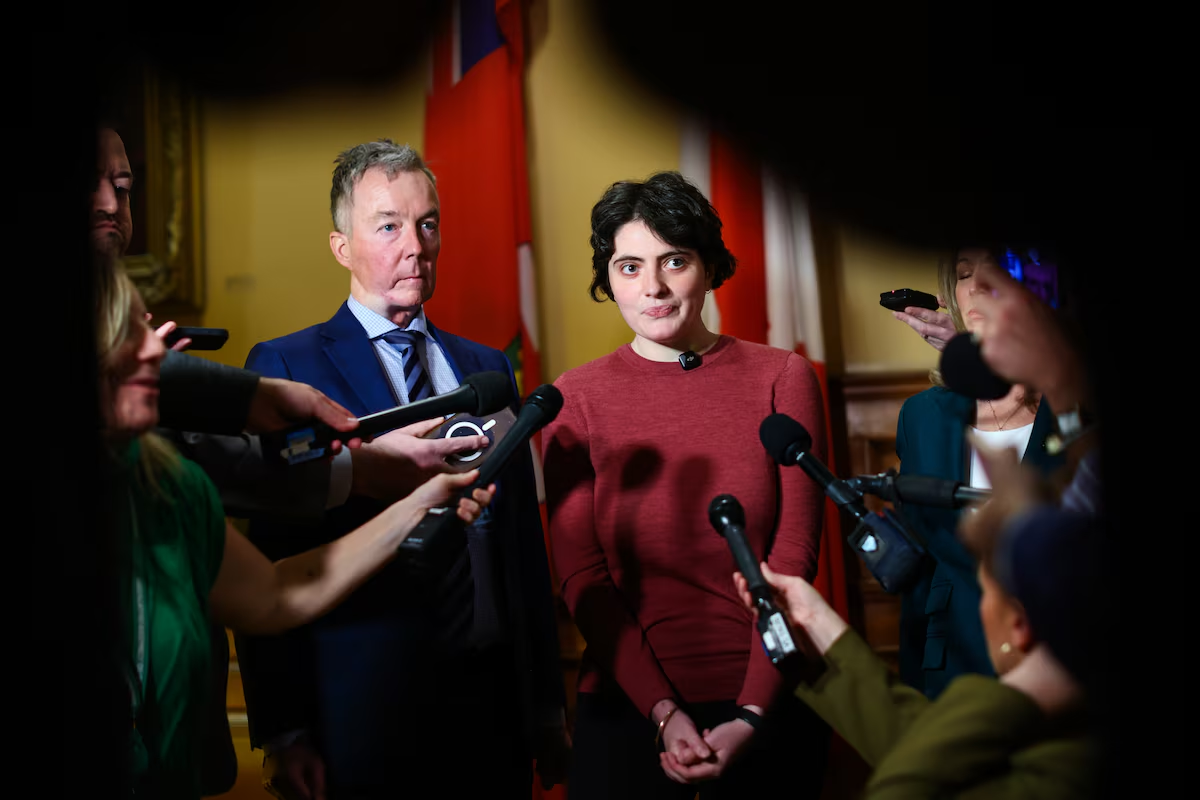
Cancer patients Kevin Nash, left, and Sabrina Apitz-Grossman, left, speak with media, alongside Ontario NDP leader Marit Stiles, at Queen’s Park in Toronto, Monday, November 23, 2026. (Cole Burston/The Globe and Mail)Cole Burston/The Globe and Mail
Ontario acted in bad faith when it retroactively changed its rule for out-of-country health care funding, breaching the constitutional rights of two cancer patients seeking life-saving treatment abroad, their lawyers told the court Tuesday.
The Ontario Superior Court of Justice was hearing an application by the two patients, Sabrina Apitz-Grossman and Kevin Nash, who are appealing the rejection of their request to receive public funding for therapies currently available in the U.S. but not in Canada.
In their court applications, lawyers for the patients said they are not trying to invalidate the province’s ability to set its funding priorities. Instead, they took a more focused approach, arguing that the government unfairly delayed the requests their clients made under an existing program, then changed the regulatory framework.
“They followed the rules. Instead of following the rules, Ontario changed them,” Thomas Conway, a lawyer representing Ms. Apitz-Grossman, told the three-judge panel.
Ms. Apitz-Grossman has synovial sarcoma, a soft-tissue cancer that was first detected in one of her legs and has now spread to her lungs. Her oncologist says she is a good candidate for afamitresgene autoleucel, a treatment where the patient’s own white cells are genetically modified to create a customized drug. It is sold under the brand name Tecelra, and she has said she can get it at a discounted cost of US$575,000.
Ontario cancer patient who was denied coverage for U.S. treatment dismayed by province’s revised rules
Mr. Nash has melanoma, a type of skin cancer, which has metastasized into his lungs and pancreas. He has been seeking to be treated with lifileucel, which uses cells from the patient’s tumour to create a personalized medication. Sold under the brand name Amtagvi at a sticker price of US$515,000 in the U.S., it has been approved by Health Canada but is still being reviewed by Canada’s Drug Agency, which advises provincial and territorial governments on public funding for new drugs.
While acknowledging that Ms. Apitz-Grossman’s circumstances are “devastating and sympathetic,” the government’s lawyers said in a court filing that out-of-country funding could put pressure on health budgets. The province has maintained that such individual benefits undermine the ability of public drug plans to negotiate prices with drug manufacturers.
Speaking to reporters at the legislature, Premier Doug Ford accused pharmaceutical companies of trying to take advantage of people in need of treatment. “They’re trying to circumvent the system across the country and gouge these poor cancer patients, or ultimately try to gouge the taxpayers.”
Ms. Apitz-Grossman and Mr. Nash both applied this spring to Ontario’s program to obtain public insurance coverage for out-of-country treatments. Their applications were rejected. The government directed them to appeal to the Health Services Appeal and Review Board, but then went before the board and argued that it had no jurisdiction to order funding.
In September, the board dismissed the funding requests by Ms. Apitz-Grossman and Mr. Nash. Around the same time, on Sept. 22, the Ontario Superior Court of Justice sided with Alex Shved, a melanoma patient challenging the province’s refusal to cover treatment in Florida.
On Oct. 6, as Ms. Apitz-Grossman and Mr. Nash applied to the court for a judicial review, the province made retroactive changes to the regulation for out-of-country treatment. Funding would only be provided if the treatment was already covered in Ontario but access was temporarily unavailable in the province.
The regulation change applied retroactively to Oct. 1. A month later, on Nov. 3, Ms. Apitz-Grossman received records from a Freedom of Information request that she had filed with the Ontario government in July.
She discovered in those records that two clinical experts had been consulted about her funding application and had concluded that the treatment she sought in the U.S. “is very reasonable.”
Cancer patients decry Ontario’s revised drug funding rules for out-of-country coverage
The delays and lack of transparency in the case were “the essence of bad faith,” Alyssa Holland, a lawyer for Ms. Apitz-Grossman, told the court Tuesday. “Absence of good faith can be concluded and bad faith deduced.”
Government lawyer Matthew Horner said there had been a policy intent since 2011 to align out-of-country funding with services available in Ontario. Because of the Superior Court judgment in favour of Mr. Shved, the province had to change the regulation to clarify its intent, Mr. Horner said.
The government is seeking leave to appeal the Shved decision, Mr. Horner added.
Mr. Nash’s lawyer, Claire Boychuk, said her client had been told in January that there was a median life expectancy of about three to six months for his type of cancer.
She added that Ms. Apitz-Grossman was 15 months into the 12-to-18-month median survival range for her cancer.
“They do not have a day to waste.”
With files from Jeff Gray at Queen’s Park