
Open this photo in gallery:
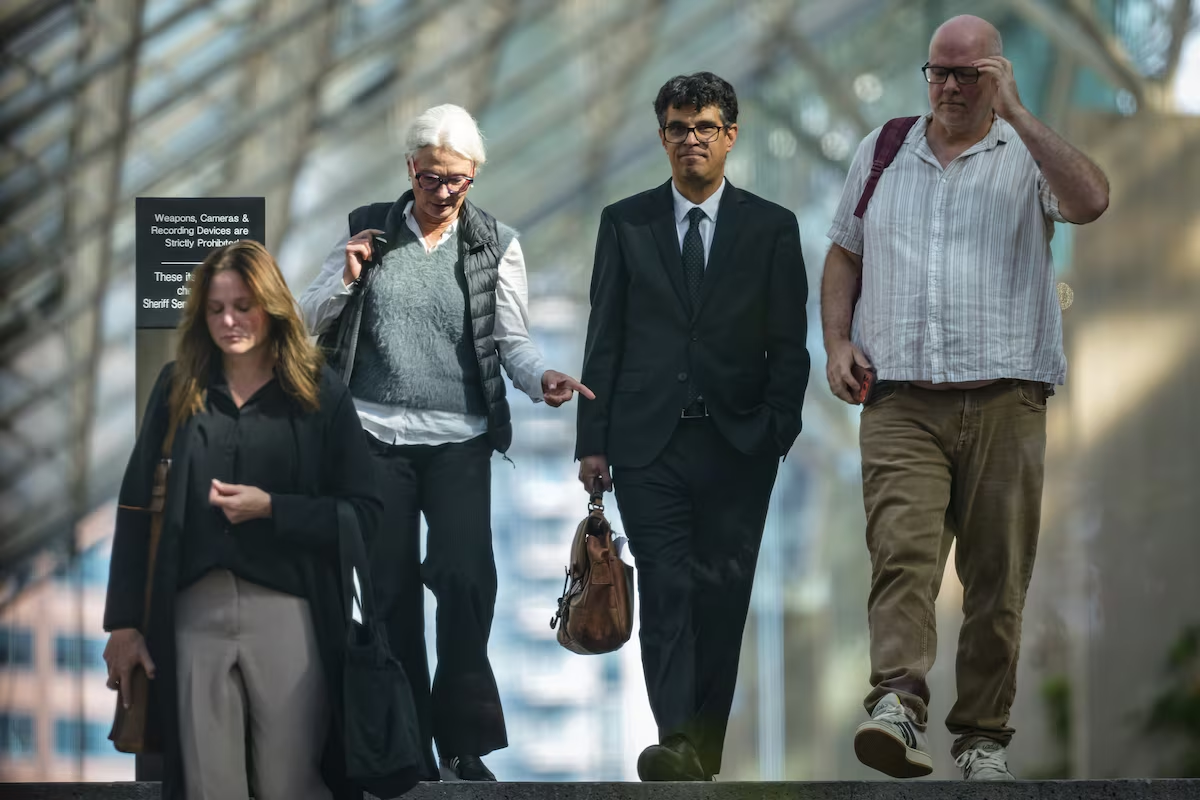
Author and former University of British Columbia professor Steven Galloway and his wife Katie Wagner, leave B.C. Supreme Court in Vancouver during lunch break in his defamation trial last month.DARRYL DYCK/The Canadian Press
Lawyers for the former creative-writing student who accused Steven Galloway of sexual assault say it was the University of British Columbia that caused the most damage to the bestselling author’s career.
They began their closing arguments in B.C.’s Supreme Court in Vancouver on Tuesday by stating that Mr. Galloway should not receive what would be one of the highest Canadian defamation awards from their client, who they say only disclosed her allegations to a small group of people.
Galloway’s lawyers say he deserves one of Canada’s largest defamation awards
Arden Beddoes, lead counsel for the accuser, who is known as A.B. because of a publication ban on her identity, told Justice Neena Sharma a direct line cannot be drawn from the defamatory statements she made to a small group to the actions of Mr. Galloway’s employer, UBC, starting with its unusual decision to publicly announce his suspension because of “serious allegations.”
“That’s the day we say this gets out of hand,” Mr. Beddoes argued.
Then, he said, seven months later, in June 2016, the school inflicted further damage to Mr. Galloway’s reputation and career by announcing his dismissal as the chair of its creative-writing program, for what it called “a record of misconduct that resulted in an irreparable breach of the trust placed in faculty members.”
During this period, he told the court, A.B. was a frightened former student desperate for UBC to investigate her claims, and not the malicious “puppet master” who, Mr. Galloway’s lawyers allege, co-ordinated a years-long push to destroy their client.
In 2018, Mr. Galloway sued A.B. for defamation over her sexual-assault allegations, along with two dozen others for repeating them online. Most of them settled, leaving only his accuser standing trial alongside her supporters Mandi Gray and Glynnis Kirchmeier, and Dana Kagis, who posted a single defamatory statement and has not participated in the legal process.
Mr. Galloway’s lawyers want a judgment of millions of dollars in damages against A.B. for embarking upon what they say was a strategic campaign to leverage criminal accusations of sexual assault and to spread these far and wide through a cast of collaborators.
Mr. Galloway’s counsel told court Tuesday their client deserves a rare award of special damages solely against A.B. amounting to $4.9-million. They are also asking she pay at least $2.5-million in general, aggravated and punitive damages, which – if granted – would total $7.4-million.
Court had previously heard that one expert’s report found the author’s lost income to date and future earnings up to the age of 70 amounted to $7.1-million, while another pegged that figure at $11.7-million.
Galloway success disappeared ‘almost overnight’ after assault claims, publisher says
Mr. Beddoes took issue with the higher estimate, saying that publishing expert was told only to compare Mr. Galloway’s earning potential to that of bestselling novelist and Governor-General’s Award winner Miriam Toews. The lawyer argued that was too narrow a lens.
Court has heard Mr. Galloway’s 2008 novel The Cellist of Sarajevo was an international smash hit that brought in more than a million dollars in royalties, though his follow-up work, 2014’s The Confabulist, sold a fraction of that.
The plaintiff is also seeking general, aggravated and punitive damages in the form of least $250,000 from Dr. Gray, at least $80,000 from Ms. Kirchmeier and $30,000 from Ms. Kagis.
The school is not a defendant in the lawsuit. UBC had to pay more than $240,000 in damages to Mr. Galloway following his firing after an arbitrator found the university’s actions violated his privacy rights and damaged his reputation.
In his closing statement, Mr. Beddoes argued A.B. only agreed to share her allegations with a group of creative-writing professors after they requested she do so for an emergency meeting held without Mr. Galloway. Plus, he told the court, his client’s alleged defamatory words were “spoken within the university reporting context.”
The letter A.B. sent to UBC’s then-president Martha Piper, which Mr. Galloway’s lawyers described at trial as a “nuclear bomb,” did not mention him by name and was not alleged to have been defamatory, Mr. Beddoes said.
“The plaintiff’s case rests on a finding that a report to fewer than 10 people cost him his entire writing career,” Mr. Beddoes argued.
A.B. did not testify and, at the start of the trial, one of her lawyers told the court she was withdrawing her defences of truth and fair comment. However, she continues to deny the accusations that she spread lies about Mr. Galloway, with whom she had a two-year relationship. Her lawyers have told the court that she tried to kill herself twice this year because of the stress of the legal process.
On Tuesday, Mr. Beddoes told the court that her psychiatrist suffered a serious accident this summer, which has delayed a report into A.B.’s mental capacity.
This evidence will be central to a debate over whether A.B. can be held in contempt after Justice Sharma denied her request to be excused from testifying in pretrial discovery in June. The parties debated over whether this motion was part of the trial or whether it would be heard early next year. A resolution on this matter is expected later this week.
UBC professor regrets helping colleague approve Galloway accuser’s unfinished thesis to complete degree
During closing arguments earlier this week, Mr. Galloway’s counsel took the court through various high-profile defamation cases they argue are analogous, where awards stretched into millions of dollars.
But Mr. Beddoes argued Tuesday that A.B.’s case is very different from those campaigns, which often lasted months and included defendants posting hundreds of times on social media, contacting employers and pursuing coverage in mainstream media.
A.B., Mr. Beddoes pointed out, declined media requests from a reporter right after Mr. Galloway was suspended and only ever issued a public comment at the behest of her lawyer in November 2016.
“That’s very different from our client going on social media and making every effort she can to broadcast her allegations as widely as possible,” he said, referencing other high-profile defamation judgments.
A.B.’s legal team continues its closing arguments Wednesday.