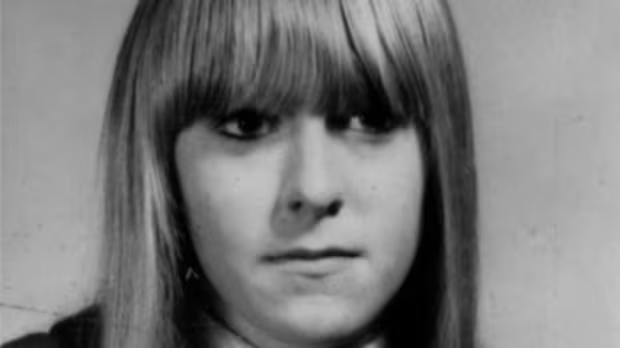
London, Ont., police have solved a cold case involving the murder of teenager Jackie Dunleavy, who was found strangled in 1968 just blocks from where she went missing after a work shift at a convenience store.
Police used modern forensic DNA technology and genetic genealogy to identify Dunleavy’s killer as Michael Joseph Moore, who was 25 at the time of the murder. He later became a firefighter in London, retiring with the rank of captain, police said.
Moore died on March 3, 2018, so no criminal charges can be laid, investigators said. At the time of the killing and in subsequent years, he wasn’t a suspect or person of interest.
WATCH | London police announce cold case solved through DNA evidence:
“This outcome reflects the extraordinary dedication and persistence of the investigators who worked on Jackie’s case, both past and present,” London police Chief Thai Truong said.
“Their professionalism, the careful preservation of evidence and advances in forensic science ultimately brought us to where we are today, providing long-awaited answers about who was responsible for Jackie’s death.”
Police announced the breakthrough at a news conference at their headquarters on Monday. Dunleavy’s case is one of nine cold cases that they have been working on. Dunleavy’s younger brother and his wife were at the announcement, but declined interviews.
Police said there’s no evidence that Dunleavy and Moore knew each other.
Moore was born in Ireland in 1942 and emigrated to Canada in January 1967, police said. He moved into an apartment on Springbank Drive in May 1967. He was white, around six feet tall, had dark hair and was typically clean shaven, growing a beard sometimes while on vacation.
An obituary in the London Free Press states that Moore was a firefighter for 28 years, both in Ireland and London. He was not a firefighter at the time of the killing, police said. He died after a long illness and was survived by his wife and three children, it said.

The front page of the Jan. 10, 1968, London Evening Free Press highlights the Dunleavy case. (Supplied by London Public Library)
Dunleavy was a Grade 10 student at Westminster Secondary School and worked at Stanley Variety Store on Stanley Street, near Wharncliffe Road.
She was the daughter of a London police officer.
On Jan. 9, 1968, Dunleavy finished her shift at the convenience store at about 6:30 p.m. and was last seen walking away from the store, likely to catch a bus home, which she often did, reports said. Witnesses later said they remembered a girl fitting Dunleavy’s description waiting at a bus stop on Beaconsfield Avenue and getting into a white vehicle. Moore drove a white Ford Galaxie 500.

These photos of Michael James Moore were released by London police. (Supplied by London Police Service)
At about 8 p.m. that evening, three young people found her remains on the grounds of Katherine Harley School, which is now the location of Matthews Hall, on Oxford Street near Sanatorium Road, in the city’s west end.
Collecting biological material crucial
The cause of death was strangulation. News reports at the time revealed Dunleavy had a pink tissue box stuffed in her mouth. Investigators interviewed witnesses and collected biological material, which was preserved, police said.
“The investigators who worked on Jackie’s homicide in 1968 did everything they could with the investigative and forensic tools available to them at the time,” said Det. Sgt. Micah Bourdeau of the London police major crime section.
“The evidence they carefully collected and preserved ultimately allowed investigators decades later to continue that work. This investigation shows the importance of preserving evidence and continuing to revisit historical cases as new technology becomes available.”
Dunleavy’s murder was recounted in the popular book The Forest City Serial Killer by local author and sleuth Vanessa Brown, as well as Murder City: The Untold Story of Canada’s Serial Killer Capital, 1959-1984, by former London police officer Mike Arntfield.
Her case was part of Project Angel, a join London police and Ontario Provincial Police cold-case task force from 1997 to 2001. Moore’s name came up during that investigation, which re-examined old murders, but he was not named as a suspect then and records have since been lost, Bourdeau said.
Investigators analyzed preserved evidence and sent DNA to Othram Labs, a Texas-based company that specializes in forensic genealogy, which combines DNA and genealogical databases to identify suspects, police said.
“DNA evidence and genealogical work narrowed the focus of the investigation,” police said. “This led to further interviews and the collection of new forensic evidence. This evidence was compared to the suspect profile, confirming Michael Moore’s DNA as the suspect profile.”
Had Moore been alive today, he would have been arrested and charged in relation to Jackie’s murder.Det. Mike Budzyn, London police
Toronto police helped with the genealogical research, investigators said.
“The evidence established a level of certainty that would have supported criminal charges,” said London police Det. Mike Budzyn. “Had Moore been alive today, he would have been arrested and charged in relation to Jackie’s murder.”
The decision to identify Moore was not made lightly, officers said.
“Publicly identifying Moore provides an accurate historical record and answers that Jackie’s family and the community have sought for decades,” they said.
“Hearing the name Michael Joseph Moore, or learning information about him today, may bring back memories for people who knew him, had contact with him, or were familiar with him during that time. Information that may not have seemed significant at the time could have meaning today.”
Anyone with information related to this investigation, or who believes they may have relevant historical information, is encouraged to contact the London Police Service at 519-661-5670.