
Listen to this article
Estimated 3 minutes
The audio version of this article is generated by AI-based technology. Mispronunciations can occur. We are working with our partners to continually review and improve the results.
Canada’s justice minister is defending the country’s judges, saying a “troubling narrative” is creeping into discussions about judges and their decisions.
Sean Fraser blames political actors who, he says, don’t just disagree with a judge’s decision, but go beyond that to attack the credibility of the court itself.
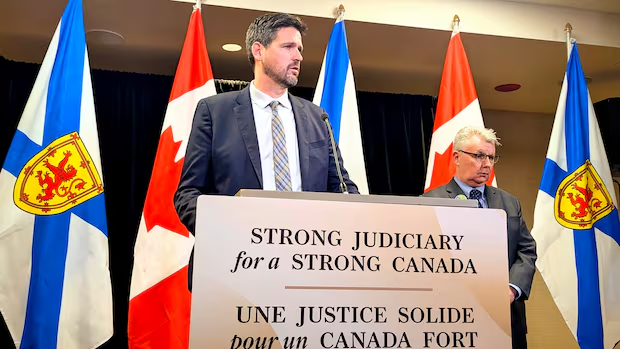
Fraser was speaking Friday to a symposium of the Nova Scotia chapter of the Canadian Bar Association. He used his speech to encourage more lawyers to apply to be judges and for more people to speak up to defend the rule of law and the independence of the judiciary.
Fraser said a recent report on the well-being of judges found that public criticism is taking a toll.
“The level of public scrutiny is sometimes not just based upon a point of philosophical disagreement, but there’s real animosity, there is political pressure being applied by certain corners of the public to judges who are not free to defend themselves when it comes to making the counter-argument in community,” Fraser said.
His concerns were echoed by Jason Cooke, the president of the Nova Scotia chapter of the Canadian Bar Association.
“We’re seeing increasingly personal attacks on the integrity of judges and that’s terrible,” Cooke said.
“The public should be fully confident that we have an outstanding judiciary who make decisions applying the law of Canada.”
For his part, Fraser acknowledged that there are genuine problems fuelling public frustration with the justice system, such as delays.
He said this past summer, the government passed legislation aimed at speeding up some processes—such as those in sexual assault cases—to reduce the time they take to go through the courts.
One of the most serious issues relating to delays is the so-called Jordan deadlines. Those are time limits imposed by the Supreme Court of Canada to ensure cases do not drag on for too long. In federal courts like the Nova Scotia Supreme Court, that time limit is 30 months, spanning from the time a charge is laid to the end of a trial.
Since the Jordan timelines were imposed in 2016, as many as 10,000 cases per year have been dismissed across Canada because they took too long.
He said he’s heard from victims in many of these cases, including women who have been attacked by an intimate partner. Those victims often have to keep living in the same community as their attacker, who is free “not because there’s been a fair hearing in which the person was found not guilty, but because the charges have been stayed for delay,” Fraser said.
“That doesn’t feel like justice for the victim to me.”
Fraser said when a Jordan deadline is reached, courts are being asked to consider other solutions, instead of just a stay of proceedings.
“The main concern I have is not with ordinary Canadians who are frustrated with delays—it’s with people who for political reasons seek to undermine the integrity of the court,” Fraser said.
MORE TOP STORIES