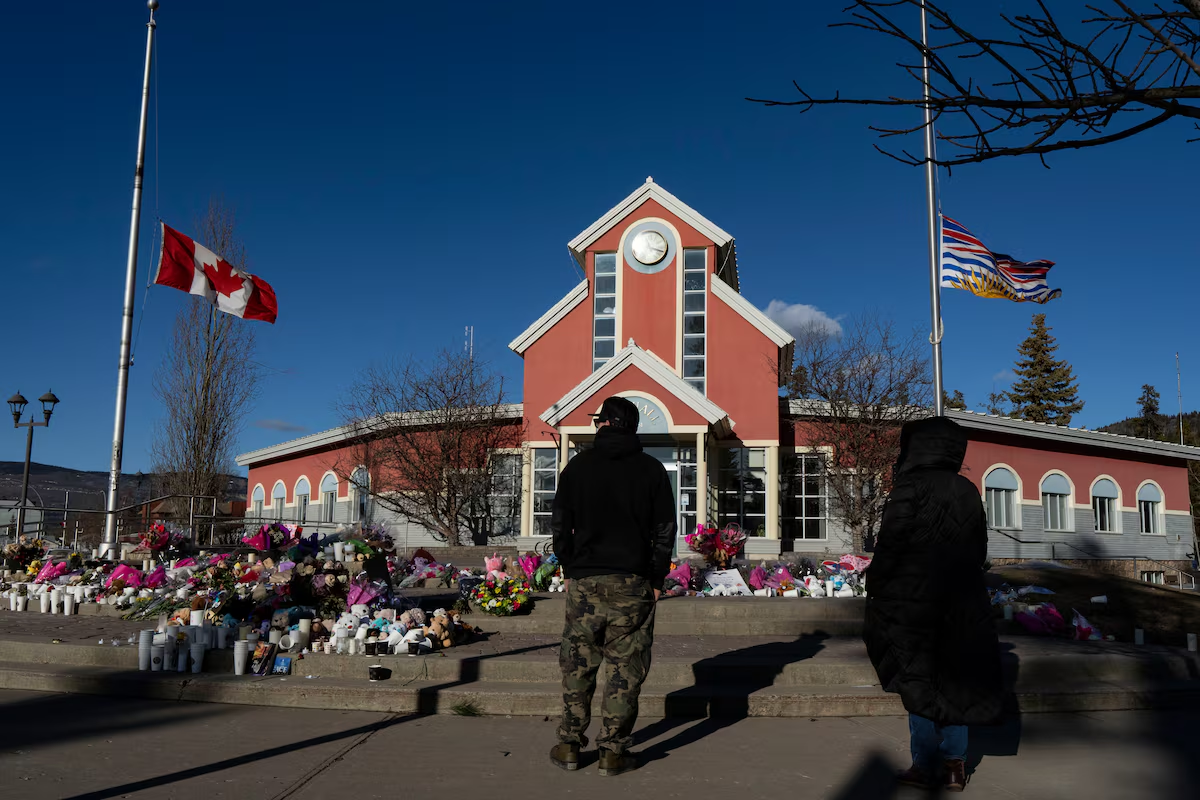

Open this photo in gallery:
People pay their respects at a memorial on the steps of the Town Hall in Tumbler Ridge, B.C., on Feb. 14.Christinne Muschi/The Canadian Press
OpenAI’s chatbot helped the Tumbler Ridge shooter by providing advice on making illegal 3D-printed weapon parts and engaged in detailed violent fantasies about mass shootings, alleges a new report from a U.S. non-profit media outlet.
Journalist Mark Follman said his reporting was based on copies of the Tumbler Ridge shooter’s ChatGPT conversation history and sources with direct knowledge of the matter.
ChatGPT helped the shooter design a 3D-printed foregrip for one of her weapons, and may have helped design a device that can allow a semi-automatic rifle to operate in a fully automatic capacity, the Mother Jones article alleges. It also said the shooter received help from the chatbot when she asked about fixing a spring inside a 3D-printed high-capacity magazine capable of holding 35 rounds of ammunition.
The new reporting underlines concerns about the shooter’s use of OpenAI’s technology in the lead-up to February’s deadly mass shooting in British Columbia. At least 37 lawsuits have been filed against OpenAI in California in connection with the incident, after it was revealed that months before the shooting the company had flagged, but not reported to authorities, worrying interactions between the shooter and ChatGPT. The chat logs Mr. Follman said his reporting is based on are expected to be central to those lawsuits.
Tumbler Ridge shooter’s ChatGPT messages were flagged months before attack
On Feb. 10, 18-year-old Jesse Van Rootselaar killed eight people and injured dozens of others in the northern B.C. community before killing herself. Before entering the town’s school, she killed her mother and 11-year-old half-brother in their family home. The Globe and Mail has previously reported that friends of the family and a relative said Ms. Van Rootselaar had a history of mental illness, including stints being held involuntarily in hospital.
Mother Jones’s reporting alleges that ChatGPT provided Ms. Van Rootselaar with vivid, violent fantasies about mass shootings, including descriptions torturing wounded victims. The news outlet has previously reported on the Tumbler Ridge shooting based on chat logs it obtained.
Lawyers have previously told The Globe they expect OpenAI to argue to keep Ms. Van Rootselaar’s ChatGPT history out of the public eye, especially as the company readies for an initial public offering that could see it valued at $1-trillion.
A spokesman for OpenAI did not respond to a request for comment. In April, CEO Sam Altman formally apologized for his company’s role in the mass shooting, saying he was deeply sorry that OpenAI did not alert law enforcement to Ms. Van Rootselaar’s account.
Tumbler Ridge families argue for OpenAI lawsuits to be heard in San Francisco
B.C. politician Niki Sharma, who will be replaced Friday as Attorney-General after the New Democrats lost last month’s provincial election, said the latest details of the chat logs are “really disturbing.”
“It’s more horrifying every time.”
Ms. Sharma said the alleged snippets of these logs that have been leaked to the media shed light on how disturbing the chatbot’s interactions with the Tumbler Ridge shooter are alleged to have become, but also point to concerns about how seriously public safety is treated inside OpenAI.
“What is the actual corporate culture and responsibility within [OpenAI] that so many people quit or feel compelled to leak stuff … that so much that alarms them is going on inside the corporation,” said Ms. Sharma, who launched the province’s own lawsuit against OpenAI.
“This is one of the most powerful companies in the world, driving this technology that is going to affect all of our lives. And we have signs of the internal workings that are just not very good,” Ms. Sharma said. “So it should scare people.”
B.C. Attorney-General, federal AI Minister alarmed by report ChatGPT coached Tumbler Ridge shooter
Ms. Sharma reiterated her call for strong regulation of the AI industry, and better guardrails to protect Canadians.
Separately, the FBI arrested Washington resident James Cody Bryant, 30, of Bellingham, Wash., in October for allegedly helping Ms. Van Rootselaar while she was contemplating her mass shooting.
Ms. Bryant (who authorities said uses she/her pronouns) faces charges of aiding Ms. Van Rootselaar, including providing money and advice while planning the attack.
About six months before the attack, “Van Rootselaar told Bryant that she had stolen guns and ammunition from her family’s gun safe and was hiding them in her room in preparation for a mass shooting,” according to the court documents in Ms. Bryant’s case, which is expected to go to trial in December 2027.
“Van Rootselaar also said she convinced another person to purchase ammunition on her behalf.”
Alleged Tumbler Ridge conspirator indicted by grand jury in U.S.
According to Ms. Bryant, Ms. Van Rootselaar was “fixated on mass shootings and watched livestreamed recordings of past shootings to learn from them,” the document said. It said she asked Ms. Bryant to livestream her planned attack and Ms. Bryant agreed.
The two discussed possible locations, with the shooter wanting one that would “lead to the largest number of victims.” Ms. Bryant said it would be a “bad idea to attack a school because there would be too many young victims” and suggested instead a grocery store or church, court documents say.
Canada’s Minister Responsible for Artificial Intelligence, Evan Solomon, said in a statement that the new details in Mr. Follman’s reporting are “deeply disturbing.”
“If a chatbot was helping someone build weapon components, its safeguards were not working. AI companies must not let their products be used this way, and they must be held accountable when it happens,” the statement said.
His office did not make anyone available for an interview.
With reports from Justine Hunter and Andrea Woo