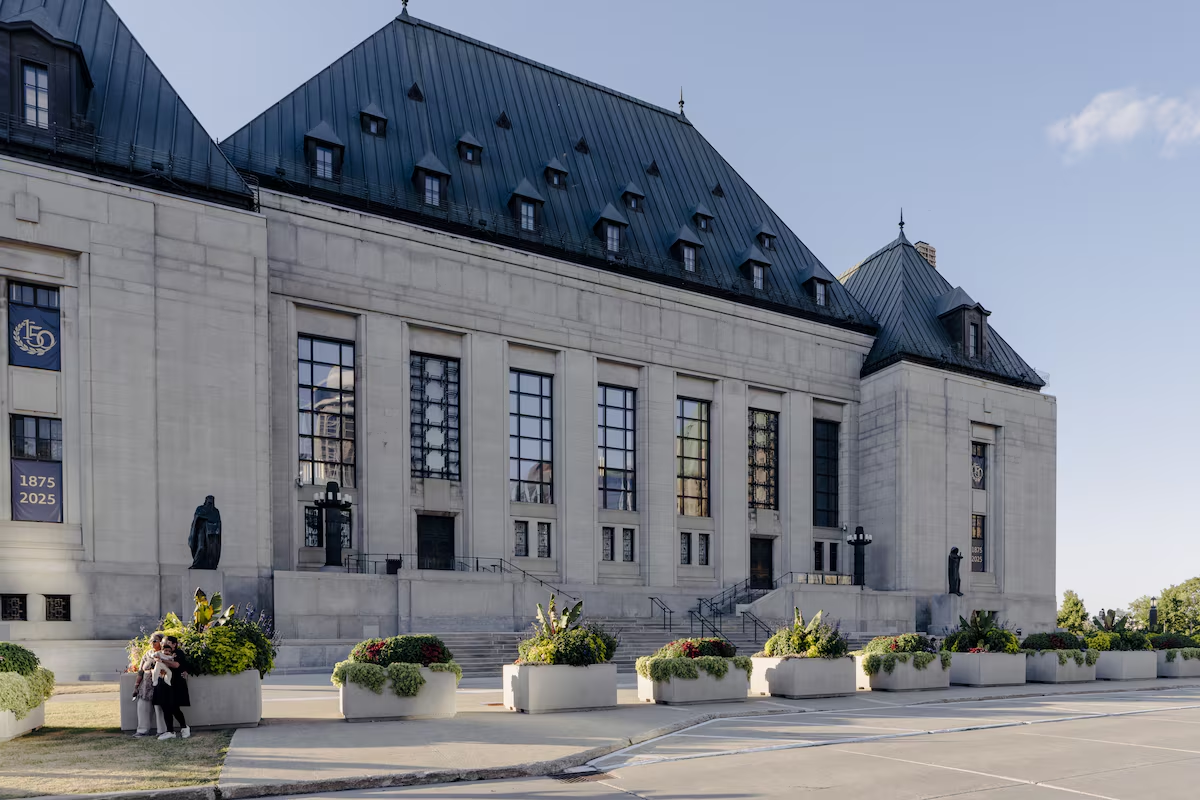

Open this photo in gallery:
In-person appearances will still have to be approved by the Supreme Court.Brendan Burden/The Globe and Mail
The Supreme Court of Canada is reopening its courtroom doors to some intervenors as of next spring, loosening an internal policy that had been criticized by lawyers.
The main parties at Supreme Court hearings present their oral arguments in person. Intervenors, groups that are not directly connected with a case but with views on the issues at stake, have only been allowed to appear by Zoom in recent years.
The Supreme Court had said this system improved access to justice, making it less expensive for intervenors to be involved in a case at the top court, but lawyers who often work for free representing intervenors objected. Many intervenors felt the impact of their oral advocacy was somewhat muted on Zoom, a point on which the court has previously disagreed.
On Thursday, Supreme Court Registrar Chantal Carbonneau announced that as of April 2027, the court will start a pilot project allowing intervenors to present arguments both in person or on Zoom. Intervenors, whether online or in person, generally get five minutes. In-person appearances will still have to be approved by the court.
Common intervenors at the Supreme Court include advocacy groups such as the Canadian Civil Liberties Association and the Criminal Lawyers’ Association, as well as provincial and federal attorneys-general. On Thursday, the court said that intervenor submissions, whether in writing only, in person or on Zoom “are given equal consideration.”
U.S. sanctions threw an ICC judge’s life into disarray. She says it’s time to fight back
The Canadian Bar Association, the largest lawyers’ group in the country, applauded the shift to open the in-person option to intervenors.
“We have raised concerns about limiting intervenors to virtual participation, and we appreciate the Court’s openness to our members’ views,” association president Loreley Chekay said in a statement.
Before the COVID-19 pandemic, the court had allowed all parties to appear in person, but as the courtroom was fully reopened for in-person hearings in 2022, intervenors remained on Zoom.
Court spokeswoman Vanessa Racine said the new change is to provide greater flexibility to intervenors.
“As a pilot project, this initiative will allow the court to continue assessing and refining its practices to ensure they best serve the public interest,” Ms. Racine said in an e-mail.
In September 2025, ahead of the landmark hearing in March on the Quebec secularism law known as Bill 21 and the limits of the Charter of Rights and Freedoms, provincial and federal attorneys-general had asked for a one-time exception to the intervenor-by-Zoom rule. Others thereafter also asked. The Supreme Court said no to all last December.
The Bill 21 hearing unfolded over four days. On the third and fourth days, the judges watched a parade of intervenors on Zoom, using individual monitors behind the bench and television screens mounted on the courtroom walls.
The hearing featured a record 38 outside intervenors and six attorneys-general. Most intervenors effectively sided with the six appellants, who had argued on the hearing’s opening day that the court should strike down Bill 21. Quebec had few allies beyond Ontario, Alberta and Saskatchewan.
On Thursday, Supreme Court also reiterated a 2021 internal policy regarding the role of intervenors. This may suggest the court will not allow every application to intervene in every case, as it usually has in recent years. “In considering applications to intervene, the court will be mindful of the need not to unduly imbalance the arguments before it,” the 2021 policy, which was restated Thursday, says.
Some top judges have spoken out about allowing too many intervenors in their courts. David Stratas, the longest-serving judge on the Federal Court of Appeal, turned down an intervenor application in a 2025 order. He spoke of “other courts” and stated: “It’s up to them whether they want to admit many on only one side of the courtroom and create the appearance of a court-sanctioned gang-up against the other side.”
Supreme Court set for busy November with major hearings, decisions ahead
The Supreme Court’s shift on the intervenor policy is the second time this year that the country’s top court appears to be responding to public calls for change.
Another issue cited by many lawyers in recent years was the number of cases the Supreme Court agrees to hear. Beyond a smaller number of criminal cases that the court automatically hears, all others must apply to have their appeal taken on by the top court.
From 2018 to 2025, under Chief Justice Richard Wagner, the court agreed to hear an average of 35 new cases each year – known as granting leave to appeal. During the previous eight years under former chief justice Beverley McLachlin, the average annual number of cases was 55. In that period, the McLachlin court said yes to 11 per cent of applications. The Wagner court, through to the end of 2025, said yes to an average of 7 per cent.
In 2026, the Wagner court has said yes to 13 per cent of applications, and on Thursday, it said yes to three more applications for new cases, bringing the annual total to 55 – the most since 2012.