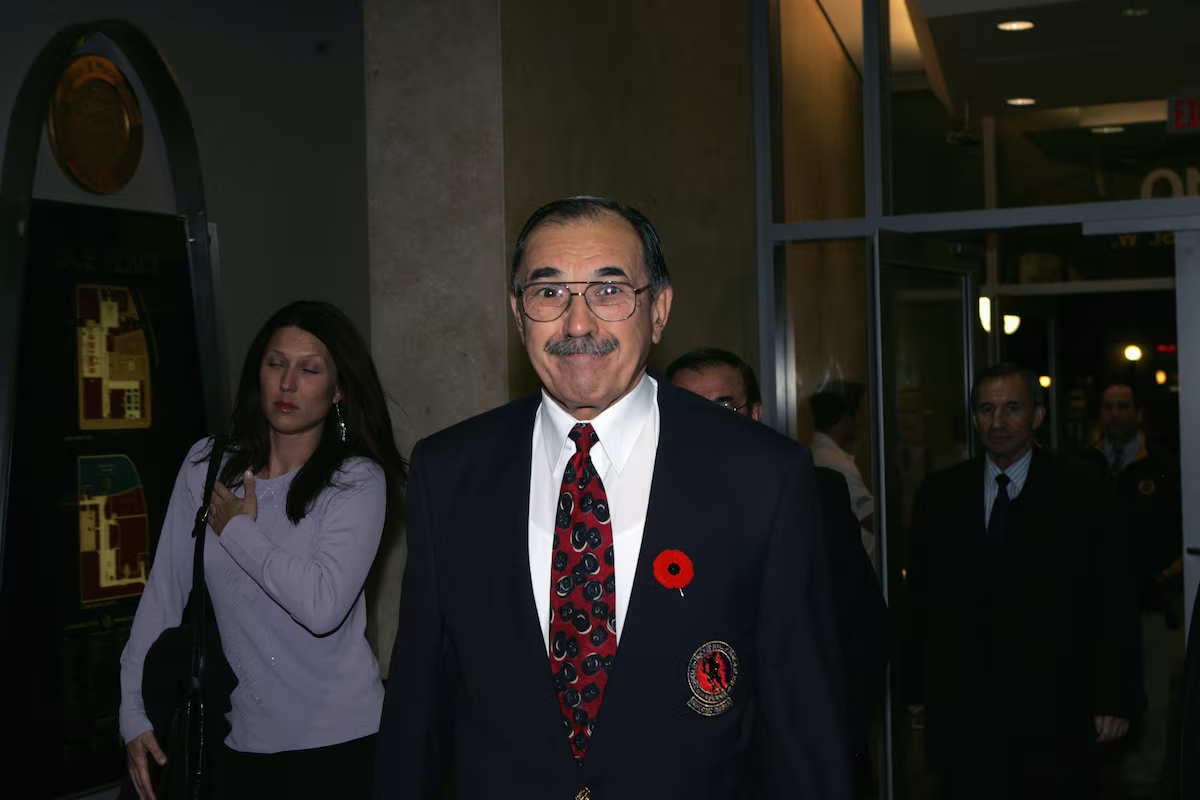

Open this photo in gallery:
Matt Pavelich arrives at the Hockey Hall of Fame in Toronto for an induction ceremony on Nov. 7, 2005. He died on Oct. 30 at the age of 92.Bruce Bennett/Getty Images
Matt Pavelich skated in more Stanley Cup Finals series than Dave Keon, Gordie Howe, Bobby Hull, Jean Béliveau or Frank Mahovlich.
Unlike those star players, he never got his name engraved on hockey’s storied trophy, though his brother did.
Mr. Pavelich, who has died at 92, served as a linesman for 23 seasons in the National Hockey League, becoming the first of his profession to be enshrined in the Hockey Hall of Fame.
He worked the blue lines in 21 finals, including 19 consecutive from 1961 until retirement in 1979.
Former Maple Leafs executive, player agent and broadcaster Bill Watters dies at 83
Tall, with jet-black hair unprotected by a helmet, and, later, sporting a soup-strainer mustache, Mr. Pavelich was a familiar figure for a generation who saw him on Hockey Night in Canada and other televised games.
Linesmen are on-ice officials in striped jerseys responsible for such quotidian duties as icings, offsides and face-offs. Along with routine chores, they also have the unenviable responsibility of serving as hockey’s bouncers, breaking up fights between players.
Mr. Pavelich survived the era of wild, rock ’em, sock ’em hockey of the 1970s when the Big Bad Bruins of Boston and Philadelphia’s Broad Street Bullies engaged in assorted melees, donnybrooks and bench-clearing brawls, a period of lawless mayhem akin to professional wrestling, only without choreography and a script.
Open this photo in gallery:
Mr. Pavelich, left, and New York Rangers Dale Rolfe, right, contain Philadelphia Flyers Ross Lonsberry after a fight broke out on May 2, 1974, during the semifinals of the NHL Stanley Cup playoffs at New York’s Madison Square Garden.Uncredited/Getty Images
“Now we have maybe one fight every 10 games,” he once told the Busted Lip Podcast, whose host included his youngest son. “In my day, they used to have 10 fights in one game.”
The act of skating between two brawlers demands bravery, strength and timing. Doing so before gloves are dropped means perhaps an uneasy peace is maintained. Doing so before the fighters have tired risks the peacemaker being on the receiving end of a haymaker.
“If two guys go at it and they’re even-Steven, we let them go at it until they’ve punched themselves out,” he told the magazine writer Earl McRae in 1971. “We step in when it’s obvious one guy has the advantage and someone is going to get hurt.”
The linesman suffered cuts and scratches, as well as numerous bruises. He once needed six stitches on the inside of his mouth when he inadvertently “walked into a punch” thrown by Bobby Hull.
In one 1963 game, Mr. Pavelich intervened too quickly during a fight between Lou Fontinato of the Montreal Canadiens and Earl Ingarfield of the New York Rangers. He took a punch to the jaw and collapsed face first on the ice, as the skaters continued to wrestle and throw punches.
“I must have been out cold for a couple of minutes,” Mr. Pavelich told the Montreal Gazette eight years later. “And you know what Ingarfield and Fontinato were doing when I came to? Both claimed credit for knocking me out.”
Charismatic NHL star Ron Duguay found fame well beyond the hockey rink
For the record, it was a right from Mr. Fontinato that felled the linesman. In the player’s defence, Mr. Ingarfield had pulled his sweater over his head and he was swinging wildly.
In a game a month before his retirement, Mr. Pavelich was left dazed after being accidentally punched in the back of the head by the ironically named Larry Playfair, whose intended target was the face of opponent Al Secord. Only 46 seconds after play resumed, the hapless linesman was called on to separate tough guy Dennis O’Brien from Dave (The Hammer) Schultz, whose rap sheet was as long as the Saskatchewan winters from which he emerged.
Though he himself never played a game of junior or professional hockey, Mr. Pavelich’s own hardscrabble origins provided a street education in the fistic arts. In a 1961 game in Kingston, Mr. Pavelich and goaltender Jack McCartan, a recent winner of an Olympic gold medal, threw punches during an argument after the final buzzer. The league president reported Mr. Pavelich “said there were a couple of blows traded – but most of them couldn’t break a pane of glass.”
Matthew Ivan Pavelich was born on March 12, 1934, in Gold Park, a Northern Ontario gold mining town of 300 people about seven kilometres from Wawa. The family received a silver loving cup in honour of his being the first baby born in the community. He was one of four children born to the former Zora Stilin, known as Rose, from a Croatian family in Sault Ste. Marie, Ont., and Mate Pavelich, a Croatian immigrant gold miner who took Matthew as his English name.
Shortly after Matt’s third birthday, his father suffered a grievous facial injury on the job. He was drilling in the Parkhill mine when the act set off an unexploded stick of dynamite left behind by another crew. His face and head were peppered by rock fragments, causing him to lose an eye and be blinded in the other. He also suffered a hand injury.
Memorial Cup winner Dave Draper lived a full life in hockey
On Boxing Day in 1938, he died by suicide, according to a correspondent’s report for the Daily Clarion, a Toronto-based pro-union newspaper. He was 42. His widow remarried another Croatian immigrant, Davorin Krmpotich, known as Martin, and the family settled in Sault Ste. Marie, where Matt was raised in a blended family.
Older brother Marty Pavelich debuted in the NHL during the 1947-48 season, going on to win four Stanley Cup championships with the Detroit Red Wings. A year later, Matt Pavelich exchanged a hockey stick for a whistle.
“I was only 14 and had just got off the bus at an outdoor rink in the Soo,” he told Dave Waddell of the Windsor Star in 2011. “They didn’t have a referee, so they asked me. I didn’t have my skates with me, so I ran up and down the ice in my boots with these little tykes.”
He decided to become an on-ice official because the speed and agility he displayed on skates was lost once he had to hunch over a hockey stick.
He was the first member of his family to graduate from high school, though he twice ran away from home to join a travelling carnival when it passed through the Soo.
Open this photo in gallery:
Mr. Pavelich walks the red carpet prior to the 2015 Hockey Hall of Fame induction ceremony in Toronto on Nov. 9, 2015.Bruce Bennett/Getty Images
At age 20, he became a referee for the Northern Michigan Intermediate League, a tough circuit where his car tires were slashed and he needed a police escort for some games. He made his NHL debut at Boston Garden on Oct. 11, 1956, a 4-4 tie with the Toronto Maple Leafs. The legendary Red Storey worked as the referee, while Doug Davies was the other linesman.
That season, he and his brother made NHL history by being the first pair from one family to have a player and an on-ice official in the same game. By coincidence, the Skov brothers – Art, a linesman who later became a referee, and Glen, a linemate of Marty’s on the Red Wings – matched the brothers’ feat later that same season.
When assigned a game with the Red Wings, Mr. Pavelich always arranged for the other linesman to handle Marty during hostilities.
While his brother retired from hockey after the 1956-57 season, Mr. Pavelich continued a career that would see him handle 1,727 regular-season games, including 14 as a referee. He also worked 245 playoff games, as well as 10 All-Star Games and the 1976 Canada Cup tournament.
One of his most memorable games pitted the felonious Flyers against the Soviet Red Army in an exhibition game in Philadelphia on Jan. 11, 1976. After referee Lloyd Gilmour did not call a penalty on a check thrown by Ed Van Impe that left Valery Kharlamov in a pile on the ice (a “dying swan routine,” the linesman said afterward), the Soviet team refused to resume play. The referee called them for delay of game and they left the ice, as a television audience heard Bob Cole make one of the most famous calls in the history of hockey broadcasting: “They’re going home! They’re going home! Yeah! They’re going home.”
The Soviets were coaxed back onto the ice, reportedly after being reminded they had yet to be paid for Super Series ’76 exhibitions.
Later in the game, won handily by the Flyers, 4-1, Mr. Pavelich broke up a confrontation between Reggie Leach and Boris Alexandrov, grabbing their sticks. “That’s enough,” he said. The Soviet player pushed the linesman, swearing at him in Russian. The linesman, who spoke Croatian and knew a smattering of Russian, shocked the player by getting the referee to assess a two-minute penalty for unsportsmanlike conduct.
The linesman missed the occasional game over the years from what he suspected were heart problems. The ailment was eventually diagnosed as a hiatal hernia, a stomach and esophagus issue which can manifest as chest pain. Mr. Pavelich remained on the ice until 1979 before spending 15 seasons as a supervisor of officials for the NHL, serving as a mentor for those who wear the striped sweater, a fraternity jocularly known as zebras.
Referee Josef Kompalla was dubbed the villain of hockey’s 1972 Summit Series
He continued in a supervisory role for Junior B and C games in the Ontario Hockey Association into his late 70s.
Mr. Pavelich, a longtime resident of Windsor, Ont., died on Oct. 30. He leaves his wife, the former Dragica Stipaničić, whom he met in his father’s birthplace of Senj, a coastal town in Croatia on the Adriatic Sea. They were married in Yugoslavia in 1964. He also leaves a daughter, Carol Brown, and sons Matthew and Mark Pavelich, as well as four grandchildren, two great-grandchildren, and a brother, Ronald Krmpotich.
He was predeceased by two sisters and two brothers, including Marty Pavelich, who died in 2024 at age 96.
What turned out to be the linesman’s final NHL game was played on May 21, 1979, as the Montreal Canadiens won their fourth consecutive Stanley Cup by beating the visiting New York Rangers by 4-1 to take the series in five games.
In the dying seconds, a Rangers player dumped the puck into the Montreal end, where goaltender Ken Dryden reached down to pick it up in his trapper. “A lovely souvenir of a special occasion,” he later said, “my final game.”
Mr. Pavelich raced to the goalie as the final horn sounded, asking for the puck.
“Matt, it’s my last game,” Mr. Dryden said, sharing a secret only his wife knew.
“Ken, it’s my last game, too,” Mr. Pavelich replied. “And I think I have more seniority than you.”
As Canadiens players mobbed their goalie, he turned his catching glove over to let the puck fall into the linesman’s bare hands.
Mr. Dryden, then aged 31, asked the linesman, then 45, to leave the puck for him in his will. The linesman agreed. As it turned out, the goalie preceded the official in death by a little more than a year.
You can find more obituaries from The Globe and Mail here.
To submit a memory about someone we have recently profiled on the Obituaries page, e-mail us at obit@globeandmail.com.