
Open this photo in gallery:
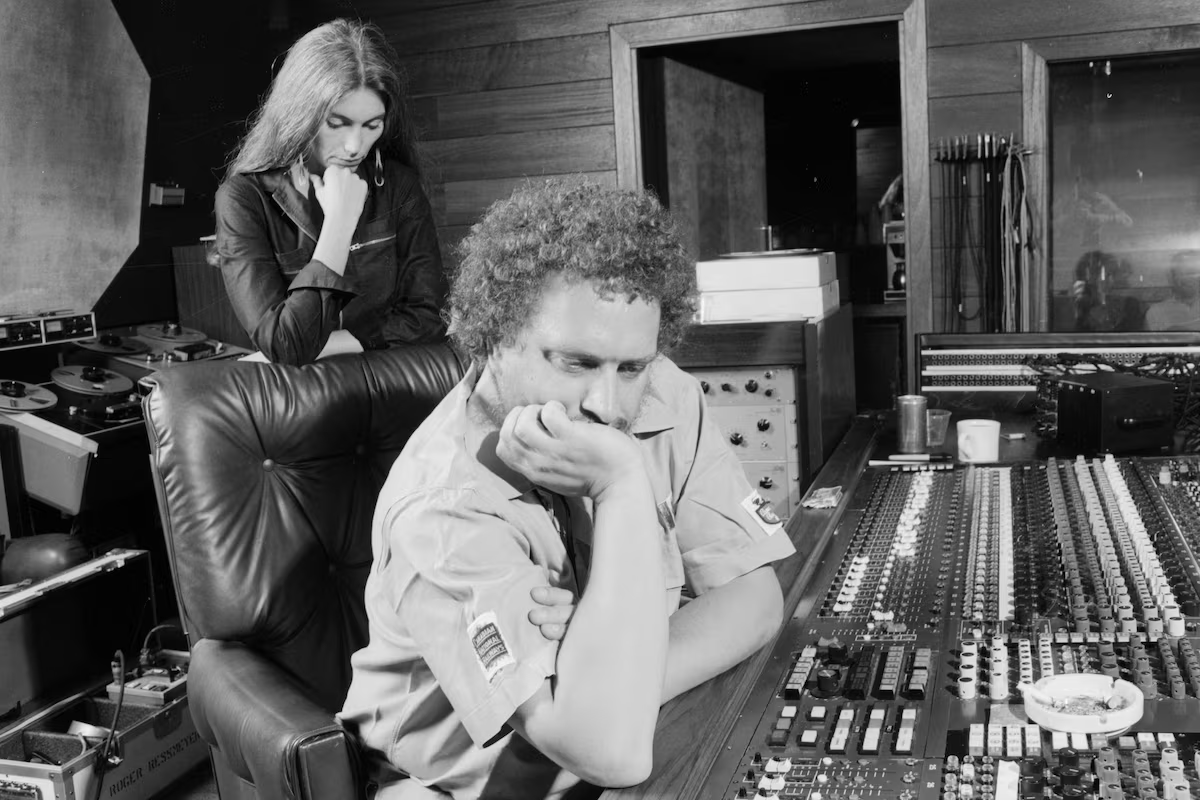
Brian Ahern was known for his fruitful collaborations with singers such as Emmylou Harris, seen together here in a recording studio.Roger Ressmeyer/Getty Images
Record producer Brian Ahern, known for his work with Anne Murray and Emmylou Harris, often used strings players from the Toronto Symphony Orchestra to sweeten his recordings in the early 1970s. He found, however, that the assorted violinists, violists and cellists lacked enthusiasm in the studio compared with their more vigorous performances in concert.
To spark their passion, he booked a session at the city’s Massey Hall, then the orchestra’s venerable home, outside of which he parked his custom-made mobile studio, the 42-foot (13-metre) facility dubbed the Enactron Truck. Playing in familiar environs, the attitude of the string players drastically improved.
“They played their hearts out,” Mr. Ahern later told Mix Magazine. “That’s when I realized what magic I could work by having a mobile studio.”
His “control room on wheels” was a tractor-trailer converted with help from engineer Stuart Taylor and lined with a thin layer of lead to block exterior radio frequencies from interfering with the sound. In 1974, the Halifax native put the “mobile” in mobile studio when he moved it to Coldwater Canyon in Beverly Hills, Calif. There it sat next to a funky bungalow, with audio cables connecting the house to the truck’s console.
Willie Nelson fanatics know that harmonicist Mickey Raphael recorded his parts for the 1978 album Stardust, produced by Booker T. Jones, inside the house’s tiled bathroom shower.
Among the classic albums recorded there by Mr. Ahern was Ms. Harris’s breakthrough major-label debut Pieces of the Sky in 1974, with Elite Hotel and Luxury Liner to follow in short order.
“Brian’s first albums with Emmylou Harris were some of the greatest records made in my lifetime,” said musician and producer Colin Linden.
Mr. Ahern, an influential Grammy Award-winning country music producer and soft-spoken bear of a man whose early work with Ms. Harris helped lay the groundwork for the Americana genre, died of natural causes at his home on Nov. 9, in Duluth, Minn., according to his family. He was 81.
Mr. Ahern was inducted into the Canadian Country Music Hall of Fame in 2006 and was presented a Lifetime Achievement Award for Producer/Engineer at the Ryman Auditorium in Nashville four years later. He was invested as a member of the Order of Canada in 2022 for contributions to the musical landscape and for “recording with some of the finest artists of our times.”
Among the dozens of albums he produced, recorded or mixed were John Allan Cameron’s Get There by Dawn, Gene MacLellan’s eponymous debut, Johnny Cash’s Silver (which included the country hit [Ghost] Riders in the Sky), Jesse Winchester’s Nothing But a Breeze, Ricky Skaggs’s Solid Ground and a dozen long-players with Ms. Murray.
The 2013 collaborative album Old Yellow Moon by Ms. Harris and Rodney Crowell earned a Grammy Award . All told, he produced 11 solo albums with Ms. Harris, who was his wife from 1977 to 1984. After the death of her music partner Gram Parsons in 1973, Ms. Harris found herself in limbo artistically.
“Whatever vision I had was uninformed,” she told The Globe and Mail. “But Brian trusted my instincts before I did. He gave me the confidence as I grew and learned in the recording studio.”
Open this photo in gallery:
Ms. Harris, Mr. Ahern and Rodney Crowell accept the Album of the Year Award at the 12th Annual Americana Music Honors and Awards Ceremony in September 2013 in Nashville.Rick Diamond/Getty Images
Mr. Ahern’s other famous collaboration was with Ms. Murray. In 1965, she auditioned for CBC Television’s Halifax-produced Singalong Jubilee, with Mr. Ahern accompanying her on guitar. He later became the show’s music director and was newly relocated in Toronto when he sent a string of registered letters to Ms. Murray, urging her to record with him there.
She had graduated from the University of New Brunswick in 1966 with a bachelor of physical education and was teaching in Summerside, PEI.
“I knew how talented he was, you could see that,” Ms. Murray told The Globe. “I didn’t really know what he was doing in Toronto, though. It obviously wasn’t a whole lot, because he wasn’t making a lot of money.”
Ms. Murray got wind of his bank balance immediately upon her arrival in Toronto in 1967 when he asked her to get his guitars out of hock from a pawn shop.
“I had only been in Toronto once before,” Ms. Murray said. “It scared the living daylights out of me, but that’s how it all started.”
Ms. Murray’s debut album, What About Me, was released on Arc Records in 1968. The follow-up LP included the breakout hit Snowbird, written by PEI songwriter Mr. MacLellan. Mr. Ahern paid Ms. Murray back for the pawn ticket. He could afford it: The royalties from a song that reached No. 8 on the U.S. pop singles chart would have been a bonanza.
He could afford a shave and haircut, too, but never paid much attention to fancy grooming. The former football player at St. Mary’s University stood 6 feet 2 inches tall and dressed eccentrically, often with a bandana covering his head. He wore firemen’s boots with shorts and a shoulder bag, and typically donned sunglasses in the studio.
“He was a thinker,” Ms. Murray said. “I didn’t care what he looked like. We were there to make music.” Mr. Ahern, known by friends and family as “B.A.,” won four Juno Awards for the recordings with Ms. Murray.
He was cavalier about his image, lived outside the mainstream and was never concerned with outside approval or expectations. His manner was subdued, occasionally grumpy, with a dry sense of humour and a quietly imposing presence. His words were measured and meaningful, if hard to detect.
“My imitation of Brian talking is putting my hand over my mouth and mumbling,” said business partner Bob Hunka. “Brian spoke just clearly enough to make himself understood, and he was worth paying attention to.”
In 1991, Mr. Ahern moved to Nashville. By then he had established a reputation as a selfless producer and creative soul who earned the trust of elite artists.
For the duets album The Bradley Barn Sessions, he paired country legend George Jones with artists such as Marty Stuart, Keith Richards, Dolly Parton, Mark Knopfler and Mr. Jones’s ex-wife Tammy Wynette.
“Brian believed being a producer was more than gathering songs and performances,” said fellow producer Rick Clark, a mentee of Mr. Ahern. “It’s helping forge a chapter of an artist’s life, and Brian rose to that responsibility time and time again.”
Decades after Mr. Ahern’s divorce from Ms. Harris, the two reunited for the latter’s 2008 album All I Intended to Be, her first LP in five years. The record was judged one of the year’s 50 best by Q magazine and was nominated for a Grammy Award.
It included a pair of songs she co-wrote with Montreal sisters Kate and Anna McGarrigle. Though his career took him to Los Angeles and Nashville, Mr. Ahern promoted Canadian songwriters. One of his first domestic hits he produced was a version of Bobby Gimby’s Canada in 1967 by the Toronto sunshine-pop vocal group the Sugar Shoppe, featuring actor Victor Garber.
Ms. Murray’s first album featured songs written by emerging Canadians Joni Mitchell, Ken Tobias, David Wiffen and William Hawkins. In addition to recording Mr. MacLellan’s Snowbird, Ms. Murray also sang his gospel song Put Your Hand in the Hand. Mr. Ahern produced Ronnie Hawkins’s country-hit cover of Gordon Lightfoot’s Home from the Forest.
“At the time, Canada was gaining its autonomy, and there seemed to be a hunger for things Canadian to reinforce this whole idea,” Mr. Ahern told music journalist Jason Schneider for his book Whispering Pines. “It wasn’t anti-American or anti-anything, just pro-Canadian.”
Open this photo in gallery:
Before he devoted himself to producing records, Mr. Ahern spread his guitar talents among three bands.Courtesy of family
He was born in Halifax on Jan. 8, 1945, one of six children in a musical Scottish-Irish household. His father, Terence Ahern, owned the Maritime Hobby Centre and was the choir director and organist at Saint Joseph’s Catholic Church; his mother, Teresa Ahern (née McKay), was a homemaker and progressive type who played piano, loved to dance and enjoyed a strong cup of tea.
His first guitar was a Harmony-made S.S. Stewart archtop, given to him after he was hospitalized for asthma. He strummed his way through Saint Patrick’s High School and the era’s folk music revival.
By 19, he was music director and band leader on Frank’s Bandstand, the Halifax segment of CBC TV’s national Music Hop series. One of the singers was Patrician Anne McKinnon, with whom Mr. Ahern was romantically involved. The relationship produced a daughter, Shannon Ahern. Ms. McKinnon’s sister was singer Catherine McKinnon; Mr. Ahern played guitar on her 1964 album The Voice of an Angel.
Before he devoted himself to producing records, Mr. Ahern spread his guitar talents among three groups, including the Offbeats. “I wore sunglasses in that band, because the lights annoyed me, but the image of the sunglasses became a very hip thing and generated lots of fan mail,” he said in 1996.
Another of his bands, the Nova Scotians, played Celtic jigs and reels. He changed his hairstyle and took off the sunglasses. “We wore plaid blazers and really itchy grey flannel pants,” he recalled.
On CBC’s Singalong Jubilee, he met Ms. Murray, a wholesome, honey-voiced native of Springhill, N.S. Though his career was thriving in Halifax, he grew bored with the scene. “I went to Toronto and starved for a while and talked Anne Murray into doing a really cheap album for $2,500,” he told Mix Magazine.
That album, What About Me, earned Ms. Murray a record deal with the U.S. label Capitol Records. Her 1973 album Danny’s Song, was partly recorded by Mr. Ahern live at the National Arts Centre in Ottawa and included the titular hit single written by Kenny Loggins. The follow-up LP Love Song included a cover of the Beatles’ You Won’t See Me, notable for the bassline by her bandleader Skip Beckwith.
“John Lennon came into my dressing room and said that version of You Won’t See Me was the greatest,” Ms. Murray said. “He just loved it, and it was Skip’s bassline.”
Mr. Beckwith presented Mr. Ahern with three songs written by the then unknown Nashville songwriter Mr. Crowell. One of them, Bluebird Wine, ended up as the lead track on Ms. Harris’s Pieces of the Sky album.
Ms. Harris and Mr. Ahern were married at his parents’ home on Jan. 9, 1977, one day after the record producer’s birthday. A snowstorm had delayed the arrival of guests flying in for the ceremony. It was the Alabama-born singer’s idea to get married in Halifax.
“I not only married Brian, I married his country,” Ms. Harris said. “I adored his mother, and I wanted to marry into his family.” The marriage produced a daughter, Meghann Robern.
Mr. Ahern produced Mr. Crowell’s debut 1978 album Ain’t Living Long Like This. “I called him ‘Bullseye,’” the Grammy Award-winning singer-songwriter said. “I knew it when I got into his creative zone. It might be a chuckle if I played the right note or sang the right thing. They were small gestures from Brian perceived in a large way.”
Mr. Ahern’s Enactron Truck is on display at the Musicians Hall of Fame & Museum in Nashville. He leaves his siblings Aileen Ahern, Nanci Ahern and Patrick Ahern; daughters, Shannon Ahern and Meghann Robern; and ex-wife, Emmylou Harris.
You can find more obituaries from The Globe and Mail here.
To submit a memory about someone we have recently profiled on the Obituaries page, e-mail us at obit@globeandmail.com.