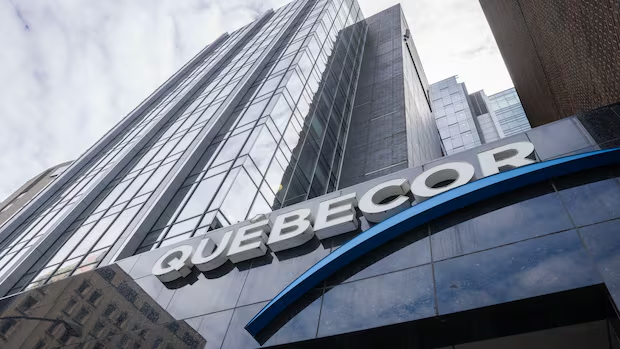
Quebecor has made a proposal worth $31 billion to take over Telus — a move that would dramatically change the telecom landscape and raises questions about competition, if it were to move ahead.
The Montreal-based telecom company said Monday in a news release it submitted a non-binding proposal to Telus in June to serve as a basis for negotiations. Telus is currently reviewing an enhanced proposal submitted by Quebecor earlier this month, according to the release.
Quebecor says the proposed deal would combine complementary networks, spectrum and operating capabilities to strengthen investment capacity and create a more competitive company.
The proposed deal would give Telus shareholders $6.35 in cash and 0.17 Quebecor shares for each Telus share they have — roughly a 60 per cent premium, according to the company.
Quebecor, Canada’s fourth-largest telecom company, has boomed in value in recent years since acquiring Freedom Mobile in 2023 through its subsidiary Videotron, and using its competitors’ networks to provide mobile service to customers. With Quebecor’s $14.77-billion market capitalization and Telus’s $21.72-billion market cap, the potential deal would make Quebecor bigger than Rogers or Bell by that metric.
The company argues that acquiring Telus would create a stronger combined firm that could better compete with other national players and foreign companies, while better serving consumers with a faster deployment of 5G, better rural connectivity and greater affordability.
In an interview with CBC News, Quebecor president and CEO Pierre Karl Péladeau said a combined company would be more efficient, allowing Quebecor to invest in areas such as network upgrades.
“With the financial resources that we will generate out of those savings, we have the capacity to reduce our debt and, secondly, to invest in our networks, one of which will be non-terrestrial networks,” Péladeau said.
The company said in the release it would maintain the Telus brands under the proposed deal.
WATCH | Quebecor’s bid to buy Telus could transform telecom industry:
Quebecor makes $31B bid to acquire rival, Telus
Montreal-based wireless provider Quebecor has made a $31-billion bid to take over Vancouver-based Telus — a move experts say would make the market less competitive and potentially affect consumer’s telephone bills.
Any deal would require approval from the Competition Bureau, as well as authorities like the Canadian Radio-television and Telecommunications Commission (CRTC) and Innovation, Science and Economic Development Canada, Quebecor acknowledged.
The federal government has taken steps to try to enhance competition in the telecom sector, like regulations requiring large internet providers to open their networks to competitors and spotlighting affordable cellular plans, which it outlined in its recent telecom competition roadmap.
In a statement, Industry Minister Mélanie Joly said the government has taken note of Quebecor’s proposal, which she says will be “independently and rigorously” reviewed by the Competition Bureau and CRTC.
“In the face of accelerating technological change, global instability and ongoing cost-of-living pressures, the Government of Canada will relentlessly prioritize the best interests of Canadians and Canadian sovereignty,” Joly said in a statement.

TELUS corporation’s headquarters at TELUS Garden in downtown Vancouver, British Columbia, on Wednesday, May 6, 2026. Telus’ board is considering the proposal from Quebecor, but says it has concerns that remain unanswered by the Montreal-based telecom company. (Ben Nelms/CBC)
Telus says it has formed a committee to review the offer to determine the value of the potential deal. So far, the committee has surfaced a number of “significant risks” according to chair of Telus’s board of directors, John Manley.
Quebecor “has yet to explain how what it is proposing could be approved under the current telecom regulatory framework in Canada and that a regulatory review of such a transaction would be a long and costly process for our shareholders,” Manley said in a statement.
Telus also takes issue with how the Quebecor proposal values the company.
Manley added that Telus would continue to engage with Quebecor, the government and regulatory authorities about those concerns, while exploring alternatives.
LISTEN | How could proposed Quebecor takeover of Telus impact consumers?:
BC Today32:51How will a proposed Quebecor takeover of Telus impact Canadians?
Quebecor said it has retained experts to assess the proposed deal and issues that might be raised by authorities. It’s also ready to discuss “measurable commitments” about pricing, employment and regional connectivity with those authorities, the company said in its release.
‘A way bigger deal than the Rogers-Shaw deal’
The potential deal would be a major shakeup in the sector, and the largest takeover in Canada’s telecommunications sector since Rogers Communications Inc. purchased Shaw in 2023. That deal was approved by the federal government with a number of conditions, including that Rogers spend billions enhancing its broadband and wireless networks and that it create 3,000 jobs in Western Canada.
Shaw’s Freedom Mobile was sold to Quebecor’s Videotron as part of that takeover, which required the company to offer lower-cost service comparable to what it was offering in Quebec in other markets, among other conditions.
That agreement allowed Quebecor to scoop up a lot of business in Ontario and Western Canada and become a far bigger player in the Canadian market, according to Dwayne Winseck, Carleton University communications professor and director of the Global Media and Internet Concentration Project.
WATCH | Rogers takeover of Shaw approved by Ottawa:
Rogers takeover of Shaw approved by Ottawa
Rogers is set to take over Shaw after the federal government approved the merger with conditions which it insists will make the deal good for consumers. But some are skeptical the merger will actually be good for their wallets.
The federal government has been trying to increase competition in the telecom sector for nearly two decades by encouraging a fourth player to emerge, Winseck said.
With Quebecor’s gains since acquiring Freedom making it a bigger player, he says allowing the merger to go ahead now would “fly in the face” of the government’s work, and make the telecom sector less competitive.
“This is a deal that Canada doesn’t need,” Winseck said. “I just can’t see it delivering anything good.”
While mobile wireless service prices decreased in recent years in Canada and more affordable deals came online, the cost of wireless ticked back up in 2025, and Canada still had some of the highest wireless prices compared to other developed countries, according to Canada’s annual telecom price report.
Winseck says the small amount of progress to make wireless connectivity more affordable would be lost if Quebecor were allowed to buy Telus. As a result, he doesn’t expect the Competition Bureau will allow it.
“This is a way bigger deal than the Rogers-Shaw deal,” Winseck said.
WATCH | Wireless services cost less around the world:
Wireless mobile plan costs around the world
Cellphone users in Ireland, France and Australia react to cost-per-gigabyte price differences in Canada.
For his part, Péladeau credits his company with helping bring prices down in the years after Quebecor acquired Freedom and says Quebecor would “continue in this direction” to create value for consumers if the deal goes through.
Jennifer Quaid, a competition law expert and law professor at the University of Ottawa, says any potential deal will have to be assessed on its specifics, not on generalities.
While competition in the telecom sector is a concern overall, Quaid told CBC News it would be up to the Competition Bureau to look at regional markets to determine how it would impact competition on a more local level.
“I think it’s probably inevitable that in some places, Quebecor will be in a position where they can exercise more power to charge higher prices. And the question is going to be, is it enough to scuttle the deal?”
She also cautioned that the proposal is still in its very early stages. Quebecor would have to convince Telus’s board to agree to a deal before arguing its merits to the Competition Bureau, which Quaid says means the deal is “definitely not a certainty.”