Earlier this month, Rugby Canada board chair Kathleen McGinn happened to be visiting the prime minister’s office around the same time as Turkish president Recep Tayyip Erdoğan.
As is customary, the state leaders exchanged gifts — for example, in a meeting between Prime Minister Mark Carney and Erdogan in July, the former gifted maple syrup while the latter offered a personalized revolver.
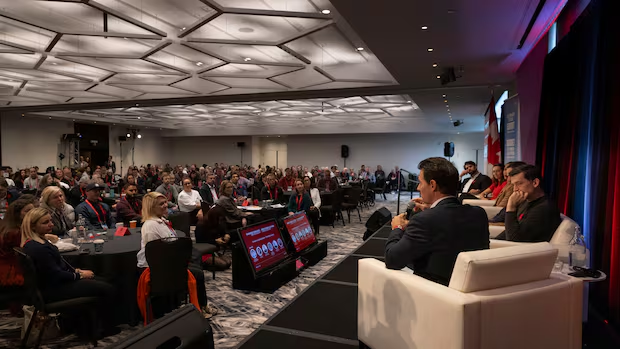
This time around, Carney avoided stereotype. Per McGinn, who was speaking on a panel at the Primetime Sport Conference on Friday, Carney sourced a Canada basketball jersey to hand to Erdogan.
It’s the latest visual of the federal government’s continued emphasis on sport. There was Carney’s campaign slogan ‘elbows up’ and a commercial filmed in a hockey rink. There was a $1 billion sports investment in the spring, and another $1.5 billion toward sport infrastructure included in the last week’s budget.
WATCH | CBC Sports’ Karissa Donkin details Canada’s current sport system:
Karissa Donkin on fixing Canada’s ‘broken’ sports system
CBC Sports reporter Karissa Donkin has been travelling near and far to help determine ‘A New Game Plan’ for Canada’s sports system.
On Monday and Tuesday in Ottawa, federal Secretary of State for Sport Adam van Koeverden convened around 400 of the country’s sport leaders to discuss what’s next. The two-day summit covered plenty of ground, from alignment to participation to corporate investment to inclusion.
It ended with plenty of ideas — but no specific calls to action.
McGinn said the next step should be a way to measure the outputs of the investment.
“How do we know that the investments that we are making into the sports system are going to yield gains?” McGinn said. “And measure and invest in doing that and doing it really specifically, in a smart way that’s like, yes, about KPIs, but actually be so clear: what is the country getting in return?”
“I would want to know as a citizen, all this investment in sport, how is it benefitting everyday Canadians? We need to be able to tell that story outside of the anecdotes and the ‘Yay we’re winning medals’ and all of that. It actually has a more foundational place, right?”
McGinn’s sentiment was shared by many of the national sports organization (NSO) leaders whom CBC Sports spoke with in Ottawa and Toronto.
There is a feeling of optimism and opportunity — and the resources to back it up — that is undeniable. But although it is still early days in the rebuild of the Canadian sport system, NSOs are seeking more specific guidance beyond the broad-strokes priorities of participation and alignment.
WATCH | How high a price to play sports?:
A New Game Plan: How high a price is pay to play sports?
Donnovan Bennett explores how the pay to play model is impacting the Canadian sports system.
So what’s next?
NSO applications for funding in the next fiscal year will soon begin, and with an emphasis on participation, those organizations will have to get to work on new ideas and ways to bring more people into their sports.
They’ll also have to look within themselves, and maybe even ask some hard questions. Four aquatic sports — swimming, water polo, artistic swimming and diving — have lbegun research on potential amalgamation. Bobsleigh Canada Skeleton and Luge Canada announced intentions to merge.
Other sports will be looked at for this, too — especially in the wake of the Canadian Olympic and Paralympic committees announcing their own further intentions to work together. Could baseball and softball combine? What about alpine, freestyle ski and ski jumping?
And if those things happen, will each current NSO’s provincial and territorial sports organizations (PTSOs) jump on board?
McGinn said Rugby Canada meets with its PTSOs in person twice yearly, with the next opportunity slated for the end of the month.
WATCH | The Norway model:
A New Game Plan: The Norway Model
CBC Sports’ Donnovan Bennett explores Norway’s sporting system, and how Canada might be able to learn from the Nordic nation.
“The provinces always play a role. They know their people inside their provinces. They have the relationship with the people inside their provinces. They have visibility. They see the participants. They know the players. I think that that is a really, really important role for them to play, and they should play it forever,” McGinn said.
Still, there could be some opportunity for Rugby Canada to oversee an element of participation, and streamline it through analysis of their national registration system.
“As soon as you can see who’s participating and where and understand more about them and what are their challenges and what are the hotspots and what are the pockets that actually would benefit from more leadership or more effort, I think it’s really smart strategy and so that’s the piece where through that sort of deployment of that technology, we’re trying to work with the provinces to get a little more intel,” McGinn said.
Stuart McReynolds, the COO of Jumpstart Foundation, the charitable arm of Canadian Tire, said the government should be using similar analysis to determine how to distribute the infrastructure funding.
WATCH | Sport funding 101:
A New Game Plan: Sports Funding 101
CBC Sports’ Donnovan Bennett sat down with Canada’s secretary of sport, Adam van Koeverden, among others, to discuss Canada’s current sporting system, and how it can be rebuilt.
“Do we know what kids and youth want to play? And are we designing strategies around that? And again, I think there’s got to be some accountability around that. I think tactically, some of the work that we’re doing around data and using data to inform decisions is going to be really important,” McReynolds said.
Accountability for government funding is another topic on the minds of some within the industry.
Partially, that will be accomplished through the funding framework that is set to be finalized within the next two weeks, according to van Koeverden.
But some NSOs also want their own feet held to the fire — for there to be direct incentives or disincentives tied to specific government priorities.
For now, the NSO community — particularly those that rely more on government funds — can look to Rugby Canada as an example after it crowdfunded $1 million en route to a silver medal at the women’s World Cup last year, proved its model and parlayed that into $2.815 million in additional funding this year.
McGinn said Rugby CEO Nathan Bombrys is both making and fielding plenty of calls within the sport community on how to continue moving forward.
“It’s not just one way. We obviously learn a ton from what other sports are doing as well. It’s really about just having a very clear vision, mandate, purpose and heading for it. We’re victims in Canada a little bit of the shiny object. And so, yes, we have new funds now, but … it’s not like we’re all going to sit back and go, ‘Wow, this is great.’ You better make sure you stay on it,” McGinn said.
For Rugby Canada, that means carefully formulating a plan “in a proper business fashion,” setting goals, prioritizing financial stability and being intentional about which opportunities are pursued.