
Open this photo in gallery:
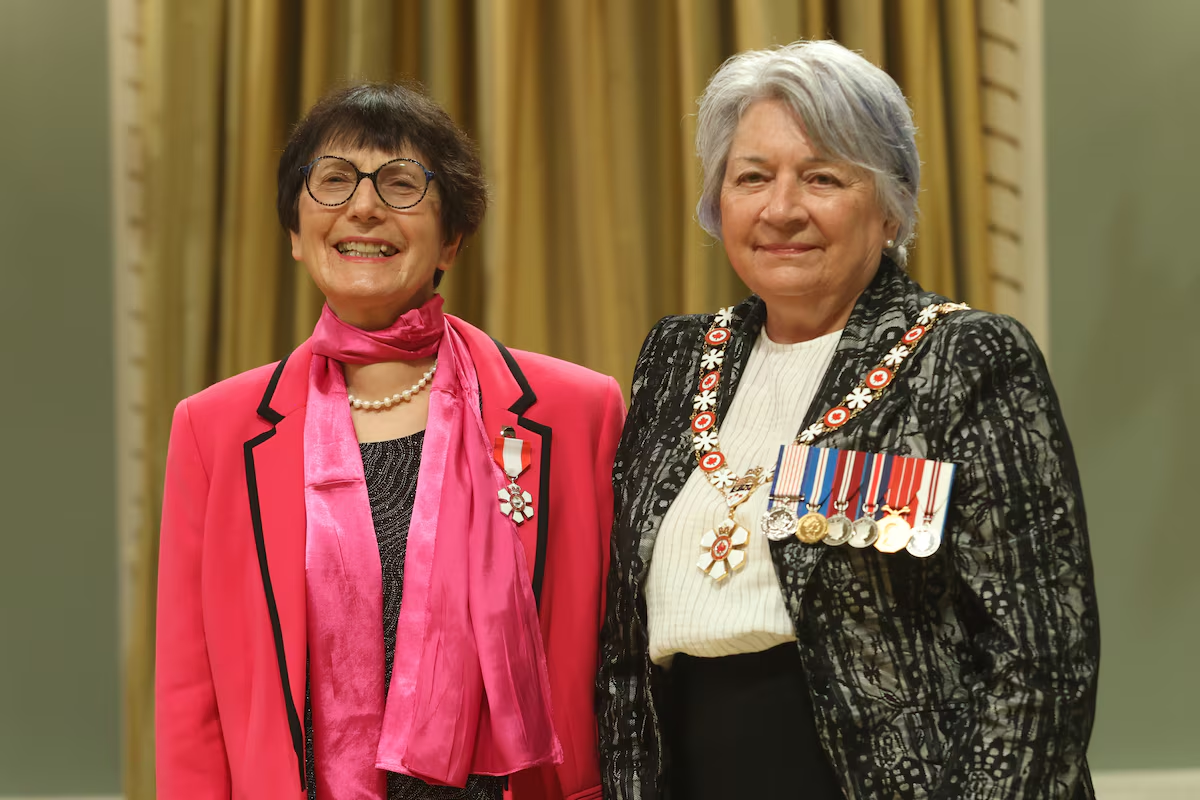
Cross-country skier Francine Lemire was invested as a member of the Order of Canada by Governor General Mary Simon during a ceremony at Rideau Hall in Ottawa, on Sept. 18, 2025.PATRICK DOYLE/The Canadian Press
When Francine Lemire was 11 years old, doctors amputated her left leg above the knee because of complications resulting from a benign tumour.
It was the last of many annual surgeries on the leg after its growth was stunted when she was a toddler. But she did not let the disability deter her from realizing big dreams.
She became a two-time Paralympian cross-country skier, competing at the Winter Paralympics in Innsbruck in 1984 and 1988, and winning a pair of gold medals.
Off the snow, she became an award-winning family doctor, medical educator and family-medicine leader, aiding Canadian and international doctors and health organizations. She was both the first woman and the first francophone to serve as CEO and executive director of the College of Family Physicians of Canada, a management position, after previously serving as its volunteer president. In 2023, she was named a member of the Order of Canada for her contributions to sport, medicine and her community.
Open this photo in gallery:
Francine Lemire lights the torch to open the Canada Games in Corner Brook, Newfoundland, Feb. 20, 1999.JACQUES BOISSINOT/The Canadian Press
Dr. Lemire died on Oct. 11 in Corner Brook, N.L., after a brief battle with ovarian cancer. She was 74.
“[Her disability] didn’t prevent her from doing anything,” said Dr. Sarah Funnell, the CFPC’s current president.
Francine Lise Lemire was born in Montreal on Aug. 14, 1952. She was the only child of Robert Lemire, a grocery store owner, and Alice Lemire (née Jacob), who worked in the women’s clothing department at Eaton’s department store.
Doctors removed a tumour from Francine’s left knee when she was about three, but damage to the growth plate surrounding the knee inhibited the leg’s development, so as her other leg grew normally, the difference between the two legs increased.
She underwent years of bone-extension procedures and increasingly elevated shoes before doctors recommended amputation and a prosthesis to improve her mobility.
Francine’s health issues sparked her interest in family medicine and her desire to become a doctor. After taking her early schooling in French, she sought to learn English, so she studied medicine at McGill University. Her medical-school preceptor advised her to launch a family-medicine practice in either Newfoundland and Labrador or British Columbia. She knew a Newfoundland-based doctor and decided to do her residency in St. John’s. Her rotations took her to the emergency ward of Western Memorial Hospital, in Corner Brook, where she met cardiologist Jamie Graham, her future husband.
“I was taken with her right away,” Dr. Graham said. “My own first marriage was on the rocks and I was looking around [for a new relationship]. … The first time I met her, she told me about her problems with physical activity in her prosthesis. She said that she always wanted to learn skiing. That was my hobby. I’ve been skiing since the age of three. I was an instructor in cross-country skiing. I invited her to take a few lessons from me, which she started off in January of 1980.”
She learned to ski by holding onto a broomstick for support while Dr. Graham and his daughter, Jeri, held each end. Advancing quickly, Dr. Lemire soon excelled in competitions, winning several medals. One of Dr. Lemire’s coaches, Margaret (Muggs) Tibbo, also managed Canada’s disabled skiing team and invited her to a camp in Banff, Alta., where she improved her technique, earning a spot on the 1984 Canadian Paralympic team. She barely missed the medal podium, placing fourth in both of her disability classification’s five-kilometre and 10-kilometre events in Innsbruck. Four years later, again in Innsbruck, she captured Paralympic gold medals in the two events at the age of 36.
Open this photo in gallery:
Francine Lemire, third from right, competed for Canada in cross-country skiing during the 1988 Winter Paralympics in Innsbruck.Margaret (Muggs) Tibbo/Supplied
Later in 1988, Dr. Lemire was named Newfoundland’s female athlete of the year, topping disabled and able-bodied athletes alike. In 2014, she was inducted into the Cross Country Newfoundland and Labrador Hall of Fame
While operating a full-scope (i.e., birth-to-death) family practice between 1979 and 2002, she also served as an anesthetist and obstetrician, delivering approximately 1,500 babies.
Dr. Lemire served as the elected president of the CFPC’s Newfoundland chapter from 1989 to 1990 and the group’s national president from 1998 to 1999.
During her two decades in CFPC management, from 2002 to 2022, Dr. Lemire worked weekdays in Mississauga, Ont., at the headquarters of the 47,000-member organization, returning to Corner Brook on weekends. During her first decade as membership director, she also supervised family-medicine residents at Toronto Western Hospital. From 1997 to 2003, she oversaw a Memorial University program that assessed and provided clinical training to internationally educated physicians preparing to practise in Canada. She served on the World Organization of Family Doctors (WONCA) board from 2010 to 2013, joined several committees from 2018 to 2020 and chaired its membership and voting task force from 2023 to 2024.
“Family medicine has lost a leader and we will miss her voice deeply,” said Harris Lygidakis, CEO of WONCA in a tribute issued by the organization.
Dr. Lemire also wrote a column in the medical journal Canadian Family Physician (2013 to 2022). She served as CFPC’s top executive during this same period, and her accomplishments include spearheading the creation of the Besrour Centre for Global Family Medicine, a hub based at the organization’s headquarters in Mississauga; changing CFPC’s governance model; and heading its charitable foundation, for which she raised millions of dollars.
Dr. Lemire also oversaw Canadian family-physician certification, a role that became particularly challenging for the CFPC during the COVID-19 outbreak.
With in-person gatherings restricted, the college had to find alternative ways to examine 4,100 medical residents and osteopaths who were already CFPC members and eligible to practise family medicine while ensuring they met its rigorous standards.
“Francine led the organization to quickly pivot to have the examinations be held in different ways through virtual platforms,” Dr. Funnell said. “It was a big shift.”
In March 2021, Dr. Lemire spoke out against racism in family medicine at a federal online anti-racism town hall convened after the death of Joyce Echaquan, a 37-year-old Atikamekw woman who was verbally abused by hospital staff and denied appropriate care before dying in a Montreal-area hospital in 2020. A Quebec coroner subsequently concluded that racism and prejudice contributed to her death, which could have been prevented with proper assessment and monitoring.
Dr. Funnell, a Kingston, Ont.-based family doctor and member of the Kitigan Zibi First Nation, greatly appreciated Dr. Lemire’s invitation to speak with her at the town hall.
In September 2021, Dr. Lemire co-authored an article in Canadian Family Physician acknowledging that CFPC had engaged in systemic racism. The CFPC also updated its action plan to integrate Indigenous health and cultural safety into family-medicine residency-training standards and help racialized-group leaders address systemic racism in areas where the college has responsibility and influence.
As a leader, Dr. Lemire was collaborative and decisive, said Dr. Funnell. As a teacher and family doctor, Dr. Lemire was kind, caring and compassionate, according to former colleagues and patients who posted online tributes to her.
“She was an incredible mentor,” wrote McMaster University medical professor Lynda Redwood-Campbell on LinkedIn. “She believed in us when we didn’t believe in ourselves.”
Former patient Catherine Meaney appreciated the way Dr. Lemire was “completely interested” in what she had to say every time she saw her.
“Just as I turned 18, I started to become very ill. She followed me intently and was always available to see me when an episode would take place. Her follow-up with tests and procedures was always prompt and I always knew she was in my corner,” Ms. Meaney wrote in a tribute on the Fillatre’s Funeral Homes’ webpage containing Dr. Lemire’s death notice. “Five months later, I was diagnosed with Crohn’s disease. She saw me regularly and ensured I got what I needed. I think of her often as she was always there for me, especially at a very scary time in my life. I’ll never forget her.”
After retiring from the CFPC in 2022, Dr. Lemire served as a Newfoundland and Labrador Health Services trustee and chaired its western regional health council. She also sat on the boards of Canadian Doctors for Medicare, Vision Loss Rehabilitation Canada and the Canadian Alliance of Physiotherapy Regulators, while advocating for better eldercare and more health human resources before parliamentary committees.
Dr. Lemire remained active in cross-country skiing, coaching young skiers with disabilities, serving on Cross Country NL’s board and volunteering at events. She also oversaw medical services at the 1999 Canada Winter Games in Corner Brook.
In retirement, Dr. Lemire remained an avid swimmer, enjoyed time at her family’s cottage near Parry Sound, Ont., and continued to entertain family and friends with dinners and wine tastings, indulging her long-time passion for cooking.
She and Dr. Graham, 86, also cross-country skied in Norway, Sweden, northern Italy, Alberta, B.C., and New Hampshire, in addition to paddling a canoe and kayak in waterways located across Canada while he maintained his cardiology work before retiring in September.
“Toward the end, we were skiing 800 kilometres a year,” Dr. Graham said.
Dr. Lemire died through Medical Assistance in Dying (MAID) in Western Memorial Regional Hospital’s palliative-care unit 27 days after receiving her diagnosis of inoperable cancer. As her symptoms rapidly worsened, the procedure date was moved up twice. Prolonging the inevitable “felt useless,” Dr. Graham said.
“She just didn’t have anything to live for,” he said. “All the family were around, so it would have been what she would call a good death. She was always interested in having a good death. She didn’t want to be suffering for months.”
Dr. Lemire leaves her husband of 42 years, Jamie Graham; stepchildren, Jeri, Philip and Ian Graham; cousin, Nancy Dessureault; and step-grandchildren, Sarah Graham, Graham Zilkowsky and James Graham.
Dr. Funnell said Dr. Lemire lived and died the same way – with great determination. “[She was] very determined to make decisions for herself – even in death.”
You can find more obituaries from The Globe and Mail here.
To submit a memory about someone we have recently profiled on the Obituaries page, e-mail us at obit@globeandmail.com.