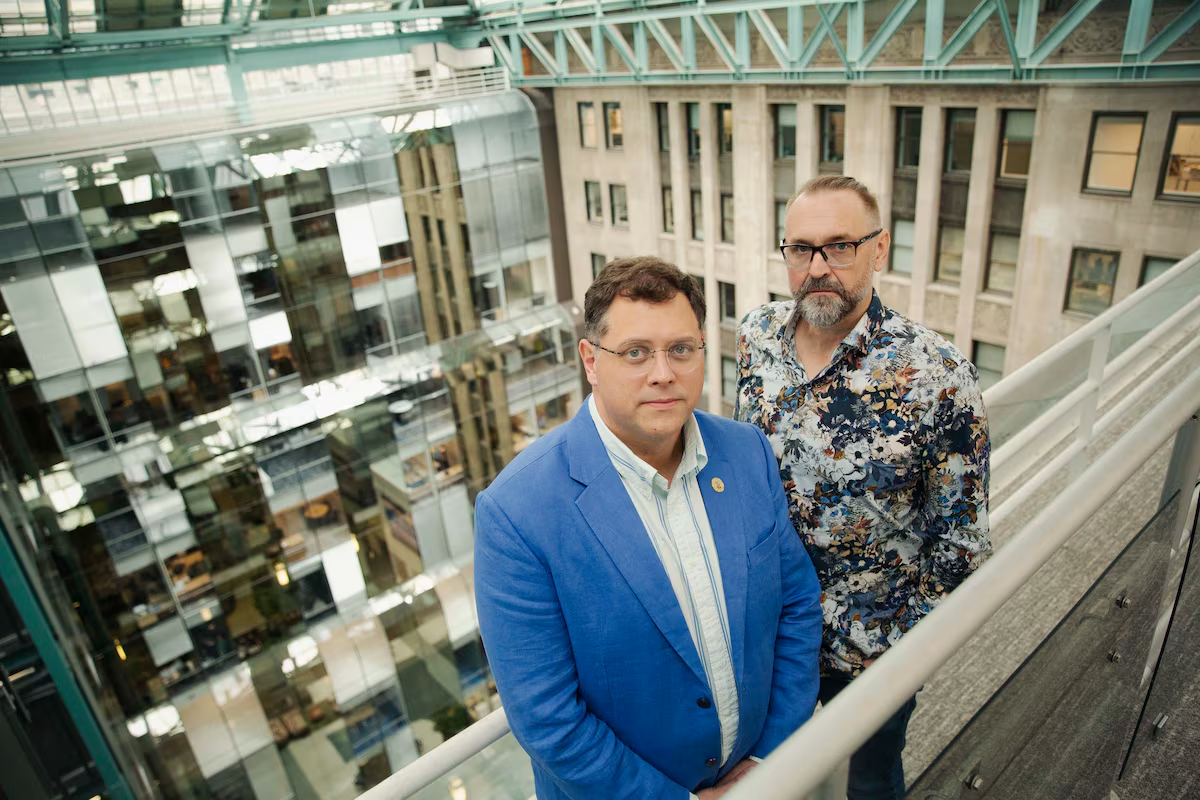

Open this photo in gallery:
Drs. Jeffrey Carter (left) and Vincent Gabriel (R) at the Chicago Board of Trade on Friday, where they convened for an American Burn Association meeting focused on cross-border collaboration following the deadly fire in Wainwright, Alta.Isabella Falsetti/The Globe and Mail
When Jeffrey Carter heard about the deadly fire at Canadian Forces Base Wainwright in Alberta, the New Orleans-based physician got to work putting together care packages for his Canadian comrades.
Louisiana delicacies such as pralines, socks that say “Actual Superhero,” and Yeti mugs were among the items that the director of trauma and burn services at University Medical Centre New Orleans and his staff sent to the burn centres in Calgary and Edmonton in boxes the size of small fridges.
But Dr. Carter’s parcels from Louisiana aren’t the only form of cross-border support that Canadian burn care specialists have received in recent weeks.
Hundreds gather to remember B.C. soldier killed in Wainwright fire
Spray-on skin technology and mineral oil used during surgery have been shipped from the United States to Canada under special emergency conditions in response to the Oct. 17 grass fire at Wainwright, which killed four soldiers and injured 39 military personnel, many of whom suffered serious burns.
The incident has revealed how unprepared the country’s fragmented health care system is for mass casualty events with high numbers of burn patients, and it has exposed Canada’s continued reliance on the U.S. for key supplies, even as political relations have deteriorated.
The burn-treatment communities in Canada and the U.S. are inextricably linked. Canadian burn centres and burn care professionals are listed as members of the American Burn Association alongside their U.S. colleagues. And the Canadian anthem is played before the American one at the association’s annual conference each year, said Dr. Carter, a past president of the organization. “We’ve always just worked together.”
Burn care is a particularly complex specialty. It’s time consuming and onerous, requiring regular painful dressing changes, temperature-controlled environments and often multiple surgeries.
Traditionally, major burns are healed using skin grafts either from the patient’s body or a donor. However, new and innovative technologies are becoming available to burn surgeons who choose to adopt them, such as a gel that helps regenerate tissue and a spray device that uses the patient’s own cells to regrow their skin.
That’s why, after the fire in Wainwright, Health Canada facilitated access to ReCell’s epidermal autograft system through its Medical Devices Special Access Program. The spray-on skin technology was invented in Australia. It uses an extremely small and thin piece of a patient’s skin to create a spray filled with their own cells to cover their wounds. It’s a particularly effective treatment for areas such as faces or fingers and toes, which can be hard to graft, said Dr. Carter, who was involved in some of its first trials in the U.S.
Although Health Canada expedited access to the product, the department said it does not currently have an application underway to otherwise authorize the sale of ReCell in the country.
When his Canadian colleagues received their shipment of the technology, Dr. Carter said he reached out to offer his support. He knows many of the specialists in Edmonton and Calgary personally, including Dr. Vincent Gabriel, who is both medical director at the Calgary Firefighters Burn Treatment Centre, where some of the Wainwright patients ended up, and treasurer for the American Burn Association.
“I offered to go up and help. They’re like, ‘We think we have it, but we’re going to bring in some of these new technologies. If you could be available by telehealth, we’ll be glad to ask questions,’ ” Dr. Carter said.
Light mineral oil has also been imported from the U.S. into Alberta under special circumstances to help treat the Wainwright patients, according to Health Canada. The product is used to reduce friction when surgeons harvest skin from a patient for a graft, Dr. Carter said.
“If you take your thumb and push it on the back of your hand, it crinkles up all the skin, makes it look like crepe paper. So, by creating a lubricant there, it allows the skin to slide into this very thin blade,” he said.
The Canadian-authorized version of this product has been in short supply since May 2026 owing to a manufacturing disruption that is estimated to end on Dec. 7. Last month, Health Canada accepted a proposal from Fresenius Kabi Canada Ltd. for the “exceptional importation and sale in Alberta of U.S.-authorized Muri-Lube (light mineral oil),” the department said in a written statement.
This co-ordination highlights the importance of maintaining national stockpiles in Canada and the U.S., as well as ensuring supply chain interoperability between the two countries, Colonel Jennifer Gurney, chief of the joint trauma system within the U.S. Department of Defence, said in a written statement.
Ottawa proposes $28-million to support those affected by CFB Wainwright fire
Col. Gurney told The Globe and Mail that the U.S. Army offered support to Canada after the Wainwright fire in the form of military burn specialists, whose mandate is to assess, treat and evacuate critically ill burn patients around the world.
Alberta’s tissue banks in Edmonton and Calgary exhausted their inventories of skin within 13 days, according to Vanessa Gomez, senior communications adviser for Acute Care Alberta. She said hospitals were securing more skin from tissue banks in Manitoba and Quebec.
Ms. Gomez could not say whether grafts had been sourced from the U.S., though health care facilities in Canada often rely on skin from tissue banks in the United States.
AlloSource, a tissue bank based in Colorado that supplies donor skin to Canada, said it has been in touch with tissue banks in Alberta and Quebec to offer support via donated skin.
As of Nov. 2, AlloSource spokesperson Colleen Kilkenny said the company had not shipped tissue directly to Alberta in connection with the fire in Wainwright. Ms. Kilkenny added that AlloSource remains available to Héma-Québec, which co-ordinates that province’s tissue supplies, in case its inventory requires replenishing in connection with the tragedy.
Back in New Orleans, Dr. Carter said he plans to send more local food to the burn centres in Calgary and Edmonton in the weeks to come.
That’s when they really need it, he said. “That’s when they’re doing really long hours of wound care a day, hours and hours of wound care, hours and hours and hours of therapy a day.”