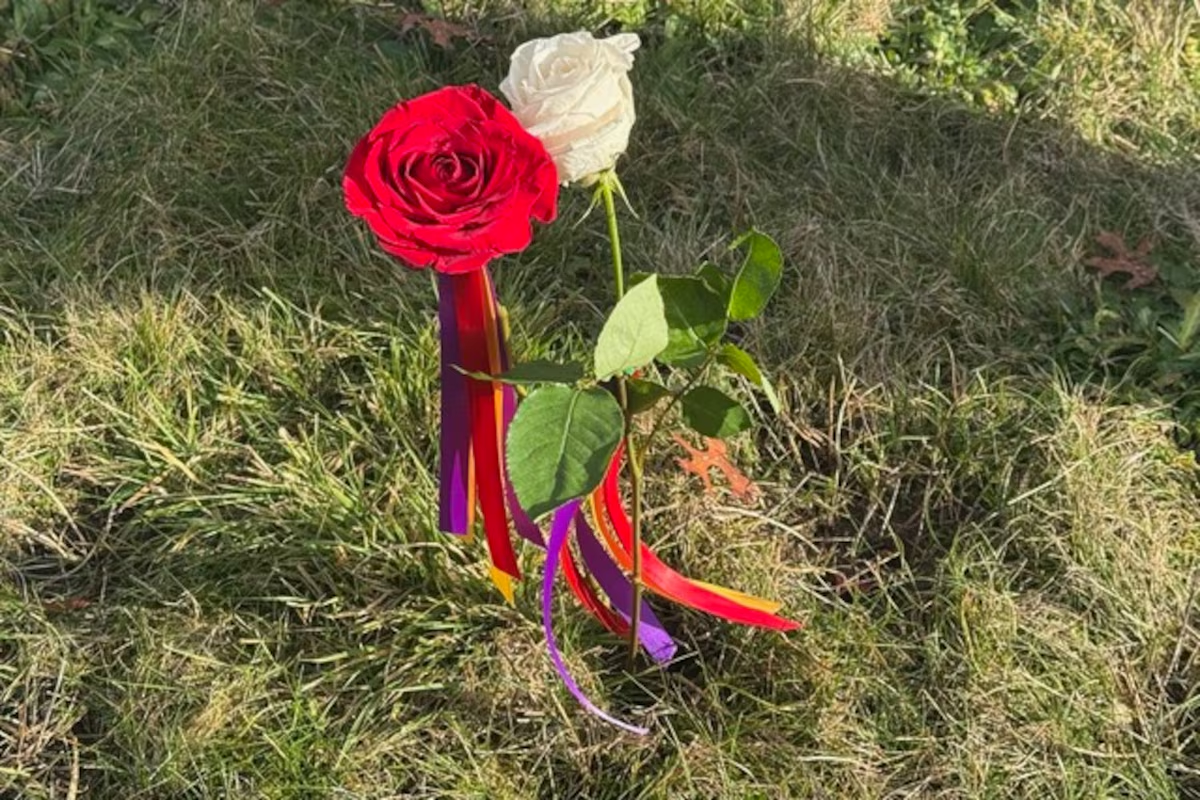

Open this photo in gallery:
Roses placed last year on Remembrance Day on the unmarked grave in Vancouver’s Mountain View Ceremony of Jacob Okonski, a veteran of the Mackenzie Papineau Battalion that fought in Spain. Tied to the roses are ribbons with the three colours of the flag of the Spanish Republic.Pamela Vivian/Supplied
Bethany Whelan Jones remembers it to this day.
On a family trip to McDonald’s, sitting at an outside picnic table with her parents and sister, they noticed an old man with a scraggly beard, rummaging through a nearby garbage can.
Her mother went inside to buy him a meal. When she returned, she told them he reminded her of her father.
“Then, she looked at us kids in the eye, and said, ‘Remember that man? Somebody loves him. He has a family out there that cares for him still.’”
Ms. Whelan Jones’s mother, Melanie, who died in 2021, had a deeply personal reason for her compassion.
Her mother’s father was Jacob Okonski, one of an estimated 1,500 Canadians who journeyed across the Atlantic in 1937 to take up arms in support of the democratically elected Republican government of Spain against the invading fascist forces of Generalissimo Franco.
Amid thousands of volunteers from other countries, they formed a distinctly Canadian unit: Widely known as the Mac-Paps, the storied Mackenzie-Papineau Battalion was named after the leaders of the 1837 Rebellions in Upper and Lower Canada.
Open this photo in gallery:
One of two photos that Bethany Whelan Jones’ mother Melanie had of her father, Jacob Okonski. The date of the photograph is unknown.Supplied
Hundreds died on the Spanish battlefield, never to see Canada again.
Mr. Okonski, a 25-year-old Polish-Ukrainian miner from Alberta, survived the savagery of the Spanish Civil War. But he was wounded twice, at the brutal Battle of Teruel and later, more severely, during the ill-fated Ebro Offensive in 1938, the Republic’s last-ditch, unsuccessful effort to halt Franco’s advancing armies.
Like a lot of Mac-Paps, he returned traumatized by what he saw and experienced in Spain.
We must preserve the stories of our veterans before it’s too late
Making matters worse was the reception accorded Mr. Okonski and his fellow combatants back in Canada. Rather than being lionized for their courage and willingness to put their lives on the line to confront fascism in a far-off country, the Mac-Paps were hounded and ostracized by Canadian authorities for defying a hastily passed ordinance making it illegal to enlist in a foreign war. Some had their passports confiscated. Others were threatened with arrest. Many were blacklisted for being communists, kept under regular surveillance by the RCMP.
Noting that just a year later, Canada, itself, was embroiled in all-out war against Germany and Italy, the same fascist countries whose military assistance had turned the tide in Spain, the Mac-Paps referred to themselves, sardonically, as “premature anti-fascists.”
Mr. Okonski was no longer the person who had left for Spain. He drifted from job to job, married and fathered two daughters but drifted away from those responsibilities, too. He became an alcoholic, eventually winding up on skid row in Vancouver, now known as the Downtown Eastside. He died in 1976 at the age of 64.
Ms. Whelan Jones’s mother did not know he had died until after she put a poignant personal ad in the Vancouver Sun, asking if anyone knew the whereabouts of her father. Someone referred her to his small death notice in the Sun. He was buried in an unmarked grave in the city’s Mountain View Cemetery.
But Mr. Okonski has not been entirely forgotten. In recent years, on Remembrance Day, a small group of Canadians dedicated to preserving the legacy of the Mackenzie-Papineau Battalion have pinpointed and made pilgrimages to known graves of those who fought in Spain.
Opinion: How veterans remember the lives of men they’ve killed
The initiative has been spearheaded by Raymond Hoff, a retired academic in Victoria, whose American father, Harold, also a volunteer in Spain, was taken in by the Mac-Paps during a hellish retreat from Italian warplanes and artillery. While researching and compiling biographies of as many Mac-Paps as the group could find, Mr. Hoff uncovered Mr. Okonski’s history and the location of his unmarked grave.
Last year, Ms. Whelan Jones came across a photo of two roses placed on her grandfather’s final resting place by the friends of the Mac-Paps. She was overcome.
“I saw the photo, and like, I cried, thinking of my mother. All these years, she thought that her dad didn’t matter to anybody because nobody contacted her when he passed.” Nobody contacted her mother’s sister. “They treated his death like he didn’t have a family.”
In a heartfelt message to the volunteers who gathered at his grave to pay tribute to her grandfather, she wrote: “Thank you for placing a rose on his grave and honouring his service. My mom carried a lot of sadness that her father ended up in an unmarked grave and felt that nobody cared about her dad or thought he was important.
“That is why seeing that photograph of a rose being placed on his grave meant so much to me. I wish my mom could have seen it. She would have known that all these years later, someone still remembered her dad.”
Like many Mac-Paps, Mr. Okonski had joined the Communist Party of Canada, persuaded by the economic hardships of the Depression that capitalism no longer worked. In 1935, he joined the famous On-to-Ottawa Trek by hundreds of unemployed, travelling by boxcar across the country to confront Prime Minister R. B. Bennett. The RCMP halted the protest in Regina with tear gas and billy clubs. Two years later, Mr. Okonski was in Spain.
Afterward, he worked intermittently as a butcher and was mostly missing from the lives of his two daughters. They remembered only brief visits when he would show up with a bunch of fruit, maybe do a special Ukrainian dance or teach them how to eat sausage. “You eat a piece of sausage and then you take a bite of bread,” her mother told Ms. Whelan Jones.
He had regular brushes with the law, usually brought on by his drinking. Ms. Whelan Jones believes he suffered from post-traumatic stress disorder. Her mom’s older sister remembered him waking in the night, running around the house and chasing his daughters outside, beset by a terrible flashback or night terror. He died alone, in his single room, of a weakened heart.
Opinion: In Saskatchewan, a special war memorial connects the generations
As she has learned more about her grandfather, Ms. Whelan Jones has become increasingly proud of him, despite his troubled life. “He had a lot of passionate ideals and fought for people’s rights,” she said.
Over the years, the renown of the Mac-Paps has been enhanced with monuments in Victoria, Toronto and Ottawa. Ms. Whelan Jones was moved to see a photograph of Mr. Okonski’s name on the Ottawa memorial, unveiled in 2001 by Governor-General Adrienne Clarkson.
Mac-Pap supporters, meanwhile, will be out again this Remembrance Day to pause and remember soldiers who have never been recognized as “official veterans” by government or the Canadian Legion.
“It’s sad that they’re not remembered at the traditional Remembrance Day ceremonies,” said Pamela Vincent, who co-ordinates the trek to the Mountain View Cemetery. Her great-uncle, Peter Johnson, was killed during an early bombing raid in Spain. “They saw the threat of fascism and did their part.”
As for Ms. Whelan Jones, she said she and her two siblings now hope to provide a proper headstone for their grandfather.
“My mother always thought he’d been buried in a mass grave with other uncollected ashes. Now that we know where he rests, we’re looking into having a beautiful grave marker placed there, so that he can be properly remembered,” she said.
“The marker will also identify him as a Mac-Pap veteran.”