
Open this photo in gallery:
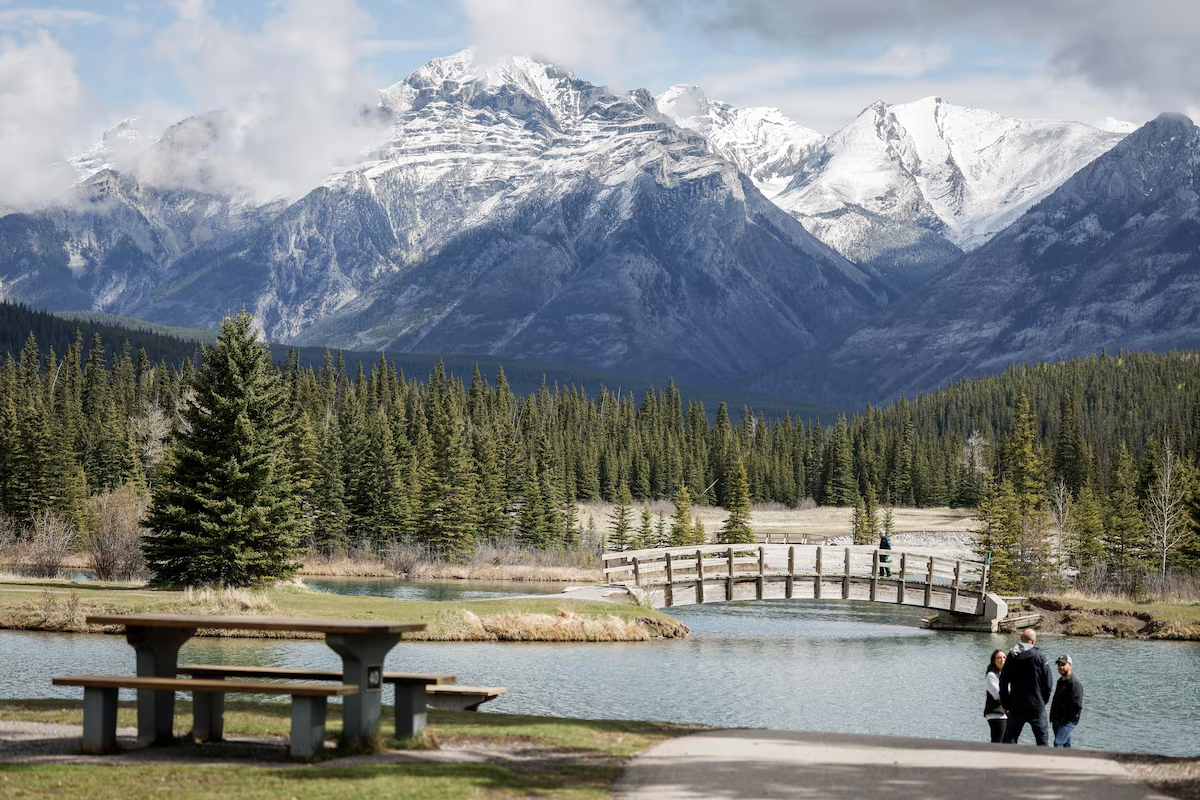
Visitors take in Banff National Park in May 2025. Parks Canada has discontinued its search-and-rescue dog program.Jeff McIntosh/The Canadian Press
Thousands of Parks Canada employees have received notice that their jobs may be cut as the federal agency moves to shrink its work force and reduce services in line with the government’s cost-cutting measures.
Parks Canada has sent letters to 2,917 employees across the country to inform them their jobs are “impacted by workforce adjustment,” spokesperson Meaghan Bradley said in an e-mail. Not every one of those employees will lose their job, but decisions will be made in the coming weeks, she said.
The cuts are expected to eliminate about 500 full-time-equivalent positions, close 13 park-warden detachments and scale back visitor program, outreach and camping services. As well, the search-and-rescue dog program at Banff National Park – the only such program in Canada – has been discontinued.
“Over the coming months, Parks Canada will implement organizational changes to align with available funding, modernize operations, strengthen field-based decision-making and ensure it remains well positioned to deliver on our mandate into the future,” Ms. Bradley said.
Budget 2026 highlights, from housing to business tax relief
The Canadian Parks and Wilderness Society, an environmental charity, said it is “deeply concerned” by the planned reductions, which it said could put ecosystems, visitor safety and local economies at risk. It also argued the move makes little economic sense: Parks Canada had a budget of about $1.3-billion in 2025-26, while visitors spent $6.5-billion in or near its sites, according to the federal agency.
Kecia Kerr, executive director of the society’s northern Alberta chapter, said the province’s national parks are already struggling to manage tourism and its effects on wildlife and visitor safety.
In Elk Island National Park, which is slated to lose its park-warden detachment, Ms. Kerr said speeding drivers have resulted in at least 11 bison deaths that she is aware of. There have also been issues with poaching at both Elk Island and Jasper National Park.
“Human-wildlife conflict, and a need for additional education for visitors on how to behave around wildlife, are already issues and these cuts will make those issues much worse,” she said.
She added that the federal cuts compound provincial decisions that have reduced protections for ecological reserves and removed portions of provincial parks for resort development, putting more pressure on Alberta’s protected areas.
A recent employment equity annual report stated that as of March 2025, Parks Canada had a total work force of about 6,000 employees, of which 48.5 per cent were seasonal. The Treasury Board of Canada Secretariat, meanwhile, recorded 4,773 active Parks Canada employees this year.
The Public Service Alliance of Canada said 2,671 of its members at Parks Canada received the notices. To date, the employer has not explained which specific programs or services will be affected, the union said.
Opinion: Traffic between Banff and Jasper is a symptom of a larger problem
Jamey Mills, PSAC regional executive vice-president for B.C., said 217 Parks Canada staff across seven sites in the province received the letters, including “entire workforces” at some sites. The park-warden detachment in B.C.’s Gulf Islands National Park Reserve will also close.
He said the cuts are particularly concerning in a province with geographically diverse parks that require workers with specialized training.
“It is important that there are on-the-ground staff with the ability to respond to potential emergencies, maintain critical infrastructure, meet visitor needs, and protect sensitive ecosystems,” Mr. Mills said in a statement.
Jean-Michel Lavergne, president of the Union of National Employees, a component of PSAC, said in an e-mail that ending the search-and-rescue dog program in Banff raises concerns about avalanche searches, missing-person rescues and replacement response capacity. He added that park-warden detachment closures could mean longer response times and less backup for officers.
Other detachments set to close include those in Kluane National Park and Reserve in Yukon, Point Pelee National Park in Ontario, Kejimkujik National Park in Nova Scotia, Fundy National Park in New Brunswick and Nahanni National Park Reserve in the Northwest Territories.
Ms. Bradley said Parks Canada will maintain law-enforcement coverage through a regionalized model, with wardens redistributed according to need and risk.
Visitor experience gets makeover at Banff National Park
Janet Sumner, executive director of the conservation organization Wildlands League, said the cuts undermine a plan announced by Prime Minister Mark Carney to protect 30 per cent of the country’s land and waters by the end of the decade.
“How do you do that while at the same time cutting the very agency that’s going to be responsible for managing some of that?” she said.
Reducing the agency’s work force could also have implications for national urban parks, which are particularly important because of the biodiversity they contain, she said.
The agency reductions are part of the Carney government’s comprehensive expenditure review. The review is expected to cut federal spending by $9-billion in 2026-27, $10-billion in 2027-28 and $13-billion in 2028-29, according to the government.
Parks Canada’s share of those cuts totals about $145-million: $24.6-million in 2026-27, $45.3-million in 2027-28 and $75-million in 2028-29.
The 2026 federal budget, released Thursday, commits $3.6-billion over 10 years to Parks Canada to maintain capital assets, as well as $282.7-million over 11 years, and $18-million annually, to establish and operate two new national marine conservation areas. The funding is separate from the planned spending reductions, which target the agency’s operating costs, staffing and existing services.
The budget also allocates $76-million to renewing the popular Canada Strong Pass program, which was first introduced in summer 2025 and offered free or discounted admission to Parks Canada sites, participating museums and galleries, as well as discounted rail travel. Visits to Parks Canada sites increased by 13 per cent because of the pass, the budget document said.
However, PSAC said in its October statement on the work force cuts that there was no additional staffing to handle the increased tourism.
“This announcement is an insult after our members did more with less all summer long,” the union said.