
Listen to this article
Estimated 2 minutes
The audio version of this article is generated by AI-based technology. Mispronunciations can occur. We are working with our partners to continually review and improve the results.
Even at the best of times, it’s hard to imagine swimming outdoors in November — no matter where you live in Canada. But 2026 is changing that conventional wisdom.
Parts of Quebec and Ontario have been experiencing potentially record-setting summer-like temperatures this week, with highs over 20 C.
Normal highs in major cities this time of year are around 10 C.
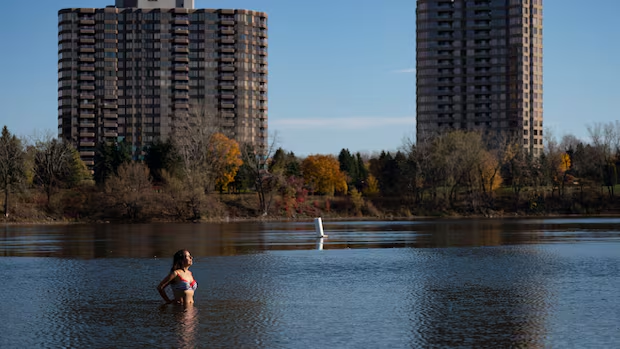
In Montreal on Wednesday, it was 22 C, but felt like 24 C. Good enough for a trip to the beach.

A woman enjoys the warm weather at Verdun Beach in Montreal on Wednesday. (Christinne Muschi/The Canadian Press)
According to the Weather Network, the weather anomaly is due to a strong, high-pressure ridge off the U.S. East Coast and a warm front associated with a Colorado low — a low-pressure area caused by the Rocky Mountains that tends to track northeastward. Those systems combined are pushing warmer air into parts of Canada.
Toronto has also been warmer than normal.

With a high around 21 C in Toronto Wednesday, some people took to a hammock to enjoy the sunshine. (Chris Young/The Canadian Press)

Wearing shorts in Toronto in November? Why not? This man took advantage of the warmth as he walked his dogs Tuesday. (Alex Lupul/CBC)
WATCH | So what’s behind these warm temps?:
What’s behind the warm November weather in London?
The first week of November in London, Ont. has seen temperatures as high as 21 degrees, according to Environment Canada. It’s welcome news for some Londoners who want to make the most of the warmth before the snow hits, but what’s behind the unseasonably high temperatures?
El Niño effect
This year’s strong El Niño is probably part of the story, too.
Bill Merryfield, a research scientist at Environment and Climate Change Canada, says El Niño usually affects Canada toward the end of the year, causing unusually mild fall and winter temperatures.
“This year’s event is truly exceptional because this warming has already exceeded three degrees, which is well above that of any previous event and is expected to go even higher before the usual peak of El Niño in November or December,” he said, referring to Pacific Ocean temperatures tied to the weather phenomenon.

Two people take a break on Parliament Hill during an unseasonably warm Nov. 4. (Dan Taekema/CBC)

It was a warm day under the fall foliage at Toronto’s High Park. (Alex Lupul/CBC)

A cyclist in Toronto took advantage of the delayed start of cooler temps, too. (Alex Lupul/CBC)
People had the same idea in western Quebec, too.