
Open this photo in gallery:
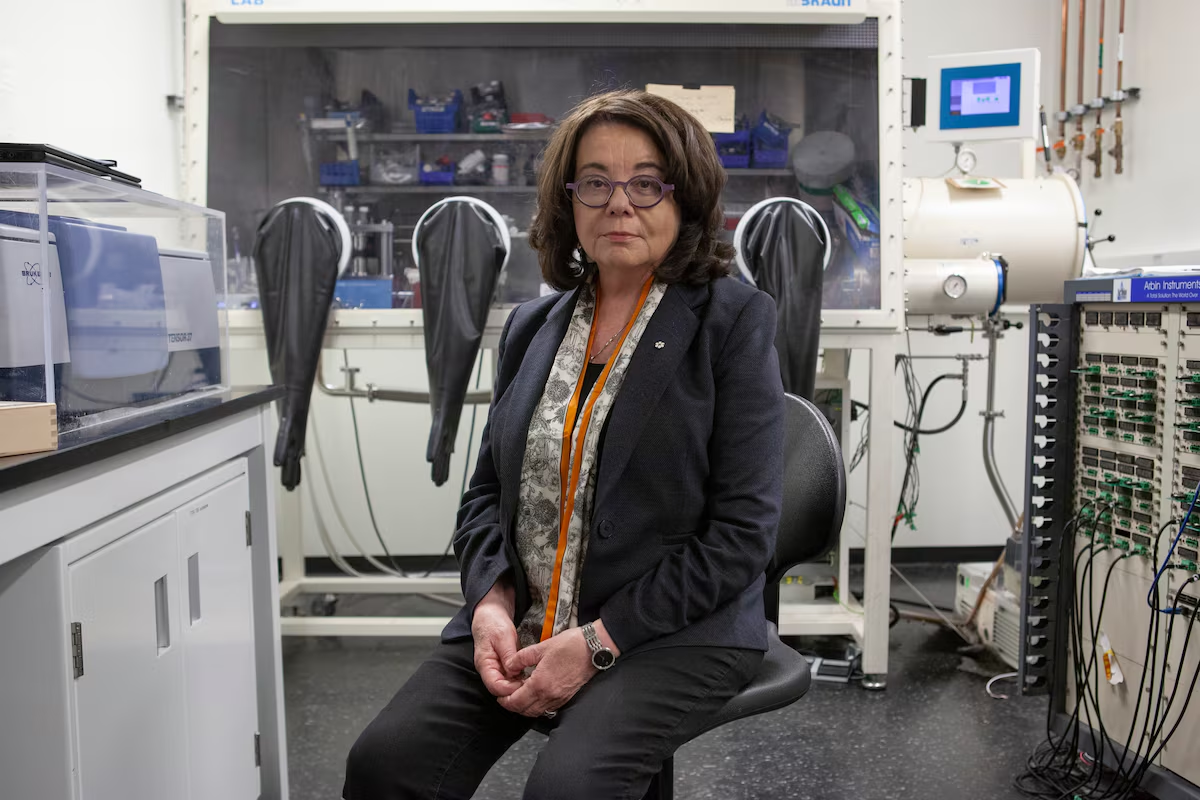
University of Waterloo chemist Dr. Linda Nazar, pictured at the Mike & Ophelia Lazaridis Quantum-Nano Centre last month, has spent decades researching materials for next-generation batteries.Azad Amin/The Globe and Mail
Linda Nazar always liked science in high school and she was good at it. When she headed off to university, her plan was to aim for medical school.
But then a first-year chemistry course unexpectedly captured her imagination. The more she learned, the more she was drawn to the world of atoms and the elegant geometry that governs their structure and behaviour.
“For some reason it just really clicked,” said Dr. Nazar, who now holds the title of university research professor in chemistry at the University of Waterloo. “It might have been a sense of understanding – or feeling like I understood something about nature at the point of chemical reactions.”
Since then, Dr. Nazar has been on an odyssey of discovery at the atomic level that she has mostly pursued with one key goal in mind: finding materials that can improve how we store and dispense electricity in the form of batteries.
From the archives: Canadian scientists are in a race to make the next breakthrough in battery tech
On Wednesday, Dr. Nazar will be recognized for her contributions at a ceremony in Ottawa when she receives the Gerhard Herzberg Canada Gold Medal for Science and Engineering, the country’s most prestigious science prize for non-medical research. It includes $1-million in additional research funding from the federal government.
The award acknowledges Dr. Nazar’s achievements as a scientist and highlights the critical importance of a field that is literally about keeping the lights on for humanity.
At the surface it sounds like a very basic problem, Dr. Nazar said. Every battery consists of separated positive and negative charges that can drive an electric current through whatever device is powered by the battery. The current is balanced by the movement of ions inside the battery through a medium called an electrolyte, which completes the circuit.
The challenge comes in finding materials that can accomplish this efficiently and safely, and that can also be manufactured for a reasonable price at scale.
The solutions vary based on application. Batteries that are lightweight are important for transportation, including in vehicles and aviation. For example, the growing use of drones in defence, agriculture and many other domains underscores why it matters so much to have batteries that can carry a maximum amount of energy within a minimum amount of mass.
For other applications, such as large-scale storage for renewable energy, what matters more is achieving a high-energy density without causing the chemical constituents in a battery to break down. The risk is “thermal runaway” – a process where increasing temperature within a battery accelerates a heat-causing reaction that can lead to an explosion or fire.
The key to solving these challenges is finding materials that can work together in the right way – a field that Dr. Nazar said is still far from being thoroughly explored but is accelerating rapidly.
“There is an amazing amount of stuff that remains to be discovered,” she said. “Companies are starting to use artificial intelligence to design liquid electrolytes, and that may lead to some real changes.”
Dr. Nazar’s work spans multiple applications and approaches, including solid-state batteries, which can store more energy, and those that involve an aqueous electrolyte solution, which tend to be safer and cheaper to produce.
At Waterloo, she is a co-director of the Ontario Battery and Electrochemistry Research Centre, launched in 2024, which aims to provide facilities for academic researchers, startup companies and larger industrial partners to develop and test materials for new kinds of batteries.
She is also part of the Aqueous Battery Consortium, a research collaboration funded by the U.S. Department of Energy that is working toward affordable grid-scale energy storage.
Dr. Nazar grew up in Vancouver and was an undergraduate at the University of British Columbia before earning her PhD at the University of Toronto in 1984, where she worked on methods of depositing metal atoms into polymers and other materials.
This work attracted the attention of Exxon, which hired Dr. Nazar to work as a postdoctoral fellow at its research facility in Annandale, N.J.
At the time, the company employed more than 200 scientists engaged in pure research, based on the model pioneered by Nokia Bell Labs, which drove a revolution in electronics.
Dr. Nazar said the fast pace and dynamic nature of industrial research proved to be incredibly stimulating, including Friday afternoon sessions when young researchers would get together and bounce around ideas, both creative and silly.
It was while working on projects there that Dr. Nazar picked up the electrochemistry that would prove useful for battery research. Following her time at Exxon and a stint at Rutgers University, she returned to Canada to take up a faculty position at the University of Waterloo in 1987.
A few years later, lithium batteries were introduced commercially, transforming how small, portable devices are powered. Dr. Nazar has become one of many researchers looking to take the revolution further with new materials in different configurations.
In depth: Physicists want to catch neutrinos in the sea. Step 1: Make sure their machinery won’t drown
To colleagues, she is best known for her pioneering discoveries on lithium sulphur batteries, including her most citied paper on the subject, published in 2009. In another highly cited work published in 2016 she showed how vanadium oxide can be applied to making an effective zinc ion battery. Both results have opened up new avenues for research.
But beyond any one innovation, Dr. Nazar has developed a reputation for understanding the chemistry of batteries at a deeper level than almost anyone.
“She gained a lot of respect because she ‘sees’ structure,” said Jillian Buriak, a chemist who specializes in nanomaterials for energy applications at the University of Alberta. “I wonder if she imagines ions navigating solid state materials the way the character Beth Harmon in The Queen’s Gambit visualized chess pieces moving on a chessboard on the ceiling.”
In recent years China has come to dominate the leading edge of battery research while other countries, including Canada, have been slower to appreciate the strategic importance of developing expertise in the area.
That is changing and Dr. Nazar said there is plenty for young researchers entering the field to work on.
“There are so many different aspects that you can get involved in as a physicist, as a chemist, as a chemical engineer, as a mathematician, as a computational scientist,” she said. “Irrespective of what excites you about science and engineering, there’s going to be something in this field that is undiscovered that you can really jump into.”