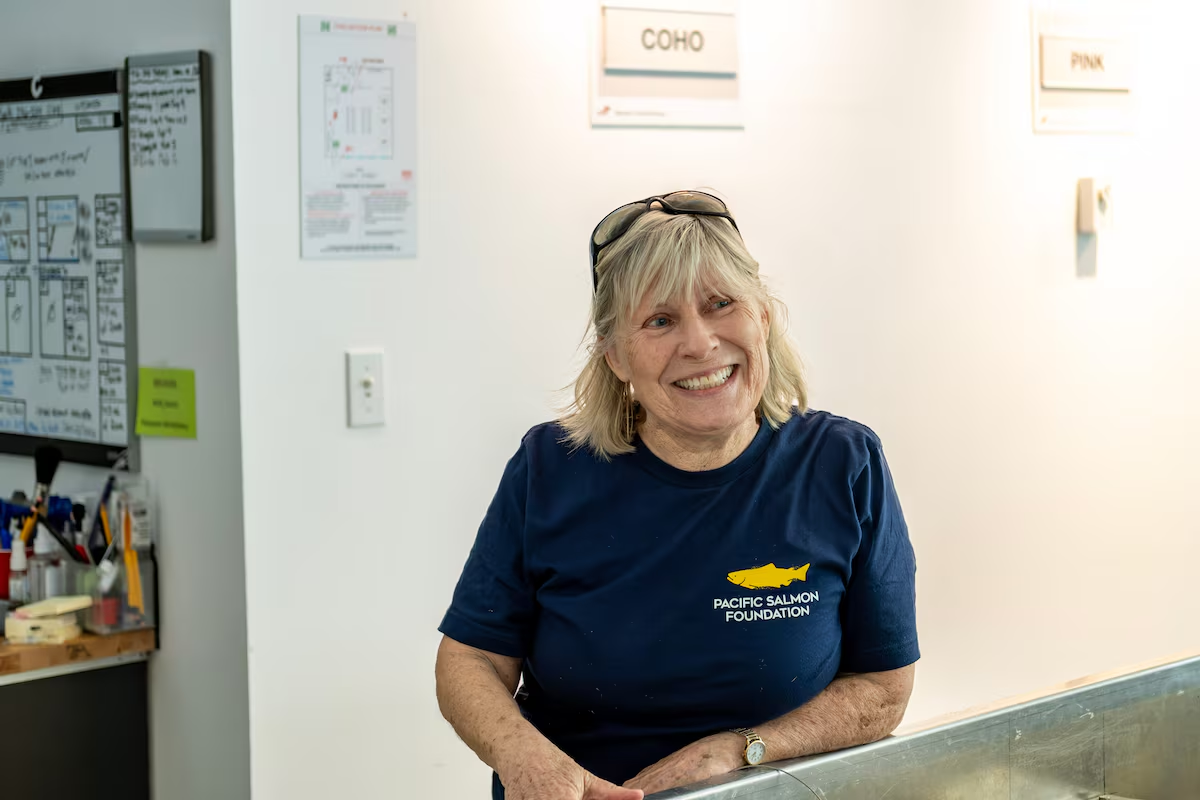

Open this photo in gallery:
Ruth Foster died at Royal Columbian Hospital in New Westminster on Sept. 28, three weeks after receiving a diagnosis of pancreatic cancer.Conal McNamara/Supplied
Ruth Foster’s favourite classroom had no desks, no chalkboard, no walls.
The educator gathered students along the banks of Mossom Creek, a crystalline British Columbia waterway about an hour’s drive from downtown Vancouver.
Ms. Foster, who has died at 77, was a high-school teacher who believed young people better remembered their lessons when they got their boots wet. She preferred teaching outdoors “instead of in the dry, dusty Sahara of the classroom,” she once said. You might say she excelled at streaming students.
In 1976, she and fellow biology teacher Rod MacVicar founded a salmon club with eight students at Centennial Secondary School in suburban Coquitlam, B.C.
“She wanted students to shape the place they lived in,” Mr. MacVicar said. “She wanted them to know you can think locally. You can make a difference as long as you get off your duffs and do it.”
Mossom Creek runs for about eight kilometres from a delicate web of brooks and culverts southeast of Buntzen Lake through the village of Anmore and city of Port Moody, including past an old refinery townsite known as Ioco, which took its name from the initials of the Imperial Oil Co. The creek empties into saltwater on the north side of Port Moody Arm, part of Burrard Inlet.
Open this photo in gallery:
Rod MacVicar and Ruth Foster, 1982.Mossom Creek Hatchery/Supplied
It was one of the few streams capable of producing salmon as the Lower Mainland became ever more urbanized. The club’s aim was to bring back a modest run of chum salmon, which had been depleted in the creek for about 15 years.
The students made an incubation box on the east side of the creek just north of Ioco Road to raise 50,000 salmon eggs. A year later, they discovered debris dumped on the banks and into the channel had destroyed the eggs and ruined their project.
The students wrote letters of protest to the environment minister and local MLAs about the dumping of debris, which was believed to have been left by contractors clearing land for an adjacent housing development.
Their protests eventually led Port Moody council to form an environmental advisory committee, believed to be one of the first of its kind in the province.
Students reintroduced an incubation box further upstream the following year. Four years later, the Vancouver Sun noted only about 20 of a batch of 19,000 chum had returned to spawn.
The creation of the province’s first student and volunteer hatchery caught the attention of the producers of the popular CBC television program The Nature of Things. David Suzuki hosted a segment on the hatchery titled, “Salmon on the Line,” in 1983.
In the fall of that year, students counted 80 returning spawners in the creek from a release of 27,000 fry four years earlier.
Open this photo in gallery:
The Keta Club, which took its name from the chum’s Latin name, Oncorhynchus keta.Mossom Creek Hatchery/Supplied
The slight increase in numbers also began attracting other creatures.
“Cutthroat trout eat the eggs which aren’t buried, and some of the fry,” Ms. Foster told the Vancouver Province newspaper in 1983. “Bald eagles, harbour seals and bear [populations] are all up in the area. That’s life.”
By 1991, some 700 chum returned to the stream, far more than would have made it without student assistance.
The Keta Club, which took its name from the chum’s Latin name, Oncorhynchus keta, eventually got a yellow-and-black school bus known as a Fishmobile to transport students to the site.
Every October, the students collected returning mature salmon, artificially spawned them and then mixed milt and eggs before nursing tens of thousands of fertilized eggs at the hatchery.
What began as a school club spawned an addition to the curriculum with a senior-year course called Fisheries Ecology 12.
Many of the students went on to graduate with postsecondary degrees and certificates at a time when companies, municipalities and nongovernmental organizations were looking for conservation and environmental expertise.
Government, corporate and private donations allowed for the building of a two-storey hatchery and education centre at the creek, which was administered by the Burrard Inlet Marine Enhancement Society, a nonprofit group founded by Ms. Foster, Mr. MacVicar and Centennial alumni.
Open this photo in gallery:
Ruth Foster, credit Mossom Creek Hatchery.Mossom Creek Hatchery/Supplied
The hatchery burned down in 2013. There were no injuries, though some 200,000 eggs from three species were lost. The facility was rebuilt and continues to maintain an open house on Sundays.
After retiring from teaching high school, Ms. Foster continued to mentor students at the hatchery while teaching at Simon Fraser University. She won numerous teaching and environmental awards over the years, including a prestigious Canadian Environmental Award gold medal.
Ruth Ellen Eaglesham was born in Guelph, Ont., on Oct. 18, 1948, to the former Doris Mabel Woodfin, a nurse, and Dr. Douglas Cameron Eaglesham, a radiologist. Both parents were born in Saskatchewan. They met and married in Britain while on military service during the war.
Ms. Foster attended John F. Ross Collegiate Vocational Institute in Guelph before earning an honours degree in biology and animal sciences from what is now Western University in London, Ont. In 1975, she completed a teaching degree at the University of British Columbia in Vancouver with a major in science education and a minor in physical education.
Ms. Foster, a resident of the village of Belcarra, which is part of Metro Vancouver, died at Royal Columbian Hospital in New Westminster on Sept. 28, three weeks after receiving a diagnosis of pancreatic cancer. She leaves John Foster, her husband of 55 years. She also leaves a son, Doug Foster, a daughter, Emily Foster, two grandchildren and four sisters.
Open this photo in gallery:
Ruth Foster won numerous teaching and environmental awards over the years.Paul Steeves/Supplied
Ms. Foster was in attendance for the hatchery’s 50th anniversary celebrations held just nine days before her death.
“Together,” she said, standing alongside Mr. MacVicar, “we have continued to follow our former students and cheer for them as they take on meaningful careers and volunteer positions in the community.”
One of the great pleasures of the high-school program was a pledge the students made. Whether working or studying, they promised to return to see the outcome of their work. A coterie returned with purpose every four years, just like the chum.
You can find more obituaries from The Globe and Mail here.
To submit a memory about someone we have recently profiled on the Obituaries page, e-mail us at obit@globeandmail.com.