
Open this photo in gallery:
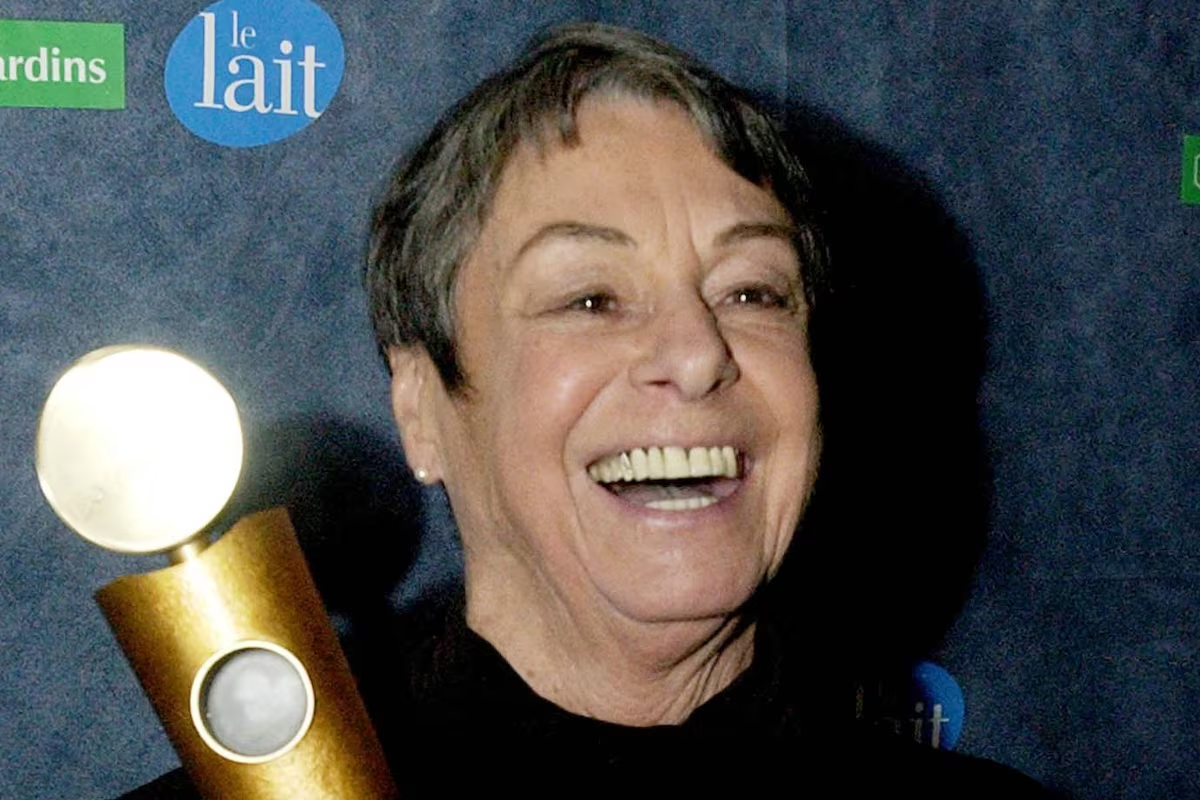
Anne Claire Poirier shows her Jutra Hommage Award for Quebec cinema in February 2002, in Montreal.MARCOS TOWNSEND/The Canadian Press
Anne Claire Poirier, who died in Montreal on Sept. 27 at age 94, was a singular force in Quebec cinema. She set a standard for documentary, fiction and experimental hybrid films working for the National Film Board of Canada (known in French as the Office national du film du Canada, or ONF). The films she made were distinctive and highly influential. Her drama Mourir à tue-tête was selected for the 1979 Cannes Film Festival. As a producer at the NFB, she also oversaw a strand of feminist films that nurtured the careers of emerging female filmmakers.
Marc St-Pierre, collection curator at the NFB, calls Ms. Poirier “one of the pioneers of Quebec cinema.” He said she was a peer of film visionaries Michel Brault, Claude Jutra, Pierre Perrault, Gilles Groulx and Jacques Godbout. “What’s more exceptional, he added, “is that she was a woman – in fact, the only [francophone] woman directing and producing films at the NFB when she first emerged.”
Anne Claire Poirier was born into a Catholic middle-class family on June 6, 1932, in Saint-Hyacinthe in southwestern Quebec, just east of Montreal. Her father, Émile Poirier, ran an upscale clothing store for women. Her mother, Berthe Poirier (née Latraverse), also worked in the store.
Ms. Poirier moved to Montreal where she studied dramatic arts and then law. She began her chosen career at Radio-Canada, but moved to the NFB in 1960, where she first worked in dubbing and received her film education by watching NFB productions in English and French. When she became an editor, she worked almost exclusively with male peers; she later joked that she became “one of the boys.” Convinced she could direct her own films, she prevailed upon her male bosses to give her a chance.
Open this photo in gallery:
The first opportunity was 30 Minutes, Mister Plummer (1963), which put her theatrical training to good use. The documentary is a closely observed look at Christopher Plummer and Kate Reid preparing to go on stage at the Stratford Festival. The film foreshadows Ms. Poirier’s signature interests in its observation of how Ms. Reid balanced her roles as actor and mother of young children.
The following year saw Ms. Poirier branch into experimental short drama with La fin des étés, co-written with filmmaker and novelist Hubert Aquin and featuring the emerging star Geneviève Bujold.
In 1973, Ms. Poirier and other francophone women at the NFB launched En tant que femmes, a groundbreaking series of six French-language films by women about women’s issues. (The following year, the NFB launched its Studio D, which produced films exclusively by women – mostly in English – over a period of 22 years.)
Ms. Poirier’s Les filles du Roy (1974), the fifth of the En tant que femmes films, is a richly visualized examination of the lot of Quebec women. Industrial textile workers, nuns, waitresses, farmers, topless dancers, artisanal weavers and clerical workers are among the subjects depicted. The uniquely stylized film is underscored with motifs of the landscapes of Quebec and echoes of Indigenous and colonial influences. In the 2003 NFB documentary Entretien avec Anne Claire Poirier, by Nicole Giguère, Ms. Poirier put Les filles du Roy into the context of the overall mission of the series she was producing, saying she wanted her film, “to broaden the daily life of women into the history of women of Quebec. It’s not exactly an historical film, but the meaning of the history of women is the primary source material.”
Open this photo in gallery:
From left to right: Kiefer Sutherland, Marcel Masse, Anne Claire Poirier, Colin Low and Donald Sutherland accept an Oscar as an honorary award for the National Film Board of Canada, in March 1989.The Canadian Press
Ms. Giguère, who began creating documentary and fictional films with a video production collective in Quebec City, is among the female filmmakers who were motivated by and found opportunity because of the En tant que femmes series. She was one of the founders of Réalisatrices équitables, a non-profit group that came together in 2007 to champion funding and opportunity for female filmmakers.
Anne Claire Poirier was the organization’s first guest speaker. In working with Ms. Poirier on the film about her career, Ms. Giguère found her subject to be “agreeable, full of humour and frequently laughing” as she described a career path that Ms. Giguère described as “audacious.”
Ms. Poirier made perhaps her boldest, most disturbing and enduring film in 1979 with Mourir à tue-tête (A Scream from Silence) filmed by Mr. Brault. This work of docu-fiction, as Ms. Poirier called it, is often considered her masterpiece. It examines in excruciating detail the rape of a nurse in downtown Montreal. Mr. St-Pierre says its depiction of the rape in the back of a van from the point of view of the victim is, “one of the most powerful scenes in the history of the NFB.”
Julie Vincent auditioned for the role of the rape victim when she was studying at the National Theatre School, in Montreal. She recalled that she was nervous when first meeting the director. “I was even trembling a bit,” she said. “[Ms. Poirier] told me that nervousness could help in the role. She said, ‘What matters is your attitude and the light in your gaze; emotion must stay inside of you, in your belly. And your thought, which comes from what you feel – injustice – that thought is in your eyes.’ ”
Open this photo in gallery:
Mourir à tue-tête was shown at the Cannes Film Festival and was lauded at the Chicago Film Festival. As she told Ms. Giguère, Ms. Poirier found some aspects of making the film to be soul-wrenching. Being on set was not a problem, because the camera and actors helped create a sense of distance from the violent act; the excruciating part for her came before that, when she interviewed rape victims about their experiences.
“It was the research that was dreadful,” Ms. Poirier said. “It was the only time on all the films I made – and on that occasion it was very acute – that I had a sense of regret for opening that door. I was saying this to myself, ‘I never knew of a woman who volunteered to be raped,’ but I had a sense of doing that myself.”
Ms. Vincent, now an established actor, producer, writer and artistic director of the theatre company Singulier Pluriel says that in the 47 years since the film’s release, hardly a week has gone by without someone mentioning the film to her. Ms. Vincent thinks that Ms. Poirier’s legal training was vital to her approach. “That was very important,” Ms. Vincent said. “She paid great attention to facts [in her research] and believed in justice and democracy.”
That capacity for research was put to a horrendous test with Tu as crié LET ME GO (1996). Ms. Poirier’s final feature documentary recounts the circumstances and context of the 1992 murder of her daughter, Yanne Cornu Poirier, who had struggled with heroin addiction. The film is a hauntingly personal testament and a rigorous examination of heroin addiction and its effects on users and their family members.
Open this photo in gallery:
Ms. Poirier’s husband, André Cornu, died in grief within two years of Yanne’s murder. The couple also had a son, Frédéric Cornu, now a realtor, who says his mother’s faith was tested by his sister’s death. Although Ms. Poirier had been raised a Catholic and had long taken an interest in world religions, she became an atheist.
“She couldn’t understand how a loving God could let such a thing happen,” Mr. Cornu said. Tu as crié LET ME GO was her means of trying to come to peace and to help others.
Like Ms. Vincent, Mr. Cornu stressed that Ms. Poirier was full of zest for life even after the losses she suffered. She gave workshops to aspiring actors and filmmakers, read voraciously, saw her friends and grandchildren and enjoyed lunch with her son every Tuesday for more than 30 years.
As Frédéric and Yanne grew up in Outremont, their parents often had parties. The children would ask their parents to leave their doors open so they could sit on the stairs to see the dancing. “Maman used to say that a party wasn’t over until there was dew on the grass outside. Sometimes she would go check at about 4:30 in the morning!”
She was also willing to discuss the challenging subject matter of her films. Frédéric was a teenager when he attended the premiere of Mourir à tue-tête in Montreal.
“It was gobsmacking. We had some long discussions about it. She brought important things to light. She was our heroine.”
Open this photo in gallery:
Singer Diane Dufresne, left, Anne Claire Poirier, centre, and actor Christopher Plummer smile for the cameras during a news conference in Montreal in September 2001, where they were named as recipients of the Governor-General’s Performing Arts Award for lifetime achievement.RYAN REMIORZ/The Canadian Press
Music and literature were Anne Claire Poirier’s constant companions. She loved jazz, particularly by Miles Davis, and shared an admiration of chansonniers with her French-born husband. Of Montreal artists, she was devoted to the work of Diane Dufresne and Leonard Cohen. Albert Camus was her favourite writer; Ms. Vincent says his book L’homme révolté (The Rebel) was especially important to her as it helped her navigate her way back to life after Yanne’s death.
Ms. Poirier and Ms. Vincent remained close after Mourir à tue-tête. Ms. Vincent strives to emulate Ms. Poirier’s rigour and collegial, supportive nature. “She would tell me, ‘You’re great!’ She gave confidence to others. Damn, but that’s rare in our business!”
In 1988, Anne Claire Poirier won the Prix Albert-Tessier; in 1997 Tu as crié LET ME GO won a Genie Award for Best Feature-Length Documentary. In 2001, she won a Governor-General’s Performing Arts Award for Lifetime Achievement and in 2003, she was named an officer of the Order of Canada.
She leaves her son, Frédéric Cornu; grandchildren, Gabriel and Frédérique; two great-grandchildren; five stepchildren; and extended family.
You can find more obituaries from The Globe and Mail here.
To submit a memory about someone we have recently profiled on the Obituaries page, e-mail us at obit@globeandmail.com.