
In the New Brunswick town of Nackawic, the pulp mill across the river emitted what might be its last puff of smoke last week. The town’s mill, its lifeblood and the largest employer for half a century, is shutting down due to “prevailing market conditions,” according to the India-based owner, AV Group New Brunswick.
It’s a devastating blow to the mill’s 350 employees, about a third of whom live here in Nackawic, 65 kilometres west of Fredericton, said Mayor Tim Fox.
“It’s not just the labour force,” said Mr. Fox during a recent interview. “It’s the whole community.”
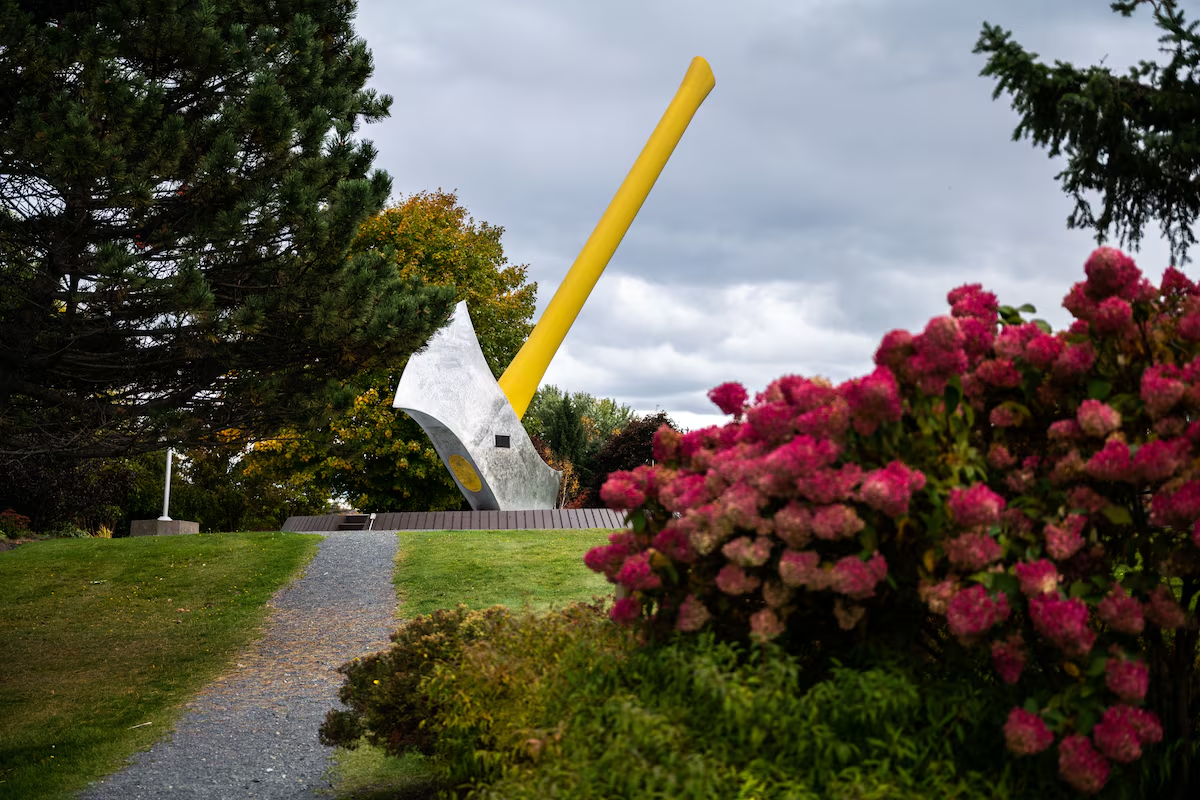
The town was populated with millworkers soon after the mill opened in the 1970s, the same decade when many of the split-levels and bungalows on the hillside above the riverbank were built. A giant axe sculpture, claiming to be the world’s largest, stands in a park in the heart of the town – a symbol of the province’s mighty forestry industry and a sign of strength many are trying to hold onto as confidence about the mill’s future wanes.
As the plant wound down its operations, millworkers were set to clock off with pink slips on Nov. 4 and the town was bracing for what’s next. Uncertainty looms: The owners of the mill describe the closure as a “temporary idling,” but have declined to answer questions about when or if it might reopen, leaving many unsure about its future.
The closure will put economic pressure on the municipality. The mill represents 10 per cent of the town’s tax base and 14 per cent of its utility revenue. In a worst case scenario – if the mill goes down permanently – Mr. Fox said the town has to figure out a way to replace that revenue, such as fast-tracking new housing developments.
But the effects spread much further than just the town. The closure is expected to have serious and far-reaching consequences for the supply chain, including for woodlot owners, truck drivers and suppliers. The Port of Saint John has said the closure will eliminate up to 10 per cent of container traffic and up to 20 per cent of container exports.
At a strip mall in the town, a pop-up booth for employment counseling has taken over an empty shopfront, while the windows of a drug store are painted with the slogan, “Nackawic Strong.” Several “for sale” signs have popped up on the neat lawns of homes throughout the town.
At Nackawic High School, many of the roughly 250 students have family members who work at the mill, some for multiple generations. It’s been a saving grace that the school district footed the bill for all school fees and some athletic fees this year to ease financial burdens on families, said vice-principal Ross Calder.
“It has made a huge impact so kids can continue to thrive and enjoy what makes the school experience what it is for them,” he said.
Like the mill is to Nackawic, forestry is New Brunswick’s economic backbone, valued at $1.5-billion annually with 9,700 direct and another 14,100 spinoff jobs linked to the sector, according to the province.
But the entire industry is facing declining revenues, thanks to falling market prices for wood and ongoing trade uncertainty, a significant challenge for businesses and the communities the sector supports, said Forestry NB executive director Kim Allen.
AV Group New Brunswick is a subsidiary of the multinational conglomerate Aditya Birla Group, headquartered in Mumbai. Established in 1997, AV Group NB also owns a second mill in northern New Brunswick, and says it manages over 1.6 million acres of company-owned and Crown land.
In September, AV announced the “temporary idling” of its pulp operations in Nackawic and said it would continue to monitor the market situation and business conditions, and assess future scenarios for the facility.
“The temporary idling process continues, as previously announced, and will be conducted in accordance with our regulatory and contractual obligations,” spokesperson Mike Legere wrote in an e-mail to The Globe and Mail. The company declined to be interviewed for this story.
The mill has always been the economic anchor of the town, officially known as Nackawic-Millville Rural Community after a recent amalgamation, except for a stint between 2004 and 2005 when the plant’s previous owner went bankrupt. That’s when AV took over, but many of the mill’s workers lost a significant amount of their pensions during the transition, and a lingering distrust remains.
Now, morale, unsurprisingly, is extremely low, said Grant Charlton, president of Unifor Local 219, which represents 228 workers at the mill.
“We’re continuing to advocate for our members, both for services as they deal with the closure, or idling, as the company would call it, as well as with government to try to look for future opportunities at the mill.”
Some workers are already looking into fly-in-fly-out jobs out west, or considering relocating to other industrial communities, he said.
Open this photo in gallery:
Grant Charlton is thinking about a career change, but is unsure where he could find a job with comparable pay to the pulp mill.
Like most of his colleagues, Mr. Charlton is unsure what the future holds. He’s worked at the mill for 12 years as a chemical plant operator, helping to dissolve wood into pulp for man-made fabrics such as viscose for the company’s textile plants in India. It’s a job he started after graduating with a bachelor of science from the University of New Brunswick.
Now, he’s contemplating a career change. But the question is whether he can find employment with comparable pay. “That’s where my uncertainty lays.”
He said he still hasn’t told his four-year-old son, who has always been enthralled with the mill where his dad works and its big machinery. “It’ll be hard news to break, to explain to him that I’m not going to work there anymore,” he said.
Open this photo in gallery:
Oct. 16 was Forestry National Day of Action for Unifor, Canada’s largest private-sector union. It sent national representatives to Nackawic to show solidarity with Mr. Charlton, right, and other workers.
Unifor, the union that represents Nackawic’s workers, recently held a rally in the town, one of dozens across the country for Forestry National Day of Action, to raise awareness about the perfect storm of trade and economic pressures that is pushing Canada’s forestry workplaces to the brink. Many of the mills at risk of closure are the last ones still operating in their regions.
Along the riverfront in Nackawic, dozens held signs and chanted “protect Canadian jobs.” They called for a national strategy for forestry and immediate transition supports for the workers who will soon be out of a job.
New Brunswick Premier Susan Holt addressed the crowd, saying she’s working on finding a solution for the mill. “I’ve been looking at all sorts of options for how we can make sure that we’re best using the site, the wood, the assets and the people that have made Nackawic a strong forestry community and will continue to,” she said.
Open this photo in gallery:
New Brunswick Premier Susan Holt spoke at the Unifor march in Nackawic.
AV has so far refused to comment on how it plans to idle the mill – whether it will be a cold idle where everything is shut down, or a warm idle that would protect the mill’s machinery, raising the chances of potential new ownership, said Mr. Charlton.
Progressive Conservative MLA Richard Ames, who represents Nackawic, said during throne speech debate in the New Brunswick legislature last week that if the plant isn’t heated, there will be a disastrous outcome. “A harsh reality is now setting in for our community,” he said. “We know that the Birla Group will never start this mill back up again. The time for waiting and hope is over.”
Open this photo in gallery:
Towns in hard times: More from The Globe and Mail
The Canada-U.S. trade war that has roiled New Brunswick’s forestry sector is also a hot topic in Sault Ste. Marie, a steel town across the river from Michigan. Ahead of their local elections this fall, Reporter Patrick White spoke with The Decibel about the people he met there. Subscribe for more episodes.