
Open this photo in gallery:
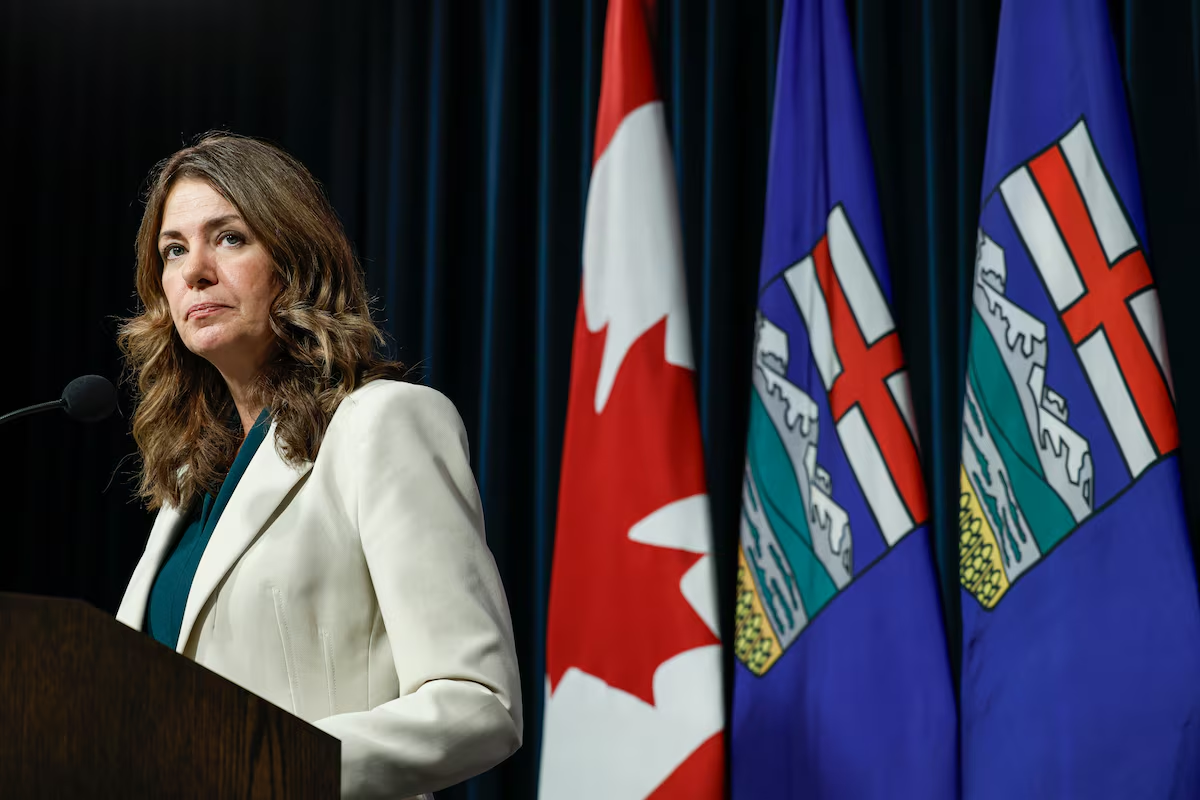
Alberta Premier Danielle Smith speaks to the media in Calgary on Oct. 21.Jeff McIntosh/The Canadian Press
Alberta Premier Danielle Smith is defending a proposal to redraw provincial boundaries in a way that the Opposition NDP says is cheating.
The proposal, made public in a report on Monday, would split the southern city of Lethbridge into four ridings from its current two. It would have one strictly urban riding while the other three would see some neighbourhoods linked to sprawling adjacent rural areas.
Smith told reporters at a conference of rural municipal officials in Edmonton on Tuesday that so-called hybrid ridings like those being proposed in Lethbridge are accepted practice and work elsewhere in the province.
“I think Lethbridge would be very well served by having four representatives,” Smith said.
The premier, who said she was to be briefed on the report later Tuesday, added that she currently represents a hybrid riding in Brooks-Medicine Hat.
“They might not make sense in all circumstances, but they certainly do in some.”
New Alberta electoral map proposes vast changes to urban ridings
The NDP has said many changes suggested in the report – including additional hybrid ridings for the battleground on the west side of Calgary – are designed to give Smith’s United Conservative Party an unfair advantage heading into the 2027 election through a process known as gerrymandering.
Gerrymandering, a feature of politics in the United States, sees electoral districts drawn up to match voting patterns to favour one political party.
NDP Leader Naheed Nenshi has promised to take the new ridings to court if they’re approved by the legislature.
Smith said her government would assemble a legal team if necessary to defend the changes. She said she couldn’t comment on how legal action could complicate next year’s election.
“I hope it doesn’t come to that,” Smith said of a legal challenge.
She added that she hopes the issue can be settled through debate in the legislature.
Kara Westerlund, Rural Municipalities of Alberta president, said rural leaders are concerned about hybrid ridings, noting the association’s members represent 85 per cent of the province’s land mass but 15 per cent of the population.
“Our main concern is just the fact that we feel that the rural voice and our issues are going to be diluted with (hybrid ridings).”
She said it’s difficult to ensure effective representation over large pieces of land that can take hours to drive across.
“If these hybrid ridings become a part of the new electoral boundaries, we will be pushing very hard to make sure that rural voice is not lost in the conversation.”
Westerlund added that members were still digesting the report.
The redrawing process has been a controversial and complicated affair, since the premier rejected the main recommendations of a public boundaries commission early this year. The commission came back with a split report.
Bucking political norms, Smith’s government voted down the commission’s majority position in the legislature and restarted the redrawing process with a new advisory panel. The report and proposals from the panel are now before the legislature.
The panel was given direction based on some recommendations from the previous commission’s chair, including expanding the number of ridings to 91 from 87 to preserve two rural ridings that were to be dissolved.
The panel was also split along party lines – with two appointees from both the UCP and the NDP as well as a UCP-appointed chair – and much of the report sees the two sides criticize one another.
The panel’s majority, in the report, does propose maintaining the two rural ridings that were to be eliminated although with adjusted boundaries. It also sees Calgary gain two seats more than it currently has while one seat is added in Edmonton.
The retention of one rural seat was a relief to Jurgen Preugschas, reeve of Lac Ste. Anne County, who went to the mic at the rural municipalities convention to thank Smith.
The panel’s report recommends expanding the Lac Ste. Anne-Parkland riding. The previous commission’s report put the riding on the chopping block, but the new panel’s report calls for it to be renamed Lac. Ste. Anne and to include Stony Plain, a town just west of Edmonton.
Smith emphasized that urban representation shouldn’t come at the expense of rural Alberta.
“We did not want rural Alberta to be under-represented,” she told the crowd.
Speaking to reporters, Preugschas said he was very concerned about he county being split up into other ridings and lobbied UCP legislature members to change it.
“I’m absolutely pleased with that result, and we support it wholeheartedly,” he said of the latest boundary proposal.
He added that bringing Stony Plain into the riding makes sense, since the town has rural roots.