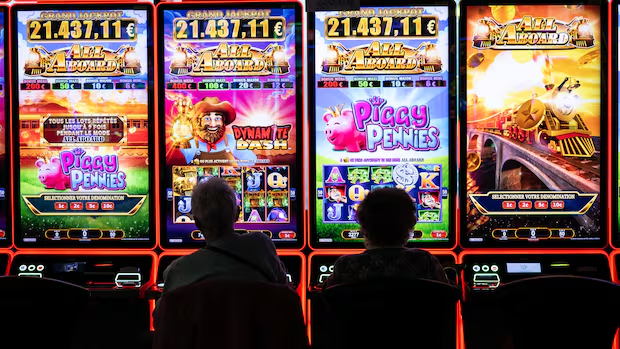
This story is part of a CBC News series examining the public health impacts of online gambling.
Dave, a retiree recovering from gambling addiction, says that when he was winning, he felt like a king, hooked by the prospect of wealth and recognition.
But he says like most gamblers, he “inevitably” started losing.
“Not only money — trust, people we care for, spouses, children, we lose the whole gamut. Everything that we built goes crumbling down,” he told CBC News during a recent online Gamblers Anonymous meeting in Toronto.
“So we often try suicide, which I did try. I turned out to be an utter failure at that.”

CBC reporter Dave Seglins speaks to a Gamblers Anonymous meeting in Toronto. (Ousama Abdel Rahman/CBC)
A CBC News investigation has found that at least 220 problem gamblers in Canada have died by suicide in the last decade, which includes a tripling of gambling-related suicides in Ontario since 2022.
But the national numbers are likely higher, as Alberta, Saskatchewan, Nova Scotia, Yukon and Nunavut don’t track gambling-related deaths, citing a lack of obvious indicators in most death investigations.
What’s more, no coroner in Canada has ever held an inquest into the issue — unlike in Australia and the United Kingdom, where inquests are being used to critically examine the gambling industry and the links between addiction and suicide.
‘Misery and great harm’
A coroner in Australia delivered a scathing inquest report last month, calling for major industry reforms after investigating the suicide of 22-year-old Kyle Hudson.
Hudson opened online betting accounts after his 18th birthday and over four years, placed more than 10,000 bets, losing a cumulative $47,000 Cdn.
The morning he died, he had placed and lost bets worth $6,200.
Coroner Paul Lowrie concluded that Hudson’s preferred platform, SportsBet, ought to have detected his problem gambling.
“Kyle’s case reveals, in the sharpest relief, the human cost of online gambling,” the coroner wrote. “It should be a clear signal that we cannot leave monitoring and intervention solely in the hands of the betting companies.”

Kyle Hudson was ‘a young man brimming with promise,’ according to a coroner’s report in Australia. He was working part-time while in his fourth year at university and loved sport. (ABC.net.au)
Hudson’s betting escalated and triggered 37 alerts on SportBet’s internal “Safer Gambling” monitoring system, the inquest heard.
The company sent him automated support emails and on multiple occasions called him to suspend his account, only to receive a call back from Hudson, who convinced them to reinstate it.
SportsBet also sent Hudson hundreds of bonus offers and inducements to continue playing, which the coroner found to be “contrary” to the company’s safer gambling programs.
“These products are carefully designed to keep gamblers engaged and active, and to extract net losses over time,” Lowrie wrote.
“They are dangerous and capable of causing misery and great harm, especially for the young or those whose traits may make them more vulnerable.”
SportsBet maintained during the inquest that Hudson did not have a gambling problem. That’s despite accounts from Hudson’s family, experts and analysis of the extent of his online gambling activity.
“It is chilling that this is SportsBet’s view,” Lowrie concluded.
LISTEN | The Big Bet:
Understood: The Big Bet2:32Introducing The Big Bet
Once associated with bookies, organized crime, and backroom bets, sports betting is now one of the fastest-growing industries in North America. This is the story of how it went mainstream — and who’s paying the price. Four episodes, releasing weekly starting Monday, October 5, 2026.
Inquests examine gambling companies’ player data
Charles Ritchie of Sheffield, England, who started the charity Gambling With Lives, says inquests are an important tool to change laws and cast light on the gambling industry.
He became an advocate after his 24-year-old son Jack took his own life in November 2017.
“We realized straight away that it was gambling that had killed him. It was there in his suicide note,” Ritchie told CBC News, detailing how Jack had started gambling as a teen and got hooked online after a fluke win of 1,000 pounds ($1,870 Cdn) on an electronic gaming terminal.

Jack Ritchie’s online gambling addiction led to his death, a U.K. coroner found. (Leigh Day law firm)
Ritchie says an inquest into Jack’s death in 2022 validated that it was caused by gambling.
Beyond that, he says inquests have become a valuable tool for grieving families to hold companies accountable if they have failed to intervene in cases of addiction.
WATCH | Gambling apps can spot warning signs, says watchdog:
Gambling apps can spot warning signs, says watchdog
Father who lost son to gambling suicide says betting companies must use player data to intervene and protect addicts.
After someone’s death, he says inquests can analyze the deceased’s behaviour using player data and banking records.
“When we look at those figures in the raw… Somebody is, at four o’clock in the morning, having hundreds of bets, is losing hundreds of pounds. You as a human being would say, ‘This is wrong. We need to intervene,’” he said.
“Gambling companies don’t do that. And that has been found in so many of the inquests.”

The U.K. has held inquests into the gambling deaths of, clockwise from top left, Arthur Soames, Jack Ritchie, Oliver Long, Gareth Evans, Luke Ashton, Ellen Mulvey and Lee Adams. (Leigh Day law firm)
No inquests in Canada
The U.K. has held seven gambling-related inquests since Jack Ritchie’s death inquiry in 2022, resulting in numerous recommendations to the government and the gambling industry.
Coroners and medical examiners in Canada have never undertaken a similar investigation.
CBC contacted chief coroners and medical examiners across Canada, who acknowledge not every jurisdiction tracks gambling suicides.
Nor do most coroners consider whether problem gambling was a contributing factor during suicide investigations. It can be hard to detect without an explicit suicide note.
People with gambling addictions tend to hide their problem from family and friends. Coroners don’t routinely probe a suicide victim’s financial records or online history to determine whether they had a gambling problem.
Journalist Rob Csernyik, author of A Losing Hand: The Human Cost of Canada’s Gambling Epidemic, says chief coroners pledged in 2003 to begin tracking the problem nationally. It has never happened.
“It’s just something that hasn’t been on the radar in many years in Canada, despite the expansion of gambling,” Csernyik told CBC News.

Canada lacks data on gambling suicides, despite the expansion of online betting, says author and journalist Rob Csernyik. (Roger Cosman/CBC)
“I think that now with the larger push into legal gambling markets, that it’s something we finally need to address.”
Dr. Shawn Kelly says the tripling of gambling-related suicides in Ontario since 2022, the year the province legalized private online betting, worries him that we’ll see an epidemic of addiction.
“This is the thing I’ve been fearful for,” said Kelly, an adolescent addiction specialist in Ottawa.
He’s calling for much closer monitoring of problem gambling as well as restrictions on gambling advertising to curb gambling’s harms before they get worse.
“To me, it would be much too late to act when we had irrefutable evidence that our changes in gambling legislation have led to an increase in suicide amongst the vulnerable.”

Dr. Shawn Kelly says the tripling of gambling-related suicides in Ontario since 2022 is a warning sign for public health officials. (Ousama Farag/CBC)
CBC asked Ontario’s Ministry of Health to comment on the rise in gambling addiction and related suicides in the province.
The minister’s press secretary deferred to Ontario’s Ministry of Tourism, Culture and Gaming, which oversees the province’s $3-billion-a-year online gambling market.
The Gaming Ministry did not address the rise in suicide rates but said in an email that since 2018, “our government has invested $421 million, including $70.1 million over the last year, in responsible gambling education, research and addiction treatment.”
In the meantime, members at Gamblers Anonymous, a peer-to-peer support group with chapters around the world, are hoping more people who are struggling reach out for help.
Dan, who like Dave considered suicide, describes the group as a “big extended family.”
“If I didn’t find GA (Gamblers Anonymous), there’s a very solid chance that either I’d be living on the streets, lost my home, marriage or even dead,” he told CBC News. “That came across my mind many times.”
WATCH | Gamblers Anonymous ‘saved my life,’ says recovering gambler:
Gamblers Anonymous ‘saved my life,’ says recovering gambler
Dan from London, Ont., says he might have lost everything or wound up dead if not for regular meetings of Gamblers Anonymous.
Are you, or someone you know, suffering from gambling? Support is available.
- ConnexOntario 1-866-531-2600 or Text CONNEX to 247247
- Gamblers Anonymous 1-855-222-5542 or visit Canada or Toronto/GTA