
Open this photo in gallery:
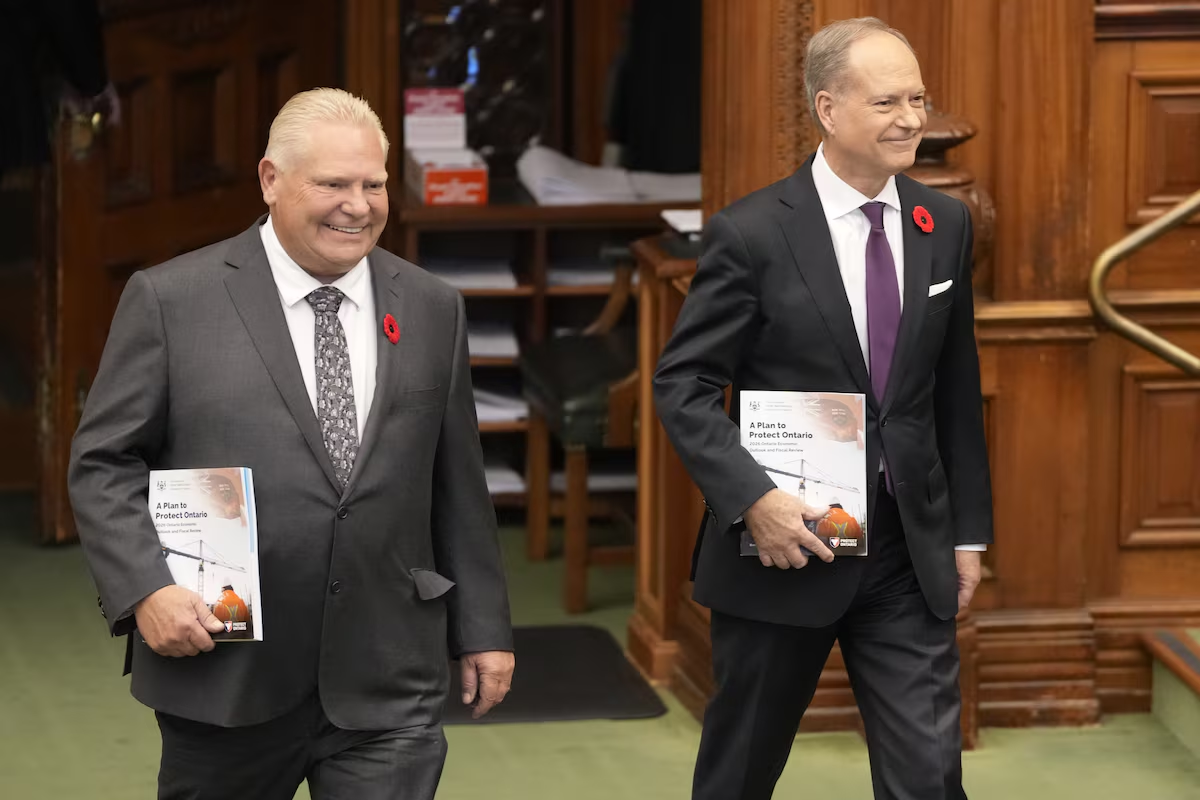
Ontario Premier Doug Ford, left, and Finance Minister Peter Bethlenfalvy arrive ahead of tabling the government’s fall economic statement in the legislature on Thursday.Frank Gunn/The Canadian Press
You are a voter who thinks that governments should live within their means. You see them spending far more than they take in, year after year. You worry about the burden that their rising debts are placing on our children and grandchildren. Who do you vote for? The answer is no longer clear.
Once, conservative parties were usually the best option. Most of them professed to believe in limited government. They said that, if elected, they would restrain their spending and balance the books.
Not all of them actually practised what they preached. Not all left-leaning governments were drunken sailors, either. Generally speaking, though, right-leaning parties were the best bet. Voters can’t count on that any more. Just consider the events of the past week in Ontario.
The centre-right candidate in Toronto’s election for mayor on Monday was City Councillor Brad Bradford. He berated the incumbent, Olivia Chow, for hitting residents with big increases in property taxes. But his own program was fiscal nonsense.
He promised to hire 1,000 police officers in his first term and to start work on an expensive new transit line while at the same time freezing property taxes in his first year and eliminating a tax on less-expensive homes. Cutting taxes while hiking spending is, of course, a recipe for deepening debt.
Toronto has prudent limits on how much it can borrow. Not to worry, said Mr. Bradford. He would simply blow up the city’s budgeting system so the city could borrow more. Fortunately for the city’s finances, he lost.
Three days later, Finance Minister Peter Bethlenfalvy rose in the legislature to reveal that Ontario’s Progressive Conservative government was forecasting a record budget deficit of $16.9-billion. That would put the province further in the red than it was at the height of the pandemic.
Ontario projects bigger deficit, cites U.S. tariffs and higher oil prices
Mr. Bethlenfalvy blamed economic conditions and U.S. tariffs, which have forced the government to spend close to $30-billion on relief for industries and workers. But the source of the red tide goes way further than the recent trade assault from our once-friendly neighbour.
The real culprit here isn’t President Donald Trump. It is Premier Doug Ford.
In his days at Toronto City Hall with his brother Rob, Mr. Ford styled himself as a tight-fisted manager of the people’s money who would “stop the gravy train.” Since he became Premier in 2018, we have seen a whole different Doug.
He has spent big on everything from hospitals to highways to public transit. Some of his pet projects are way over budget. A splashy revamp of Ontario Place on the Toronto waterfront is projected to cost at least five times the original estimate. The bill for the Ontario Line subway has more than tripled to $34-billion.
Undeterred, Mr. Ford is thinking about building a tunnel under Toronto’s 401 highway to carry more car and public-transit traffic. Experts warn the cost would be in the tens of billions.
While he doles out dollars hand over fist, he has been giving breaks on electricity and gas prices to those hard-working taxpayers that he claims to champion. The inevitable result is budget deficits as far as the eye can see. Mr. Bethlenfalvy’s economic statement this week pushed back the date when the government says it will balance the books for the fourth time since 2024.
The inevitable result of that is more borrowing. Ontario’s debt is set to top half a trillion dollars next year. By 2028, Mr. Ford will have added $200-billion to the debt mountain since taking office. That is quite an accomplishment for a guy who condemned the reckless spending of his Liberal predecessor.
Even the right-leaning Fraser Institute says the Ford government has “failed to back up its past rhetoric about the importance of balancing the budget, and instead continues to demonstrate that its word means very little.”
Bozikovic: What kind of Toronto does Chow want to build?
Sadly, the change is not confined to Ontario. In the United States, fiscal conservatism went out of vogue under Republican President George W. Bush. Today, with another spendthrift right-winger in the Oval Office, the annual deficit is close to $2-trillion and the debt recently topped the $40-trillion. This is what happens when you cut taxes while ramping up spending and pretending it adds up – the new math of right-wing populism.
Parties of the right still insist they and they alone can be trusted with the people’s money. Yet most no longer have the stomach for the painful, often unpopular spending cuts that it would take to stop the debt spiral, much less the equally unpopular tax hikes.
In British Columbia, the winner of the province’s recent election, Conservative Lorne Doerkson, says he will clean up the fiscal mess left by the outgoing NDP – but he’s also pledging to cut taxes while keeping front-line government services just as they are.
Voters are left with tax-and-spend liberals on the one hand and spend-and-spend conservatives on the other. It is not much of a choice.