
Listen to this article
Estimated 4 minutes
The audio version of this article is generated by AI-based technology. Mispronunciations can occur. We are working with our partners to continually review and improve the results.
WARNING: This story contains graphic images showing a horse with a large open wound.
Two horses were found injured on a ranch north of Raymore on Oct. 24, after what an owner and veterinarian suspect was a cougar attack.
“I kind of went into shock, like first thing in the morning you’re not wanting to deal with something like this, but when the [yearling] had a will to live, I didn’t want to put it down,” said rancher Harvey Linnen.
The Ministry of Community Safety did not respond to CBC’s request for information about the incident until Friday, when it stated in an email that after an inspection, conservation officers concluded it was not likely a cougar or predatory attack.
The email referred to only one injured horse.
The Wildlife Human Attack Response Team reviewed photos taken by a conservation officer and agreed with the conservation officers that the injuries were “more consistent with the animal having contact with an object on the property, such as fencing, barbed wire or old machinery,” the ministry’s email said.
Linnen said he was feeding his horses as usual when he found the two injured horses. He said one had less significant scratch marks, and the other had a broad open wound.
“When I jumped out of the cab and looked down, I’m seeing the throat ripped out of this one, and then it looked like you took a paintbrush to the other one. There was blood from one end of its body to the other on both sides, the face was all blood,” he said.
WARNING: The following image is graphic, showing a horse’s wounds sustained in the suspected cougar attack.

Meryl, the yearling palomino, sustained a large neck wound that veterinarian Krysta Erbach says was very close to the jugular vein. (Submitted by Harvey Linnen)
The two palominos, named Meryl and Haggard, are only in their first year of life, standing about 1.3 metres tall at the shoulder. Just after finding them, Linnen called the veterinarian’s office near Humboldt to help stitch them up.
“It was after hours on Saturday. Harvey called in a little bit of a panic, obviously, with what he found,” said Krysta Erbach, a veterinarian with Paetsch Veterinary Services, who arrived at the ranch in an hour and a half.
“Where it was cut was quite precise, which is what they say happens with cougar attacks,” Erbach said. “It almost looks like I went in there with a scalpel blade and just made this whole cut. Then on the bottom part of it, you could see almost some claw or teeth marks.”
WARNING: The following image is graphic, showing the horse’s wounds sustained in the suspected cougar attack.

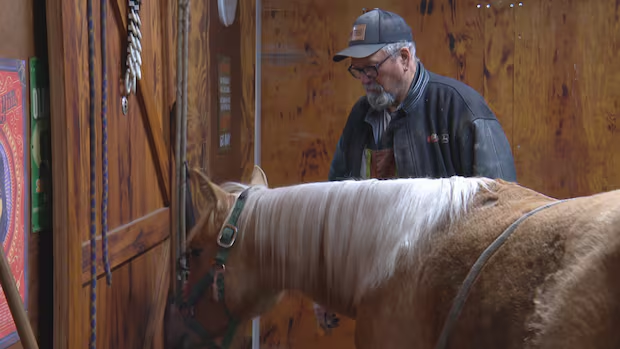
After five days, Harvey Linnen says the healing has not been very significant, but Meryl continues to eat and drink well. (Alex Kozroski/CBC)
Erbach, who used to work for the federal government doing crop insurance and identifying predations, called the wounds “textbook” for a cougar, noting the specific claw marks left behind.
“It was probably millimeters to centimeters away from hitting the jugular vein and the carotid artery, in which case that horse would have bled out within seconds to minutes. So luckily for the horse, it should recover. We did as best we could to clean it up. It’s on antibiotics, pain meds.”
First encounters
Linnen said he suspects wildfires in the north have driven more big game south, with predators following. Last year, one of his colts was torn apart by wolves, he said. After that incident, he bought a dog — a Great Pyrenees named Bernie — and now he plans to get another.
“There’ve been some sleepless nights, because you’re out there wandering around on the dark side to see if this cougar is going to come back,” he said.

Harvey Linnen stands in the pasture where the attack happened, with the other pair of horses that occupied the space. (Germain Wilson/CBC)
In the days since it happened, Linnen has seen an outpouring of support from the community. A local seamstress fashioned a custom dressing for Meryl’s wound when she sleeps, to keep the hay out of it.
A friend with hunting dogs also visited, to see if they could track the suspected cougar, but to no avail.
“It’s been continuous, people coming to help me here with ideas, who have run into these kinds of problems before … We’re all pulling for this yearling to pull through,” Linnen said.
For now, Linnen said Meryl is eating and drinking well, and he will continue to help her with hopes she can have a full life.