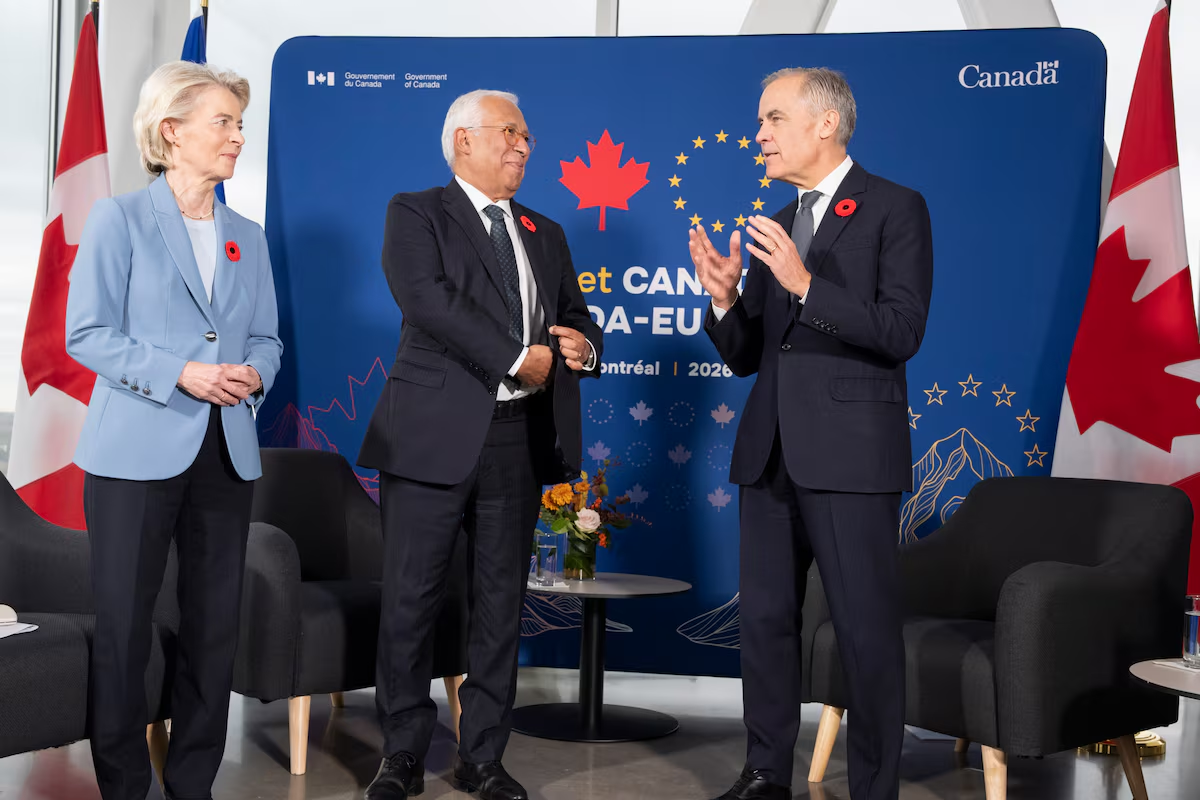

Open this photo in gallery:
Prime Minister Mark Carney, right, meets with European Commission President Ursula von der Leyen, left and European Council President Antonio Costa during the EU-Canada summit in Montreal on Friday.Christinne Muschi/The Canadian Press
In the game of pivots, Mark Carney is a champion.
When he was governor of the Bank of England, he described climate change as a “tragedy of the horizon” and that oil and natural gas reserves could become “stranded assets” if the goal of limiting global warming to 2 degrees Celsius over preindustrial level were to be met.
Today, as Prime Minister, he is gung-ho to turn Canada into an “energy superpower.” Oil pipelines and liquefied natural gas (LNG) terminals are to be built as climate regulations, including the federal consumer carbon tax, are rolled back or eliminated.
Canadian LNG exports to the EU have emerged as an economic tool that would help forge the trans-Atlantic alliance. Canada is rich in energy resources; the EU is not. Canadian LNG was no doubt a key talking point at the two-day Canada-EU summit in Montreal, which finished Friday,
The idea seems to have a certain geo-economic elegance to it. It would spur the development of Canadian LNG, which has been out-classed entirely by the immense LNG projects in the United States, Norway, Australia, Qatar and Russia; and it would protect the EU by diversifying its energy supply. The EU wants to downgrade its outsized reliance on American LNG, which the Brussels mandarins know could vanish if Donald Trump wakes up in a bad mood.
But the idea clashes with the EU’s energy reality.
Canada, EU commit to ‘ever-closer association’ to deepen economic, technology and security ties
The EU’s gas demands are falling fast. If the trend remains intact, its appetite for imported LNG will fall with it. LNG projects – financing and building the pipelines, the gas liquefaction sites, the export terminals, the insulated “Thermos” ships – can take a decade or longer. By then, the EU’s gas consumption could be half or less of what it is now. “What is clear is that the EU is reducing its gas consumption drastically,” says Adrian Hiel, director of the Electrification Alliance, a Brussels lobby group whose members generate and sell electricity. “The long-term trend is clear and by the middle of the next decade, Europe should be out of the LNG game.”
The EU’s gas reversal is an economic, political and environmental necessity. In the first decade of this century, German chancellor Gerhard Schröder and his successor, Angela Merkel, ensured that Germany became beholden to cheap, Russian gas delivered by pipeline.
The strategy worked until 2022, when Russia invaded Ukraine and the Nord Stream pipelines built across the Baltic Sea to deliver Russian gas to Germany were blown up – culprits unknown, though German prosecutors suspect Ukrainian agents triggered the subsea bombs.
Gas prices in Germany and the rest of Europe soared to painful levels. By necessity, the development of renewable electricity sources – mostly solar and wind farms – took on new urgency. One winner was Canada’s Northland Power, which, in partnership with Poland’s Orlen, recently finished Baltic Power, an offshore wind farm that generates enough electricity to keep the lights on in 1.5-million Polish homes.
A second energy shock hit Europe in the early spring, when the United States and Israel attacked Iran. Tehran retaliated by closing the Strait of Hormuz, through which some 20 per cent of the world’s LNG and crude oil passed on their way to world markets. This week, European gas prices went above 100 euros per megawatt-hour for the first time in four years, taking benchmark prices up about 40 per cent this month alone. The gas shortages will keep prices high, all the more reason for the EU to pursue renewable energy.
Canadian dollar extends monthly gain as higher oil prices raise inflation risk
Bruegel, a European think tank in Brussels, estimated that EU gas consumption in 2025 was down 17 per cent over 2020. The trend seems irreversible. Gas is too costly for industrial and consumer comfort and the EU wants to break its reliance on the U.S., which supplies close to 60 per cent of its LNG. And LNG is a fossil fuel that accelerates global warming. The EU has a binding target to cut greenhouse gas emission by 55 per cent by 2030 over 1990 levels. The target may not be reached by then, but the direction will remain intact.
Canada is plotting new LNG projects, including one that would take Alberta gas by pipeline to Hudson Bay, where it would be liquefied and delivered to Europe in ships designed to break ice.
The investment would be astronomical. Manitoba Premier Wab Kinew said in August that the price of the project, including related infrastructure, would be as high as C$80-billion – no doubt an underestimate. He didn’t say how long it would take to build the LNG system, but at least a decade would be a good guess. It took 12 years to build the LNG terminal in Kitimat, B.C.
Will the EU want Canadian LNG in a dozen years? Based on the consumption trend, probably not. The EU may not want to underwrite Mr. Carney’s vision of turning Canada into an energy superpower. LNG is not the kind of energy it craves as it strives to paint itself green.