
On a recent afternoon at the Southern Ontario Dental College, worries about paying the bills were as common as the mouth mirrors and polishing wands the future hygienists used to clean their clients’ teeth.
Katerina Athanasopoulos, a 35-year-old mother of three who commutes two hours each way from Sarnia for her classes at the school in Ancaster, a community in Hamilton, worried about having to pick up extra shifts at her part-time job as a dental assistant, on top of the 40 hours a week she spends in dental hygiene school.
Konika Bhalwal, 31, worried about making rent and having to ask her boyfriend to help pay for her groceries.
Isabella Quenneville, 27, worried about being forced to quit for financial reasons in the middle of the program, having already taken on student debt to pay for her first year of hygienist training.
All three women and their classmates are feeling vulnerable because of the Ontario government’s decision earlier this month to pause Ontario Student Assistance Program loan payments to tens of thousands of students attending private postsecondary institutions, including Southern Ontario Dental College – even though there is no suggestion the students or their school did anything wrong.
“We’re all very scared,” Ms. Quenneville said. “We’ve been trying to keep each other very positive because we’ve heard nothing, and it’s so easy to spiral out of control and feel helpless because we are helpless right now.”
Open this photo in gallery:
Katerina Athanasopoulos, a student at Southern Ontario Dental College, worries that a pause in provincial loan payments will be a blow to her finances.Nick Iwanyshyn/The Globe and Mail
The sudden freeze, which the Progressive Conservatives say they imposed to safeguard the financial aid program after explosive growth in OSAP applications and allegations of wrongdoing in online-only programming at fewer than 10 private career colleges, has put the entire for-profit educational sector in Ontario on shaky financial footing. At least one vocational school with multiple campuses, Trillium College, has already suspended academic programming because it can’t get by without OSAP.
As Ontario politicians returned to the legislature Tuesday for the first time since June, Opposition MPPs called on Premier Doug Ford to fire Nolan Quinn, the Minister of Colleges, Universities, Research Excellence and Security, who they accused of punishing hundreds of blameless private colleges for the alleged sins of a few.
The Liberals and NDP noted that the PC government had been warned as far back as January of 2023 by Career Colleges Ontario – the association that represents schools now imperilled by the pause – of massive spikes in OSAP applications at some career colleges that smacked of “suspicious activity.” Mr. Quinn “looked the other way” and “dragged his feet” on inspecting private colleges he now accuses of defrauding OSAP, said Peggy Sattler, the NDP critic for colleges and universities. “Clearly, he has failed to do his job.”
The Premier defended Mr. Quinn, who told the legislature he had no choice but to halt loans to all career college students while a third-party auditor and the Ontario Provincial Police investigate. “We need to hold the bad actors accountable,” Mr. Quinn said. “If what we have found proves to be what we think it is, then it is nothing short of criminal.”
Open this photo in gallery:
Premier Doug Ford defended the OSAP changes when MPPs returned to Queen’s Park on Tuesday.Arlyn McAdorey/The Canadian Press
Open this photo in gallery:
Nolan Quinn’s higher-education ministry looked into red flags at private colleges, and is working on new legislation to oversee such institutions.Arlyn McAdorey/The Canadian Press
Hundreds of pages of court documents, first reported on by The Canadian Press, shed light on what the Ministry’s OSAP Inspection and Compliance Unit allegedly discovered when it inspected three Greater Toronto Area campuses of a private career college called Academy of Learning in 2025.
The schools were among six notified in May that their OSAP eligibility wouldn’t be renewed for the coming academic year.
Ministry inspectors allege they found red flags with online-only programs at Academy of Learning campuses in Brampton, North York and downtown Toronto, including dozens of students accessing coursework from the same IP addresses, often located outside North America.
They found evidence that students completed entire asynchronous online courses in a day or two and finished exams in less than five minutes. And when inspectors contacted apparent students, some couldn’t “name the institution, program or courses they completed” or “communicate independently in English,” according to inspection reports.
None of the allegations have been proven in court.
Owners of the three Academy of Learning franchises deny wrongdoing. They responded to concerns raised by inspectors with detailed corrective action plans, and say they were working in good faith with a ministry-approved compliance monitor when they learned their OSAP status wouldn’t be renewed.
Open this photo in gallery:
This Academy of Learning franchise in Brampton, Ont., came under investigation for its OSAP eligibility.Arlyn McAdorey/The Globe and Mail
Before loan payments were paused across the sector, there were 242 private postsecondary institutions in Ontario whose students were eligible for OSAP. Although the freeze applies to private universities, chiropractic and naturopathic medicine colleges and even Canada’s National Ballet School, most of the institutions affected are private career colleges.
Private career colleges offer short, skill-specific training programs for jobs such as hairdressers, personal support workers, medical office assistants and early childhood educators. They tend to attract new Canadians, recent high school graduates from working-class backgrounds, and parents looking to upskill.
They also tend to charge higher fees than most public colleges and universities because they aren’t subsidized by taxpayers. Tuition for Southern Ontario Dental College’s 22-month hygienist program, for instance, is $51,997, an amount that covers everything from scrubs to textbooks to dental equipment.
It’s no surprise, then, that low-income students taking expensive courses would rely on financial aid. At Southern Ontario Dental College, more than 90 per cent do. Their OSAP disbursements for this academic year had already been approved. Most were expecting lump sums of a few thousand dollars or more in September to defray living costs while they attend school full-time.
The dental college itself was expecting about $2-million in tuition payments from OSAP, its chief source of revenue. Although classes are carrying on as usual for now, “the hard reality is, we can’t survive if we don’t have the money,” said Alysse Estrabillo, the college’s chief operating officer. She and her husband, dentist Roland Estrabillo, have owned the college for 22 years. They have about 70 staff and 282 students to think of.
“I’m a big mama bear,” Ms. Estrabillo said, “and I just feel sick to my stomach.”
Alysse Estrabillo and her husband, Roland, own the Southern Ontario Dental College, established in 2004. More than 90 per cent of students here rely on financial aid.
Nick Iwanyshyn/The Globe and Mail
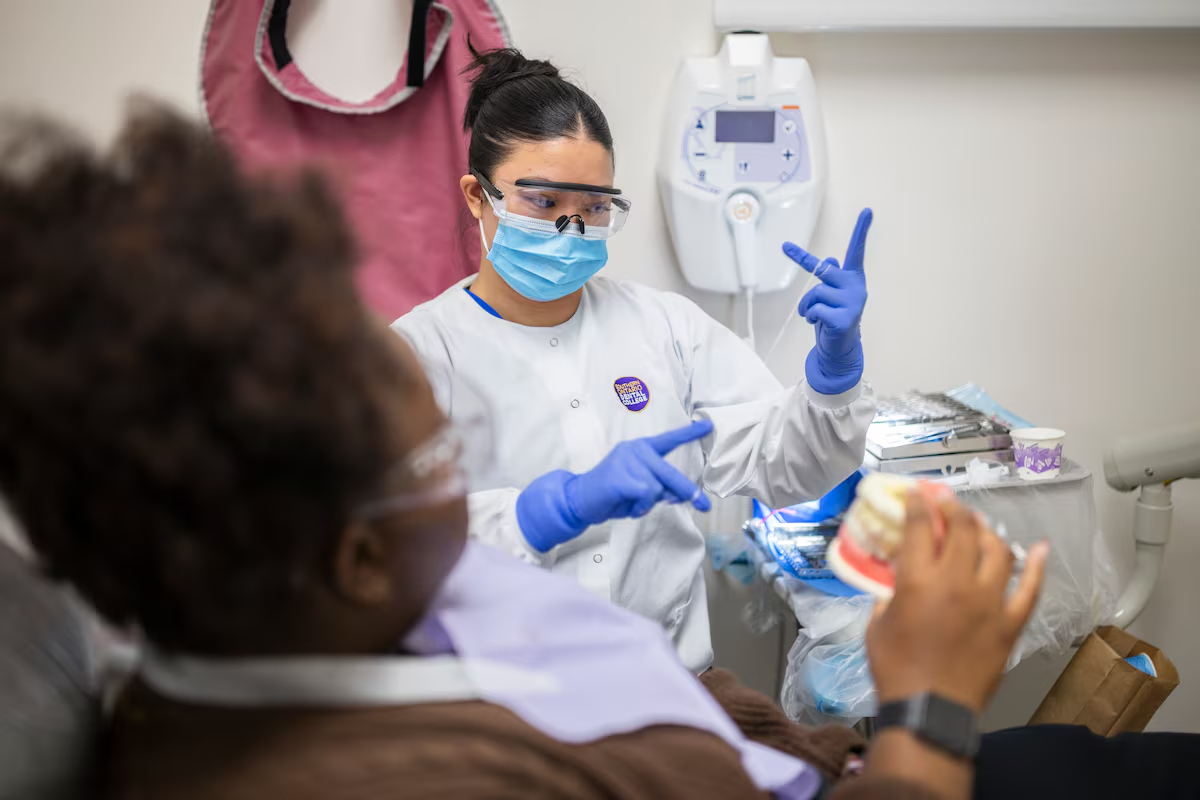
The college is also a working clinic for dental cleanings, X-rays and other services. One second-year student, Crystal Au, gives a patient tips on proper flossing; another, Kiera Donohue, works on an assignment with clinical instructor Sava Pijanovic.
Nick Iwanyshyn/The Globe and Mail
‘Serious concerns’ are flagged
That ill feeling has been spreading through the private postsecondary sector ever since Mr. Quinn announced the OSAP loan pause on Oct. 6.
By that point, the provincial government had already suspended OSAP eligibility for six private colleges in the Greater Toronto Area, including the three Academy of Learning sites. When, in August, the PCs brought in third-party auditor KPMG to examine OSAP use in the private postsecondary sector more broadly, enough “serious concerns” emerged that the government notified the Auditor-General and referred the matter to the Ontario Provincial Police.
Mr. Quinn later confirmed that OSAP payments to private postsecondary students wouldn’t resume until January at the earliest, after the government passes legislation to strengthen oversight, including placing caps on OSAP-funded enrolment and excluding predominantly online-only programs.
Five of the private college campuses accused of wrongdoing are suing the Ontario government for cutting off their OSAP eligibility. Owners of three Academy of Learning campuses in Brampton, North York and downtown Toronto and two Citi College campuses in Mississauga and Toronto say in separate applications for judicial review filed over the summer that the decision should be quashed because it’s unreasonable and procedurally unfair. (The sixth school is another Academy of Learning franchise that hasn’t taken legal action against the government.)
Open this photo in gallery:
The province is being sued by five private colleges cut off from OSAP. The schools deny any wrongdoing.Arlyn McAdorey/The Canadian Press
A huge increase in financial aid applications from students attending a relatively small number of private Ontario career colleges has had ramifications beyond Ontario, and beyond private colleges. The federal government cited the spike when it announced, in last November’s budget, that the Canada Student Grant for Full-time Students would no longer be available to people studying at private, for-profit postsecondary institutions across the country (with exemptions for some health and child-care programs, including dental hygiene.)
Ontario followed suit last February, ending OSAP grants to private college students as of the 2026-2027 academic year. From then on, career college students would have access only to repayable loans.
At the same time – and more controversially – the Ontario government overhauled OSAP for students at publicly funded colleges and universities. Under the new formula, a maximum of 25 per cent of a student’s OSAP would be given as nonrepayable grants, down from the old ceiling of 85 per cent. The rest would be disbursed as loans, saddling the next generation of low-income learners with a heavy debt burden.
Premier Doug Ford, perhaps straying off script, suggested at the time that the change was necessary because he’d heard “nightmare stories” about students “buying fancy watches and cologne” with financial aid. But the official line from Mr. Quinn’s office was that Ontario had to bring its ratio of grants to loans more in line with other provinces because OSAP was hurtling towards financial unsustainability.
Indeed, spending on OSAP grants ballooned to about $3.4-billion in 2024-2025, a 32-per-cent increase from three years earlier, according to data obtained through a freedom-of-information request.
But the entire increase in grant outlays could be laid at the feet of students attending private colleges. Spending on OSAP grants for students attending public institutions actually fell slightly over that period, the data show.
Furthermore, as The Canadian Press reported using data from a separate freedom-of-information request, much of the increase in OSAP grant spending could be attributed to just seven private career colleges in the GTA that saw explosive growth in online-only classes, including the Academy of Learning franchises now suing the province.
“The government justified pulling the rug out from students who were relying on OSAP grants by saying the program was unsustainable,” Ms. Sattler of the NDP said in an interview before the legislature returned. “But they knew all along why it was unsustainable – or they should have known all along why it was unsustainable.”
Caitlyn Elton, Lucy Tran and Preet Powar are among 282 students at Southern Ontario Dental College, which has a staff of about 70. Alysse Estrabillo, the chief operating officer, says she’s worried what the loss of OSAP will mean for them.
Nick Iwanyshyn/The Globe and Mail
Inspections failed, OSAP status not renewed
It was an association of career colleges that alerted the province to the problems in the sector. Career Colleges Ontario first raised the issue in January of 2023, according to a Feb. 26, 2026, letter to the co-ordinator of the Ministry’s OSAP Inspection and Compliance Unit filed as part of the Academy of Learning court case.
Officials from the private college association met with the province’s inspection and compliance unit in January, May and twice in November of 2023. By April of 2024, the association was urging ministry inspectors to call the police on a career college whose name is redacted in the court documents.
“We were advised that the Ministry did make contact with police, and that police indicated they would need to conduct their own investigation in order to proceed,” the letter says.
Career Colleges Ontario knew about the suspicious enrolment spikes because it processes financial aid applications in co-operation with the province for much of the sector.
In a separate letter to ministry inspectors sent Jan. 15, 2025, the association practically begged for help. OSAP applications at eight schools had grown by more than 500 per cent in two years. Another two grew by more than 200 per cent.
One member school whose name is blacked out in an accompanying chart had grown from 107 OSAP-funded students in 2022 to 2,992 in 2024 – an increase of nearly 3,000 per cent.
Two of the Academy of Learning campuses involved in the court case appear in the same chart. One campus grew from 775 OSAP submissions in 2022 to 1,612 in 2023 and then to 5,748 in 2024.
“These anomalies are concerning, and we find ourselves with limited ability to audit and justify these increases,” Kate Bartz, the executive director of Career Colleges Ontario wrote. “We are writing to you as we want to protect the integrity of OSAP. Our goal is to maintain public trust, safeguard taxpayer dollars, and ensure access to quality career education for eligible students … I want to reiterate that our concern is limited to 10 school locations and not the sector as a whole.”
Open this photo in gallery:
The Academy of Learning in Brampton East was based at another location when the Ontario ministry started a routine inspection of it.Arlyn McAdorey/The Globe and Mail
Three months before the private college association sent that letter, in October of 2024, Ministry inspectors started a routine inspection of the Academy of Learning franchises in Brampton and on Bay Street. But they postponed their work until the following summer, according to documents filed in court. “I apologize for the delay, which was due to transitions in roles and the implementation of new inspection procedures,” a ministry official wrote in an e-mail to Academy of Learning on Aug. 12, 2025, four days after the schools received their annual OSAP approval for the coming academic year.
The Bay location received a failing grade on its inspection in September of 2025, while the Brampton and North York locations were notified of their failures in March of 2026.
Open this photo in gallery:
Last year, the federal government also took notice of surges in financial aid at some Ontario career colleges.Patrick Doyle/Reuters
Meanwhile, in Ottawa, officials had also noticed ballooning financial aid use from students at some Ontario career colleges. (Although provinces administer student loan and grant programs, some of the aid they distribute comes from federal coffers.) Mr. Quinn has said publicly that the federal government notified Ontario of its concerns in May of 2025.
Then, on Sept. 18, 2025, Academy of Learning officials received two notices from Economic and Social Development Canada warning that federal student aid could be suspended for students at the Bay and Brampton East campuses. The letters, which are similar, flag high growth in the number of new federal student financial assistance recipients – including an increase of 1,617 per cent over three years at the Brampton East location – and a surge in students from “certain demographic categories who may not be eligible for student financial assistance.”
When the department selected 241 students for an “enhanced validation process,” 42 per cent couldn’t be confirmed as qualifying students, the federal letter to Brampton East says.
In response, Academy of Learning officials wrote a long response “respectfully” submitting “that institutional growth should not be viewed as an inherent risk indicator. Rather, it represents a reflection of program relevance, responsiveness to work force needs, and public confidence in the institution’s delivery of quality education.”
The surge in “certain demographic groups,” the Bay campus response added, seemed to be a reference to students with 900-series social insurance numbers – usually granted to temporary residents, who don’t qualify for OSAP. But Academy of Learning said its students with those SIN numbers were legitimate refugees or other federally protected groups, who are eligible for government financial aid.
Despite all that was happening in the background, on Oct. 31, 2025, Ontario PC MPPs Prabmeet Singh Sarkaria and Amarjot Sandhu attended a celebration at Academy of Learning’s Brampton East location to mark the expansion of their campus on Gore Road. There were balloons and a cake and smiling group photos.
Mr. Sandhu, in a news release marking the occasion, trumpeted the college as a beacon of hope. “I know that Academy of Learning has been playing a vital, very important role in providing career-focused, more flexible, accessible education, to thousands of learners right here in Brampton.”
(The offices of Mr. Sarkaria and Mr. Sandhu referred questions about their attendance at the event to Mr. Quinn’s office, which provided a one-line statement: “The referenced institutions are part of the six that had their OSAP suspended as part of corrective action taken as a result of non-compliance before the sector-wide OSAP pause was implemented to protect the integrity of the postsecondary sector.”)
Open this photo in gallery:Open this photo in gallery:
The Brampton East facility moved last year to accommodate a larger student body.Arlyn McAdorey/The Globe and Mail
In an affidavit sworn in July, Chamara Perera, the chief operating officer of the three Academy of Learning campuses involved in the court case, refuted in detail most of the allegations levelled by provincial inspectors and federal officials.
He emphasized that the campuses were working hard to correct any shortcomings identified in the inspections, including by working with an independent compliance monitor the ministry approved just four days before it sent the May 1 notices telling the three Academy of Learning franchises they wouldn’t be eligible for OSAP in 2026-2027, a ban later extended to 2030.
In response to questions from The Globe and Mail, Puneet Khanna, the founder and director of Opulence Education Group, which owns the three Academy of Learning campuses through other companies, said the schools take all concerns raised by inspectors seriously.
“The Province’s decision has created significant financial and operational challenges, and we have had to make difficult choices, including restructuring the organization and reducing costs,” he wrote. “We are working with affected students one by one to find options that help them complete their programs.”
Harris Rosen, a lawyer for Citi College, said instructor-led classes, with cameras on, are continuing as usual while the Toronto and Mississauga schools pursue judicial review of their OSAP nonrenewal. “The college’s immediate priority remains supporting its existing students through the successful completion of their programs,” he said by e-mail.
Open this photo in gallery:Open this photo in gallery:
Students at Southern Ontario Dental College cannot count on OSAP till next year.Nick Iwanyshyn/The Globe and Mail
Back at Southern Ontario Dental College, students and staff are trapped in limbo, painfully aware that OSAP payments won’t resume until 2027. They hope access will be restored as soon as possible next year at schools like theirs that haven’t been accused of compliance problems.
If the college, which also trains dental assistants and restorative hygienists, isn’t able to carry on, the ripple effects would extend out to the community, Ms. Estrabillo, the college’s COO, said.
Thousands of clients, many of them poor, have their teeth cleaned and cared for by the college’s trainees every year. The school charges $50 a year for adults and $25 for children. And dental offices are always calling, looking for qualified assistants and hygienists, especially now that the federally funded dental plan has expanded access to oral health care.
“But if you’re not going to help us train the people,” Ms. Estrabillo said, “there’s not going to be any Canadian Dental Care Plan to offer to anybody because there won’t be anyone to do the dentistry.”
Open this photo in gallery:
Nick Iwanyshyn/The Globe and Mail
Campus confidential: More from The Globe and Mail
The Decibel podcast
Whether they’re teaching computer science or ancient Latin, Canadian academics have largely been left on their own to decide how to use generative AI, if at all. The Decibel asked five academics from across Canada about their outlook on education and technology. Subscribe for more episodes.
From the Editorial Board
Students are paying the price for Ontario’s neglect of private colleges
The education system’s failing report card
The grey (time) zone of academia