
Open this photo in gallery:
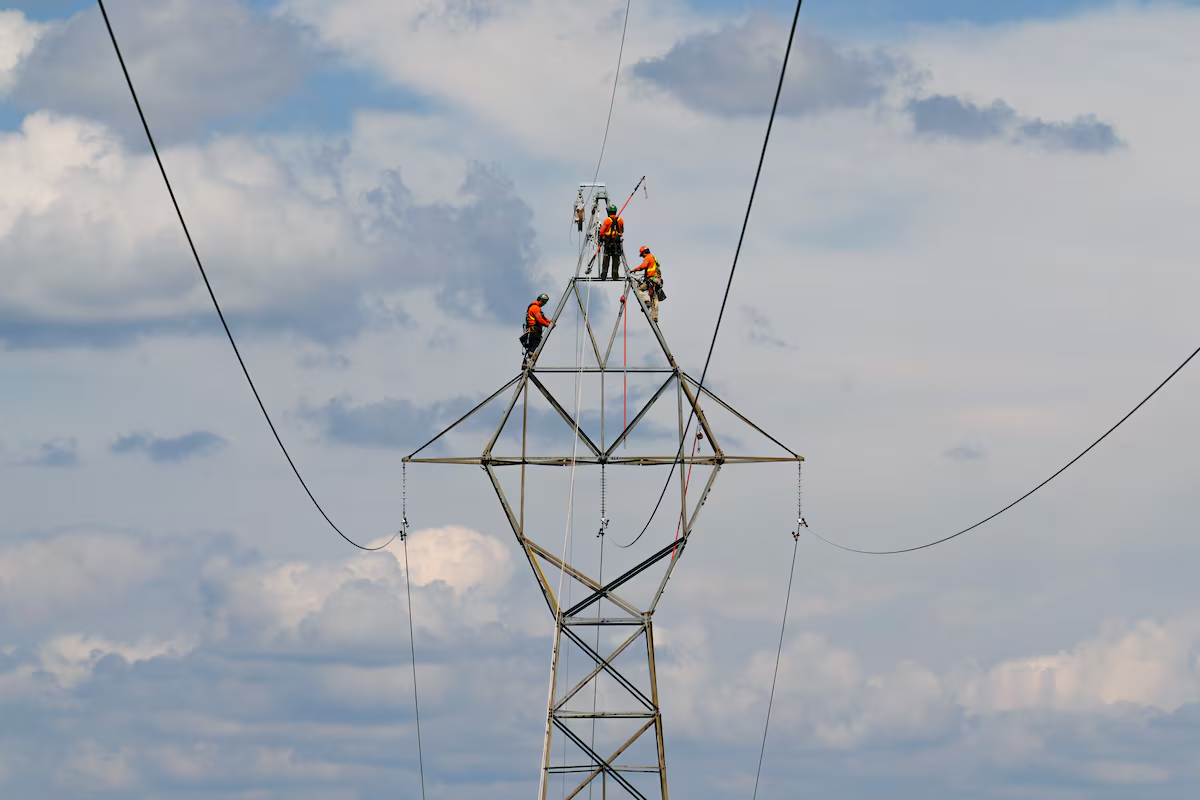
Hydro workers perform maintenance on power lines in Renfrew County, Ont. The provincial government will impose a ‘dividend stress test’ intended to ensure local distribution companies reinvest profits back into their grids.Sean Kilpatrick/The Canadian Press
Ontario’s government announced a slate of reforms on Tuesday intended to help the province’s several dozen electricity distributors prepare for a rapidly rising demand for power.
Stephen Lecce, Minister of Energy and Mines, said the government would introduce legislation on Tuesday afternoon in response to a series of recommendations received earlier this year from a four-member advisory group. The reforms include a new requirement that local distribution companies, or LDCs, produce 10-year plans “that include condition assessment, financing plans and work-force strategies.”
The government will also impose what it described as “a mandatory dividend stress test,” intended to ensure LDCs reinvest profits back into their grids.
“Because right now, across the board, that is not always the case,” Mr. Lecce said during a press conference in Toronto.
“Local utilities are facing aging infrastructure, rising capital requirements, work-force shortages and skyrocketing demands for connections. And so, notwithstanding very good efforts by our utilities, these challenges remain real, and they will imperil our economic growth if we don’t get it right today,” he said.
Ontario’s electricity is distributed by 58 LDCs that are mostly owned by municipalities. Many of them serve small numbers of customers, whereas other provinces are served by a single, monolithic Crown corporation such as Hydro-Québec.
Expectations of increasing demand for electricity have exacerbated long-standing concerns that many LDCs will be unable to maintain existing infrastructure, let alone pay for significant expansions. According to the Electricity Distributors Association, which represents Ontario’s LDCs, the tab for upgrading networks over the next couple of decades could amount to between $103-billion and $120-billion – an estimate the government has endorsed.
In depth: Why a multibillion-dollar electricity infrastructure gap is threatening Ontario’s housing goals
A year ago, the government convened a group called the Panel for Utility Leadership and Service Excellence, or PULSE, chaired by former Toronto Hydro Corp. president and chief executive Anthony Haines, to advise Mr. Lecce on potential reforms. PULSE’s recommendations, submitted in February and published Tuesday, warned that although LDCs have thus far managed to preserve reliability of their distribution systems, many have put off necessary capital investments for years.
PULSE warned LDCs are “increasingly misaligned with the scale, pace and complexity of growth in electricity demand now underway,” and that the pace at which Ontario can meet objectives such as building new housing, electrifying its industries and charging electric vehicles “increasingly turns on distribution system readiness.”
PULSE also found that while municipalities may, in some cases, be able to provide additional funding to LDCs, others must turn to alternative sources of capital such as pension funds and other institutional investors, or will need to merge with other utilities.
“Access to external investment, particularly from Canadian institutional investors, is likely to be a critical determinant of whether electricity distribution utilities can deliver required infrastructure on time and at reasonable cost,” its report concluded.
The government’s response to PULSE’s recommendations include imposing new governance requirements. Mr. Lecce said LDCs will be required to establish “independent, skills-based” boards of directors. Municipalities will be limited to having one member in a non-voting capacity – a departure from a status quo in which politicians occupy as much as half of LDC board seats.
Open this photo in gallery:
PULSE’s recommendations were submitted in February to Minister of Energy and Mines Stephen Lecce, shown in Toronto earlier this year.Fred Lum/The Globe and Mail
Benjamin Dachis, vice-president of research at the energy think tank Clean Prosperity, said there’s strong evidence that independent directors who are not associated with municipal shareholders are more likely to promote investment by LDCs.
Teresa Sarkesian, president of the Electricity Distributors Association, expressed broad support for the reforms. She said her organization understands the government will later introduce further measures focused on removing barriers to greater private investment in LDCs.
“One of the most important things for us is to make sure that we have access to capital to properly fund the grid,” she said.
“There’s two times a year that they can implement those things: One is the fall economic statement, and one is the budget.”
Of particular interest is PULSE’s observation that when private ownership of an LDC exceeds a federally imposed threshold of 10 per cent, it’s deemed to have disposed of its assets at fair market value and faces a large departure tax. This has restricted LDCs’ access to outside investment.
Nova Scotia claims its winds are ‘world class.’ It needs data to back that up
Ms. Sarkesian said that while her organization supports long-term capital planning, inflation, supply chain challenges and the geopolitical environment make it difficult to forecast a decade out; five-year plans “would be more accurate and more meaningful.”
Thomas Timmins, who leads law firm Gowling WLG’s energy practice, said the new governance and financial requirements are aimed at encouraging consolidation among the LDCs, without explicitly forcing them to do so.
The changes announced on Tuesday “put a compliance burden on the smaller utilities,” he said, “which will potentially push municipal shareholders to conclude that maintaining an independent utility is really a luxury that they can’t afford any more.”
He added: “Some of these LDCs are in financial trouble, and that is not okay. We are talking about keeping the lights and heating on – this is critical infrastructure.”