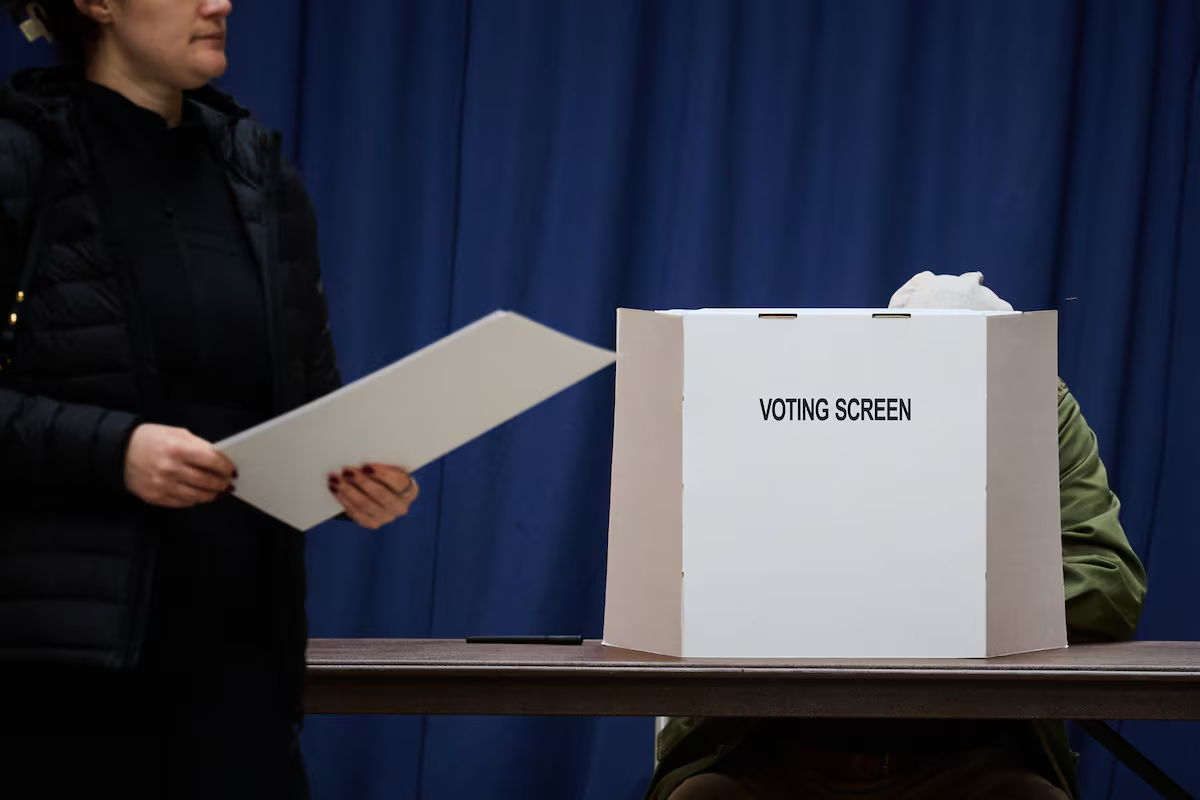

Open this photo in gallery:
People vote in Toronto’s municipal election at a polling station in Toronto, on Monday.Sammy Kogan/The Canadian Press
An hour after most polls closed in the Toronto mayoral election, results had yet to be released, after a hard-fought campaign and several polls in recent weeks that showed only a thin margin separating incumbent Olivia Chow from leading challenger Brad Bradford.
The City of Toronto said the results were delayed because of long lines at some polling stations, and that they would start to be made available at approximately 9 p.m.
Olivia Chow, Brad Bradford battle to the wire in Toronto’s mayoral election
Tense Chow supporters packed into the downtown Great Hall to watch results come in. Cheers erupted as some polls from Mississauga showed up on television screens. But Toronto numbers still hadn’t appeared 45 minutes after polls closed, leaving the mayor’s supporters uneasy.
“I’m feeling nervous, nervous as hell,” said filmmaker Sarah Polley, who canvassed in support of Ms. Chow during the campaign.
Campaign organizers said they were confident the outcome would turn in their favour, citing several polls in recent days showing Ms. Chow in the lead.
Mr. Bradford’s supporters filled a conference room at the Fairmont Royal York hotel in downtown Toronto, including high-profile guests such as Mark Mulroney, son of late former prime minister Brian Mulroney.
White and green balloons framed a “Brad Bradford for Mayor” sign with a podium that read “Thank you Toronto.”
Guests mingled and talked as they awaited results while television screens streamed other races.
With the results still to come in, Mr. Bradford’s campaign was feeling optimistic and motivated, said Laryssa Waler, Mr. Bradford’s communications director. But she added, “We’re not naïve about the battle we have to climb. No incumbent has ever lost in the megacity,” she said.
“We’re aware of how hard it is to bring change, but our voters are lining up at the voting booth. Our voters showed up for advance polls.”
The campaign was a study in political contrasts. Ms. Chow, the 69-year-old incumbent, has been a progressive political fixture in the city since 1985, when she was first elected as a Toronto school board trustee.
Despite a political resume that includes stints as a councillor and MP, she came across as reserved in public appearances, leaning on a reputation for getting things done behind the scenes rather than in front of the cameras.
The 40-year-old Mr. Bradford, by comparison, is a relative newcomer, a truculent political showman first elected to council in 2018.
He ran in the 2023 mayoral by-election, prompted by then-mayor John Tory’s resignation over an affair with a staffer, and finished in eighth place with just 1.28 per cent of the vote. But Mr. Bradford emerged undaunted about his future political prospects.
“That humiliation would have been enough to discourage just about anyone from ever running again,” said journalist and former city councillor John Filion. “But he’s an incredibly driven and determined guy, almost more than anyone I’ve ever met.”
For the next three years, Mr. Bradford effectively remained in campaign mode.
Toronto’s municipal election faces voter turnout test after 2022 record-low
He tacked right on council, taking positions against certain bike lanes, the renaming of Yonge-Dundas Square to Sankofa Square, the creation of bus lanes and cuts to police funding – all policies he’d earlier supported.
He held campaign-style news events across the city well before the campaign period opened.
He declared that city crime had become so bad he slept with a baseball next to his bed.
The preemptive electioneering succeeded on two fronts. His citywide popularity grew in polling and he established himself early as the leading conservative to take on Ms. Chow, deterring other potential right-leaning candidates from entering the race.
In March, Mr. Tory, a former leader of the provincial Progressive Conservative party, announced he would not run, clearing Mr. Bradford’s path to court the anti-Chow vote.
His campaign focused on portraying Toronto as a city of high crime, excessive spending, poor transit and congested streets that had become “stuck” under Ms. Chow’s leadership.
An election debate over public disorder frays nerves in Toronto’s Gay Village
With hate crimes rising, he also allied himself with Toronto’s Jewish community while highlighting Ms. Chow’s absence from a debate on antisemitism.
He pledged to hire 1,000 police officers, commission a line-by-line review of city finances and eliminate the city’s land-transfer tax on home sales under $1.1-million.
Ms. Chow struggled to counter her opponent’s gloomy portrayal of the city, despite a host of indicators in her favour. Under her watch, the number of homicides, shootings and homeless encampments all declined, while traffic congestion and homelessness rates improved.
In office, she patched up an inherited $1.8-billion budget hole with two large property-tax hikes and a “new deal” with Premier Doug Ford, which included $1.2-billion in operating cash over three years and the transfer of the expensive-to-maintain Gardiner Expressway and Don Valley Parkway to the province. The moves were among the reasons the city won a credit-rating upgrade to AA-plus from S&P Global Ratings.
Ms. Chow’s campaign focused on reducing fares for frequent TTC riders and providing free school lunches, while maintaining future property-tax hikes “in and around” the rate of inflation.
In appearance after appearance, Mr. Bradford asserted that the intuition of Torontonians trumped any statistical improvements. If residents feel unsafe and over-taxed, it must be true, he reasoned.
Chris Alexander drops out of Toronto mayoral race
Much of the final days of campaigning centred around a core city function that generally flies under the political radar: water.
A municipal department that reports to city council and bills residents independently of city taxes, Toronto Water maintains a self-sustaining capital program that pays for projects through user fees rather than debt.
Mr. Bradford put forward a plan to spin off the water department as a public utility corporation. Rates would be set by an independent board with Toronto as the sole shareholder. The new structure could shave $300 off the average household water bill by funding capital projects through debt, according to Mr. Bradford.
The Chow campaign seized on the idea, saying it would open the door to privatization, and ran digital ads in the closing days of the race featuring the likes of environmentalist David Suzuki.
The salvo forced Mr. Bradford, for several days in a row, to reiterate that his water scheme would keep the utility in public hands and that current provincial legislation does not allow private ownership.
Over the waning days of the campaign, most polls showed a statistical dead-heat between the front-runners.
In his final pitch to voters on Monday morning, Mr. Bradford declared that a vote a vote for Ms. Chow would be a vote for higher taxes and longer food-bank lines.
Ms. Chow acknowledged the high cost of housing and long waits in traffic, but said Toronto has made important progress under her leadership.