
Listen to this article
Estimated 6 minutes
The audio version of this article is generated by AI-based technology. Mispronunciations can occur. We are working with our partners to continually review and improve the results.
It’s been just over a week since Alberta voted in an historic referendum.
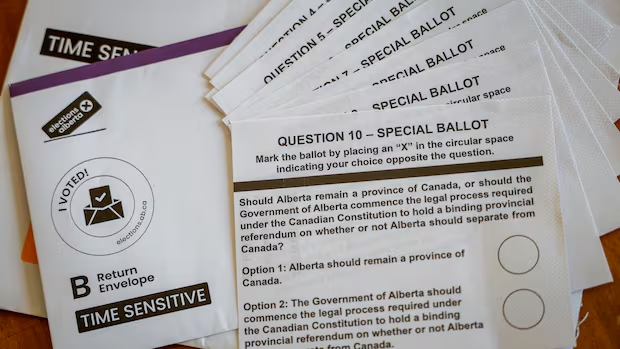
The results saw Albertans support the proposals in questions 1 to 5, which focused on immigration and access to services for non-permanent residents, and reject question 6 to 9, which dealt with constitutional issues. Question 10, the big ticket separation referendum question saw around 75 per cent of Albertans vote to remain in Canada.
But one of the major stories was the count itself. Elections Alberta said more than 20 million ballots were counted in the days following the vote. The agency says that’s more than any electoral event in Canadian history, including federal elections.
Michelle Gurney is a spokesperson with Elections Alberta, and she joined Tara McCarthy Tuesday on Edmonton AM to talk about the count.
This interview has been edited for length and clarity.
How successful was Elections Alberta in handling this referendum and the the vote counting process?
We were able to report that we completed the unofficial count on Sunday. The numbers were actually completed at around 9:14 p.m. on Saturday night.
The good news is, in all of the voting places that followed the correct procedures, we were finished the counts in those locations within 48 hours. The special ballots took a little longer and that was really due to that very high volume. And we finished those, I’d say almost 24 hours after the deadline, around 10:40 p.m Thursday, Oct. 22.
So, feeling good now as we move into this next phase, which is the really important stage of going from the unofficial to the official results.
Now, as you say, the initial 48-hour deadline to report unofficial results wasn’t met. You mentioned procedural errors and that happened at some polling stations. What do you mean by that?
Yes, and I’ll try to simplify this as much as I can: The legislation requires that we report the ballots by voting area as opposed to voting place. So, if you voted in person, you likely recall going into the voting area, the voting station, and you could see a number of different sets of 10 ballot boxes. And so we must report based on each set of ballot boxes and those are assigned by voting area.
We had a few voting places — around seven — that they actually combined their ballot boxes. So, as opposed to using the 10 for each area, they use 10 for their whole voting place. What that meant is when they took those ballots out of those secure boxes, then there was a lot of work to do to sort the ballots by signature of the election officers who were assigned to each of the voting areas. So that caused a significant delay and a big logistical job in making those corrections there, and in two places, it simply wasn’t possible to then separate the ballots because of the high volume.

From left to right, Elections Alberta spokesperson Michelle Gurney, deputy chief electoral officer Dallas Stoesz, and director of elections operations Jennifer Maskoske answer reporters’ questions at Elections Alberta’s west Edmonton warehouse on Sept. 3, 2026. (Janet French/CBC)
How did that even happen? Is it just an issue on the front end? People not understanding the procedure?
It’s hard to know because I haven’t spoken directly with anybody in those areas. I can tell you that, in more than 80 areas, electoral divisions, we didn’t have any issues. We do train the teams to be able to do this work in this way and to very specifically follow the legislation. It’s hard to know why some folks combine those ballot boxes. I think people are just looking for efficiency. But again, I can’t speak for them, but because we have to report by voting area, by voting place, that’s what we consider a procedural error.
LISTEN | Official referendum count numbers are set to come out Thursday:
Edmonton AM9:21Elections Alberta says staff hand-counted more than 20 million ballots in the referendum
More than 20 million referendum ballots have been hand-counted. Elections Alberta says that’s the unofficial number of ballots cast in the referendum. Once official on Thursday that number of ballots would be more any electoral event ever in Canadian history, including federal elections. The count is provincially mandated to be done by hand. Michelle Gurney is the spokesperson for Elections Alberta.
We know that Elections Alberta didn’t reach the number of people it wanted for a workforce for this referendum. How did that impact the vote counting process and even the process beforehand?
We were talking about how big the federal election is and that we counted more ballots in Alberta than you do at the federal election, and they have around 211,000 workers for that event. We were striving for 60,000, which is similar to what they they just had in Quebec. So, 47,000, you know, this is Alberta. We know how efficient we are here … we were aiming to get the work done within the legislative timeline, which is what we’re always trying to do. And you know, I think these procedural errors are really what caused us to miss the deadline in a few areas.
WATCH | An unofficial divide between rural and urban areas in Alberta:
A rural-urban divide for ‘the 9’ in Alberta referendum
Elections Alberta is finalizing the count of referendum ballots, but so far, results suggest rural voters seem to hold different views on immigration and constitutional fights than those in urban areas. CBC’s Nicole Healey has the details.
What auditing steps will the team take now between now and Thursday to verify the results?
There is a lot of rigour to this next stage of the work and that’s outlined in the Elections Act. This is where you have the unofficial results and those have an initial statement of vote. But then what happens is each returning office, they go in, they look at the voting numbers, they look at the number of ballots, and they look at their new elector lists, and then they’re working to reconcile all of that to make sure everything balances … if things don’t align, then they do a recount.
Given the scope of this, Michelle, the time required to hand count all of these ballots, what recommendations might be made to improve the speed of the process in the future?
So at every election event, we do a pretty significant debrief afterward, and that means we’re out talking to all the returning offices and the staff as well as the very small internal team at Elections Alberta … the folks who are having the experiences on the ground bring in really good feedback. And so for us, what we said on Saturday night is … we’ll be putting forward recommendations that there are legislative changes to the hand counts as well as the timelines for reporting.