Warning: This story contains graphic information about a stabbing scene.
A young man from Little Pine First Nation who was not taking his antipsychotic medication when he stabbed two relatives in a drunken rage — killing one of them — is now in prison serving a 12-year manslaughter sentence.
Keenan Starr’s mental health was a complex factor in his criminal case, but ultimately, he took responsibility for killing his uncle Tyrone Kakum and seriously injuring another man on Dec. 8, 2025.
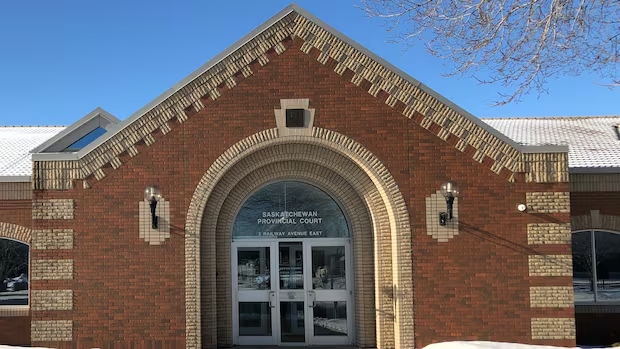
Starr, 25, was initially charged with second-degree murder, but pleaded guilty to manslaughter and aggravated assault earlier this month in North Battleford provincial court. Little Pine First Nation is about 50 kilometres northwest of the Battlefords.
Court heard that when RCMP responded to 911 calls from Little Pine, they found a stabbing victim lying in the front yard of a home, badly injured, with a broken-off knife blade protruding from his back. The 27-year-old man survived.
Starr was standing on the porch, his clothing bloody. Inside the home, police found Kakum, 45, lying on the kitchen floor with multiple stab wounds to his head, shoulder, back and chest. He was declared dead at the scene.
Police determined Starr and Kakum were both living in the home, and they had been drinking since the morning or afternoon that day, along with the other stabbing victim, Crown prosecutor Danielle Elder said in court.
The men had shared at least two 40-ounce bottles of vodka and were smoking marijuana. They argued during the day, but reconciled.

Tyrone Kakum died on Dec. 8, 2025, in his home on Little Pine First Nation after he was fatally stabbed by Keenan Starr. (Eternal Memories Funeral Service)
In the evening, Starr “was no longer welcome in the residence,” Elder said. He didn’t leave, but instead went to the kitchen and selected a large knife, about eight to nine inches long, and attacked Kakum.
The third man took cover, and after Starr left the home, he tried to help Kakum. But then Starr returned and attacked him. He tried to defend himself, and the final blow involved Starr stabbing him in the back as tried to flee. He fell in the snow outside, where police found him.
After Starr was arrested, he vomited several times in the police vehicle, Elder said. His demeanour ranged from calm to scared to angry, and he expressed irrational fears and delusions of grandeur.
The next day, when he was sober, Starr recalled some of what led up to the stabbings, including playing video games with his uncle earlier in the day, but had a “relative absence of memory” around the stabbings, Elder said.
Prior violence with knives a factor, Crown says
Starr has been diagnosed with schizophrenia. Elder noted that having mental health concerns and being grossly intoxicated could, in other cases, be considered as a mitigating factor on sentencing.
But she said the analysis here was nuanced.
Elder spent some time describing Starr’s prior criminal record — which had two prior convictions for violence with knives while intoxicated — and said Starr was “on notice” about the type of behaviour that he is capable of when he is unmedicated and intoxicated.
In 2022, Starr was stranded and when a stranger offered him a ride, Starr got aggressive and swung a knife at the man. For that, he received a nine-month conditional sentence.
In 2023, while serving his conditional sentence, Starr and an uncle (not Kakum) were both intoxicated in the parking lot of the casino in Lloydminster when Starr stabbed his uncle with a utility knife. At that time, he had been recently diagnosed with schizophrenia.
Starr was sentenced to six months in custody followed by 12 months of probation, which Elder said was a “quid pro quo” resolution between the Crown and defence after the victim in that case was no longer being co-operative.
Elder said she did not mean to be dismissive of addictions or mental health issues, but said that Starr’s “moral blameworthiness” after the 2025 stabbings at Little Pine would be lower if it was his first offence connected to those issues.
‘Toxic encounter’ a tragedy, says defence
Starr’s lawyer Logan Marchand said what happened was a tragedy.
“This was the unfortunate result of Mr. Starr’s long-standing struggles with alcohol and his underlying mental health diagnosis, combining in one toxic encounter which irreparably changed the lives of everybody who was in that house, and their families, and extended elsewhere,” Marchand said.
He said there was a long history in Starr’s family of the effects of residential schools and the intergenerational trauma associated with colonialism.
His grandparents were sent to residential schools, and his mother also attended day school. Both of his parents had a “significant addiction” to alcohol and he regularly saw them drink to excess while he was a child, and witnessed violence in the home connected to the drinking.
Starr first started drinking at the age of 12. In 2019, his mother died and Starr descended even deeper into his addiction. Marchand said Starr estimated he’d been taken to the drunk tank more than 200 times in the years after his mother died.
His client is truly remorseful and has wanted to plead guilty from an early point, Marchand said.
12-year sentence recommended
The Crown and defence jointly recommended the 12-year sentence for manslaughter. Elder noted that it is at the high end of the general range for manslaughter in Saskatchewan, of between four and 12 years.
They also recommended a five-year sentence for the aggravated assault on the second victim, to be served at the same time as the 12-year sentence, which the judge accepted.
After credit for his time on remand, Starr has about 10 years, nine months left to serve.