James Howard thinks most people would say they’re willing to pay any price to stay alive — until they’re asked to put a dollar figure on it.
“The question that nobody’s ever prepared to ask themselves is how much is your life worth … and how long does that decision take for you,” he said.
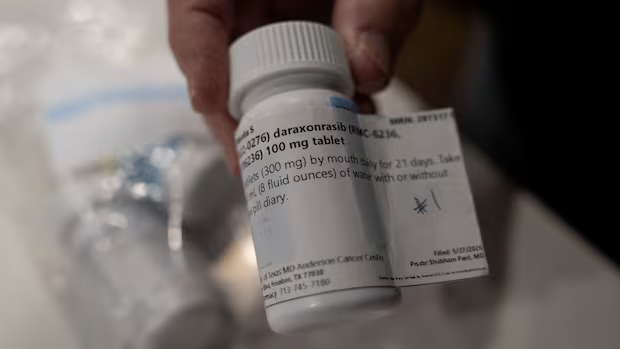
For Howard, the answer is $90,000 a month for a new pancreatic cancer drug he hopes will extend his life.
Doctors in Vancouver diagnosed Howard with pancreatic cancer in November 2025. He underwent chemotherapy, but the cancer has since metastasized and is now Stage 4.
Earlier this year, he learned about daraxonrasib, a treatment approved by the U.S. Food and Drug Administration (FDA) in August but not yet in Canada. At three doses a day, it costs him about $63,000 US — roughly $90,000 Cdn — a month.
Howard is far from the only Canadian confronting the soaring cost of new cancer treatments. Oncologists across the country say increasingly expensive drugs — particularly treatments not yet approved or publicly funded in Canada — are forcing some patients to choose between paying enormous sums themselves and going without potentially life-extending medication.

James Howard, seen in his Vancouver home, takes three doses per day of the new pancreatic cancer drug daraxonrasib, which isn’t approved in Canada and that he has to get from the U.S. at a cost of about $90,000 Cdn. a month. (Glen Kugelstadt/CBC News)
More than two dozen cancer specialists who spoke with CBC News said the trend is putting growing pressure on patients and the public health-care system.
It’s not that pharmaceutical companies don’t deserve to make money from their products, says Dr. Christopher Booth, a medical oncologist in Kingston, Ont.
But he says prices have reached a point where profit can come at the expense of patients.
“Corporate greed is gonna harm patients and health systems,” he said.
An ecosystem that forbids negotiation
Booth, who is also a health-services researcher at Queen’s University in Kingston, Ont., has been treating patients with pancreatic cancer — one of the most lethal forms of the disease — for more than 20 years.
He says U.S. drugs like daraxonrasib are approved and funded in an “ecosystem that essentially forbids” negotiation.
In Canada, Health Canada will give regulatory approval for doctors and hospitals to use a drug and then health authorities will work with the drug companies to determine a price.
But in the U.S., he says, it’s illegal for the government to negotiate with the pharmaceutical companies when they launch most new drugs — a rule that was eased slightly in the 2022 Inflation Reduction Act — allowing the manufacturers to set their own price.
The median net price for new drugs launched in the U.S. was more than $250,000 US last year, according to a new report from the Boston-based Institute for Clinical and Economic Review (ICER), up more than 35 per cent from the $190,000 US median three years earlier.
California-based drug maker Revolution Medicines set its launch price for daraxonrasib at $480,000 US ($675,000 Cdn) annually, or $40,000 for a 30-day supply at wholesale cost.
WATCH | Trump administration’s deals with drug companies could push up prices for Canadians:
Trump’s push to cut pharma costs could drive up drug prices in Canada
New documents reveal the Trump administration is striking deals with pharmaceutical companies to lower drug costs in the U.S. But that could drive up prices in Canada, warn experts.
Profits over patients
Booth recalls how he and many of his colleagues were “thrilled” to see a treatment like daraxonrasib, a pill targeting a specific mutation in pancreatic cancer cells, prove effective in clinical trials.
The research found daraxonrasib halted or reversed tumour progression in nearly a third of patients, compared with about 10 per cent of those given chemotherapy, and increased survival from less than seven months to roughly 13.
“It was a signal of hope that we finally started to see some progress in this very difficult disease,” Booth told CBC News.
But the excitement faded when Revolution Medicines announced the price of the drug, marketed as Rasonque.
LISTEN | Is Canada too reliant on the global supply chain for pharmaceuticals:
Cost of Living9:13Why is Canada so vulnerable to drug shortages?
In a statement emailed to CBC News, Revolution Medicines said how much a patient pays out of pocket depends on factors including treatment duration and insurance coverage.
“Our goal is to establish a price that reflects meaningful therapeutic advancement while supporting patient access and continued scientific innovation,” a spokesperson wrote.
But doctors whose patients may benefit from daraxonrasib question the price.
“Sometimes the prices they quote make absolutely no sense,” said Dr. Ramy Saleh, an associate professor of oncology at McGill University who researches early-stage clinical trials.
“I’m not convinced as an oncologist or a researcher that when a drug is approved that it will cost half a million a year, he said. “I’m pretty sure to produce it is, you know, a fraction of that cost.”

A Revolution Medicines facility in Redwood City, Calif. The company developed daraxonrasib, a new pancreatic cancer drug that has been approved in the U.S. but not yet in Canada. (Revolution Medicines)
Dr. Ralph Wong, a senior medical oncologist at CancerCare Manitoba, accuses the company of profiting off the backs of patients like his.
“I’ve had multiple patients in my practice crying because they can’t access the drug,” he said.
Wong says it’s “particularly galling” that Revolution Medicines set such a high benchmark price based on its clinical-trial results rather than what he considers a price that would support patient access.
He and other doctors say they do everything they can to get patients free access through clinical trials or compassionate-access programs.
But if a drug isn’t approved by Health Canada or covered by public or private insurance, patients can be left to pay for it themselves.
Revolution Medicines has yet to apply for Canadian approval of daraxonrasib.
WATCH | Could this medicine help pancreatic cancer patients double their life expectancy:
Drug doubles survival time for pancreatic cancer patients, trial shows
An experimental drug, Daraxonrasib, is being hailed as a potential game changer after trial results published in the New England Journal of Medicine found it helped pancreatic cancer patients live twice as long as standard chemotherapy patients.
‘Crippling’ cost of longer life
While wealthy patients may be able to manage the price of a drug like daraxonrasib, Booth said it would be financially “crippling” for many.
Data from the Patented Medicine Prices Review Board (PMBRB), the arms-length federal agency that regulates patented drug prices, show Canadians are spending more on medications.
Sales of patented drugs reached $22.1 billion in 2024, up nearly 11 percent in a year, according to the PMPRB’s most recent annual report. Patented medicines accounted for 47 per cent of all spending on medicines. There were 1,137 patented medicines approved for human use in Canada that year.
And that doesn’t include what some patients pay for medications that aren’t available in Canada.
For Howard, paying for daraxonrasib is like making a “down payment for a condo every month” for the hope of prolonging his life.
“It’s not sustainable long term,” he said, especially with all of the hurdles involved in getting the drug, including crossing the border to pick up the prescription at a U.S. postal address.
“[But] if I can gain a quality of life which allows you to spend more time with family, that’s a significant bonus for me.”
WATCH | Cancer patients on the hook for tens of thousands of dollars in out-of-pocket expenses:
Cancer costs Canadian patients $33K on average
A new report from the Canadian Cancer Society suggests cancer patients are paying tens of thousands of dollars out-of-pocket for expenses including transportation, prescription drugs and medical devices. And those costs make fighting the disease much more difficult.