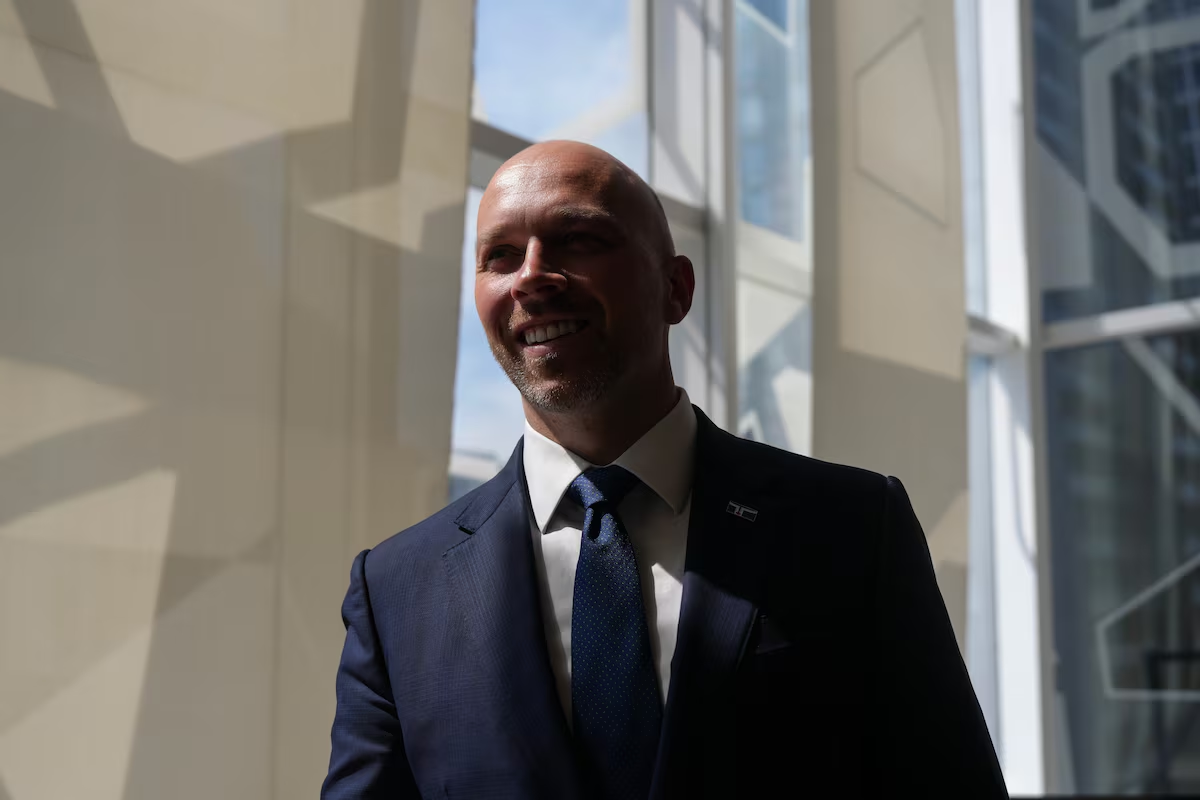

Open this photo in gallery:
Bradford‘s campaign of darkness reflects poorly on the city and on him, writes Bozikovic.Chris Young/The Canadian Press
Brad Bradford is scared of Toronto, and he thinks you should be too.
That is the unmistakable theme of the campaign from the outgoing city councillor as he challenges Mayor Olivia Chow. His campaign rhetoric has painted a consistent picture of a dirty and dangerous Toronto filled with disorder. And the implied lesson is clear. In these dark times, only one man – accompanied by the 1,000 police officers he’s pledged to hire – can save us. That is a standard challenger’s narrative.
But in Toronto of 2026, it has a problem: it is not true. During the three years of Ms. Chow’s mayoralty, the City of Toronto has become a significantly safer place, and is one Canada’s safest cities. Murders, shootings and violent crime are all down substantially. Last year’s homicide total was the lowest in 50 years. Car thefts, which spiked after the height of the pandemic, are down dramatically in the past three years.
An objective observer can only come to one conclusion: The bike-riding NDPer has been a law-and-order mayor. She has also given the police department everything on its wish list. In a strange turn of events, she even earned the enthusiastic endorsement of the Toronto Police Association, the labour organization which represents more than 8,700 police and civilian members of the police service.
How then has public safety become such a central focus of the municipal conversation?
An election debate over public disorder frays nerves in Toronto’s Gay Village
When we talk about public safety today, what we are mostly talking about is “public disorder.” That euphemism refers to the presence of unhoused people. When an executive driving downtown sees a tent from their car, that is disorder. When she sees someone nodding off on the subway, that too, is public disorder. When a provocateur on Instagram yells with disgust about the people he is stepping over on the sidewalk – disorder.
Those visible problems are driven, in large part, by the opioid crisis and by a generation of cutbacks to mental health services. These larger issues predate Ms. Chow’s mayoralty and are mainly out of the city’s control. That said, dealing with homelessness is the city’s task and the situation has improved significantly on her watch.
Unfortunately, our culture is inclined to view a big city as an inherently dangerous and disorderly place. This assumption has been baked into our politics by generations of rhetoric and too much of American TV.
The presence of unhoused people does not mean danger. But many of us feel that it does. That fear is a problem of its own. It points to apparent solutions that are forceful and costly. Take Mr. Bradford‘s key promise to hire 1,000 police officers. How exactly would that make Torontonians feel safer? Will there be a police officer on every streetcar, in every park, all the time? How will those officers deal with people they encounter who need treatment?
Who will be Toronto’s next mayor? What to know before the Oct. 26 election
None of this works as policy. It only works as a narrative, and only if you imagine a shadowy Gotham full of leering villains. But stories have power, and Ms. Chow has not risen to this rhetorical challenge. She has declined to define a clear alternative vision, one of attractive public places and streets filled with happy people. She has not told the story – the true story – of a city that remains livable, lively and safe.
That positive vision is badly needed, and it is achievable. A Toronto of better parks with richer amenities (including cafés where citizens gather and chat) is another way to attack this problem. People feel safe around other people.
For now, Mr. Bradford‘s campaign of darkness reflects poorly on the city and on him. The fact is that Toronto is a vibrant place. The streets are filled with a rich mix of humanity, of people who want to be here and who are ready to look out for their neighbours. Mr. Bradford’s bad vibes might just land him a win in Monday’s municipal election. In that case, we will find out if he is fit to run the city or just to run against it.