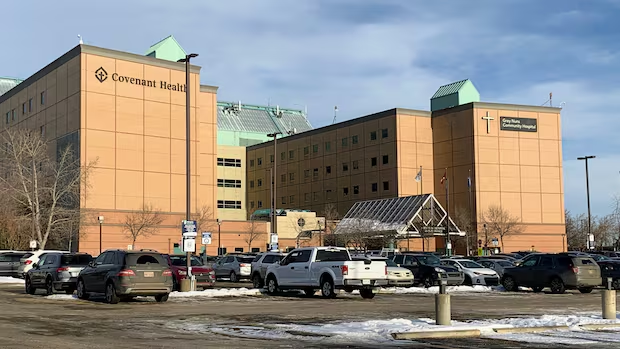
Noisy, unruly and crowded is how a triage nurse described conditions in an Edmonton emergency room (ER) the day a man died after waiting about eight hours to be seen by a doctor.
Prashant Sreekumar, 44, died at Grey Nuns Community Hospital on Dec. 22, 2025, after collapsing in the ER while experiencing chest pain.
His death is being examined by Justice Randal Brandt at a fatality inquiry at the Edmonton Court of Justice.
Registered nurse Celina Lee was working as a triage support nurse at the hospital that evening, primarily responsible for triaging patients arriving by ambulance.
At the fatality inquiry on Tuesday, she described a scene of chaos, with a number of emergency codes called that day and noted that a co-worker told her it was their worst shift in their 18 years. Lee also said she had to call protective services after a patient was verbally aggressive with her fellow nurse.
She said the ER was so loud that a patient had to tell her they couldn’t hear her when she was talking to them.
Lee reassessed Sreekumar — who was seeking medical attention for chest pain — while he waited. She testified Wednesday that the interaction was brief and challenging and ended before she could complete a more thorough assessment.
Lee recalled Sreekumar and his wife approaching the desk to ask about wait times.
She said she checked his medical chart, including his initial triage assessment and lab work, and noted that he had already received Tylenol and Advil for pain.
Sreekumar’s blood pressure was high, prompting Lee to repeat the assessment. She said Sreekumar and his wife then turned and walked away while she was documenting the results.
Lee testified that she did not get an opportunity to complete the reassessment or document it as she normally would. She said she also did not get a chance to discuss her concerns with the charge nurse before attending to the next patient.
During her testimony, Lee recommended that to have fewer interruptions at triage, a change could be implemented that would see staff ask visitors to enter at another part of the hospital. She also suggested implementing a one-visitor policy.
Registered nurse Rachel Vos told court she heard Sreekumar collapse and started an emergency code, requesting help from hospital staff.
She said she had limited interaction with Sreekumar but had taken him to a recliner in a hallway, which is considered a care space.
Vos said having additional nursing staff assigned to the chairs in the hallway would be helpful, but added that, ultimately, she believes the health-care system is overwhelmed.
Vos also raised concerns at the inquiry about a lack of care space at hospitals. She said staff know people need to see a physician but “there is no space.”
Emergency physician Dr. Miles Shang testified that he was not involved in Sreekumar’s care before responding to an emergency announcement at about 8:36 p.m.
He said he found Sreekumar unconscious on the ground, with nurses beginning cardiopulmonary resuscitation (CPR). Staff moved him to a resuscitation bay, where a team of medical professionals continued efforts to revive him.
Shang said the resuscitation was handled smoothly and professionally. Despite those efforts, Sreekumar died at about 9:11 p.m.
Shang testified that he later learned the cause of death was a blood accumulation around the heart, known as hemopericardium, caused by an aortic dissection.
He said the condition can be extremely difficult to diagnose because its symptoms vary widely. While some patients experience the classic tearing chest pain that radiates to the back, others present with less specific symptoms.
Shang said he had not been told about how long Sreekumar had been waiting, his triage score, vital signs or test results before responding to the code.
He called an eight-hour wait for a patient with chest pain “unacceptable” and said the main obstacle to seeing Sreekumar sooner was a lack of available care spaces.
The ER’s bottleneck, Shang testified, is often a result of the inability to move admitted patients upstairs because hospital wards are full. Some patients remain in hospital while waiting for supported living or long-term care.
WATCH | Woman talks about husband’s death at Edmonton hospital:
Her husband died in a hospital waiting room
Niharika Sreekumar told CBC News on Saturday that her husband, Prashant Sreekumar, 44, died after allegedly waiting nearly eight hours to see a doctor at an emergency department in Edmonton earlier this week. She believes his death was preventable and that he was not triaged properly.
‘I want justice for Prashant.’
Shang said ERs cannot simply close their doors when they reach capacity.
“We’re kind of the canary in the coal mine,” he testified, explaining that problems throughout the broader health-care system ultimately show up in ERs.
He said one of the problems is people coming to the ER because they don’t have a primary care doctor or can’t get in to see one.
Changes to protocol
Nick Beil, program manager of the Grey Nuns Community Hospital ER, said he received a call about the unfolding situation regarding Sreekumar’s death from the on-call manager.
He said they conducted a standard debrief that day so the team could have closure before going back to their homes that evening.
Beil testified that Sreekumar’s death prompted changes to the department’s chest pain protocol to more clearly identify warning signs of an aortic dissection.
He said the previous protocol referred generally to life-threatening cardiac symptoms, but that wording could make it difficult for triage nurses to determine whether a patient should be excluded from the protocol.
The updated version identifies specific signs, including a ripping or tearing sensation, that should prompt nurses to notify a physician immediately.
Beil said the changes were intended to increase awareness and help nurses flag potentially serious conditions during triage.
He also testified that reassessing patients within recommended time frames can be impractical when waiting rooms are crowded.
A two- to three-minute reassessment every 30 minutes is supposed to allow a nurse to see about 10 to 12 patients an hour, Beil said, leaving little possibility of meeting the timelines when more patients are waiting.
In January, Matt Jones, who was Alberta’s minister of hospital and surgical health services at the time, announced that the provincial government had ordered a fatality inquiry into Sreekumar’s death.
In March, Acute Care Alberta released a list of 16 recommendations after investigating the circumstances surrounding Sreekumar’s death.
The inquiry is scheduled to wrap up on Friday.