
Open this photo in gallery:
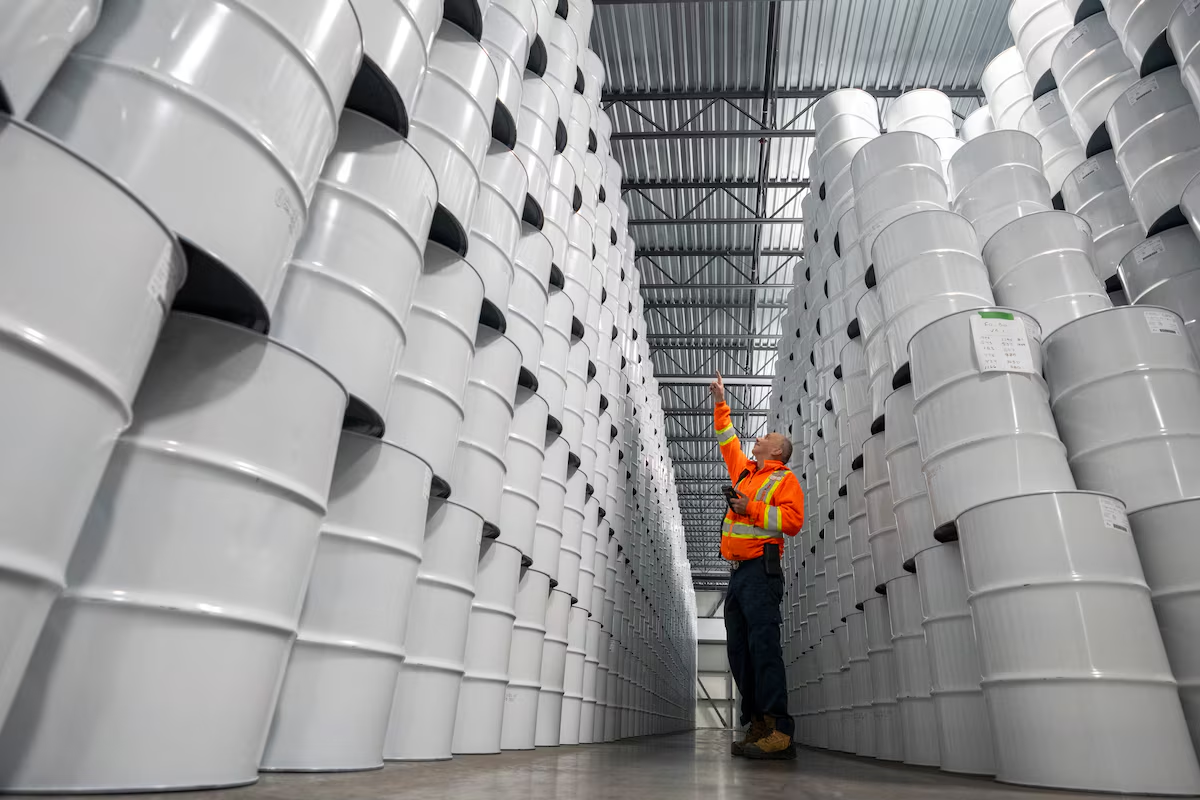
A worker checks barrels of pasteurized maple syrup stored at the Global Strategic Maple Syrup Reserve warehouse in Plessisville, Que. The reserve’s three warehouses in Quebec have a combined capacity of 133 million pounds, or 218,000 barrels.Christinne Muschi/The Canadian Press
Canada’s official maple syrup reserve is sitting near empty, the result of a strong surge in demand that has drained supply to levels not seen in more than a decade.
The Quebec industry, worth about $1.2-billion a year to the province’s GDP, produces most of the world’s maple syrup. And its stockpile is maintained by a government-sanctioned cartel called the Federation of Quebec Maple Syrup Producers, known by its French acronym PPAQ.
“At the end of next February, all the remaining syrup sold under contract will be gone,” said Simon Doré-Ouellet, deputy director-general at PPAQ. “Our warehouses will be at zero.”
The PPAQ sets minimum prices for bulk shipments, regulates production volumes through quotas, and monitors safety and quality standards.
Maple syrup that’s not sold goes to three warehouses in Quebec with a combined capacity of 133 million pounds (218,000 barrels worth $400-million if the space is all full) that can be drawn on when weather conditions yield a lower crop. The aim is to have a greater stability in supply and pricing from season to season.
At the moment, demand from consumers is simply outstripping supply. Bulk buyers and processors, such as Rogers Sugar Inc. and Les Industries Bernard & Fils, are snapping up higher volumes of syrup to meet that demand and sell to retail customers. Increasing their stocks also gives them more operational flexibility in the context of trade tension with the U.S., when they might need to make quick shipments on a timely basis.
“This is the first time we’re seeing a situation like this. There’s much more inventory in the hands of our big buyers than in the past,” Mr. Doré-Ouellet said.
Which Quebec city is the world’s true maple capital? A sticky battle is afoot
Quebec produces about 70 per cent of the world’s maple syrup and roughly 65 per cent of that annual output is shipped to the United States. The breakfast staple is not subject to U.S. tariffs, though the industry continues to brace for that possibility.
Syrup can last years without losing value when it’s stored under proper conditions. Tapping it requires maple trees and a unique set of meteorological freeze-and-thaw weather cycles that aren’t guaranteed.
Canadian exports of maple syrup grew 15.8 per cent year-on-year in 2025 and 9.3 per cent in 2024 over 2023 levels, federal government data show. Europe has been among the bigger growth markets internationally.
“Processors have boosted their inventories to guard against a possible rupture” in syrup availability, said Louis Turenne, president of Quebec’s Maple Industry Council, which represents authorized bulk buyers and processors. He called for a major acceleration in production to meet the demand.
Inventories now in the hands of processors, coupled with next year’s syrup yield, might be sufficient to meet orders, but an imbalance will catch up to the industry eventually given that the strategic reserve is nearly depleted, Mr. Turenne said. “There’s no safety net” so things could get tight, he said.
Open this photo in gallery:
Quebec produces about 70 per cent of the world’s maple syrup.Christinne Muschi/The Canadian Press
When reserve stocks last went dry and retailers couldn’t get their hands on maple syrup in 2008, they turned to other products instead and Canadian companies in the sector lost market share, according to the PPAQ. Those other options include corn syrup, molasses or even honey.
“Having a strategic reserve isn’t an end in itself. What’s important is that we continue to supply markets so we’re not out of stock completely,” Mr. Turenne said. “It can be long path to get back on the shelf if we lose space to other sweet products.”
Maple syrup farms are growing in scale, increasing the efficiency of operations. But they need access to more land and higher quotas than they have at the moment, Mr. Turenne said.
The PPAQ has offered about 21 million tree taps over the past five years, which has attracted hundreds of new producers, Mr. Doré-Ouellet said.
But he acknowledged that significant challenges remain for farmers, including securing financial backing at a time of tremendous uncertainty generally for the North American economy. The PPAQ is asking for more provincial government support, including funding.
The Parti Québécois, which took power this month after winning a minority government, recently proposed to bring in 50,000 new hectares of public forest for maple syrup production. The party also said it would consider the eventual adoption of a “national maple policy.”