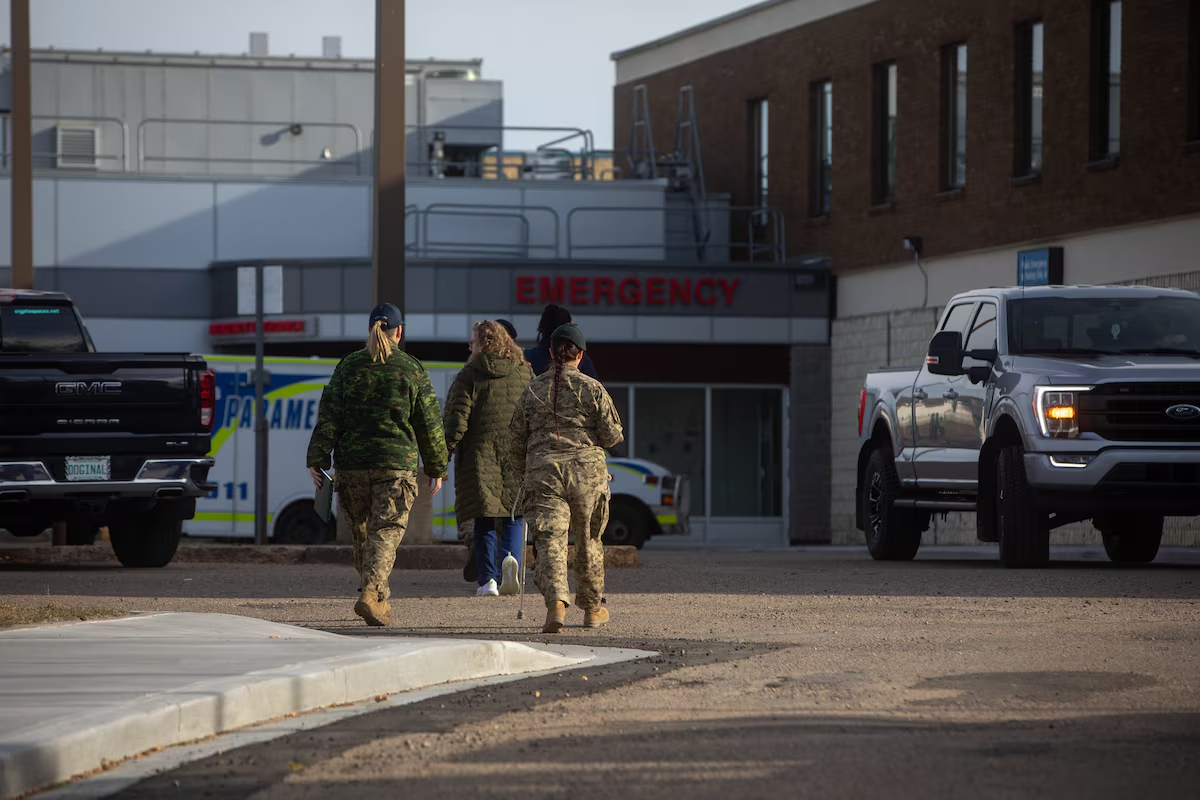

Open this photo in gallery:
Military personnel arrive at the Wainwright Health Centre on Monday.Amanda Erickson/The Globe and Mail
Brandon Simmons heard the Code Orange announced in the hallways on Saturday afternoon.
“Code orange, attention everyone. Code orange, all units.”
Mr. Simmons, who became quadriplegic after a truck accident and lives in the long-term care area of the Wainwright Health Centre, then watched as the hospital roared into action. Nurses began preparing medical supplies and lining up stretchers and gurneys and machines around the entrance, then down the hallways of the small community hospital.
When a friend told Mr. Simmons there had been an explosion at the military base, he wheeled outside and tucked himself into a corner near the emergency doors, out of the way of people coming and going, and sheltered from a wind so strong it was bending trees near the hospital almost in half.
Mr. Simmons was recording video as the first vehicles arrived with injured soldiers from the base. It didn’t take long for him to see the scope of the tragedy that had occurred, and get a sense of what was coming.
“I knew that hell was about to break loose,” he says.
Canada’s top soldier vows to release results of official probe into deadly Wainwright fire
Mayor Bruce Pugh calls the Health Centre “our little Wainwright hospital,” a small facility in a small town, where the people working may personally know the patients they’re working on. Even if the hospital had been completely empty, and it wasn’t, there are only 20 acute care and surgical beds. The disaster for which doctors and nurses were bracing on Sunday afternoon would bring double – or even triple – that number of injured.
The Department of National Defence has said that around 4 p.m. a grass fire that had been burning for hours on the base rapidly changed direction toward personnel that were taking part in live-fire exercises.
The first vehicle to pull up to the hospital was a white SUV, which parked in the emergency bay at 4:11 p.m. Mr. Simmons’s video shows four men in army greens emerging, and moving quickly but carefully into the hospital. Two had their pants hanging in tatters below the knee.
A large military truck pulled up next.
Military personnel unloaded one person and carried them into the hospital on a stretcher. Someone was screaming. Another victim, limping into the hospital himself on burned legs. Another, wrapped in a foil blanket. Another, unmoving on a gurney. Someone was moaning. The wind blew pillows and sheets onto the gravel.
And then ambulances, one after the other, after the other.
Open this photo in gallery:
Brandon Simmons, a long-term care resident at the Wainwright Health Centre, recorded video as the first vehicles arrived with injured soldiers.Amanda Erickson/The Globe and Mail
At some point, Mr. Simmons turned the camera away.
“I didn’t want to even have it on film,” Mr. Simmons said. “I didn’t even want to see it with my own eyes.”
Dr. John Damian Paton-Gay was on-call for the STARS air ambulance service on Saturday night, when he got a call that help was needed in Wainwright.
The wind was so strong it wasn’t clear whether they’d even be able to fly, but a shift in the weather allowed them to get off the ground in Edmonton with a helicopter full of supplies.
They landed at the Wainwright hospital 45 minutes later to an almost unbelievable scene.
By the time Dr. Paton-Gay arrived, the injured from CFB Wainwright had already filled up the tiny emergency department and were overflowing into the rest of the small facility.
He saw injured people in every corner and upstairs. About 30 patients crammed into a small space, with staff moving quickly around them. A scene, he says, “that would make a medical TV show look fairly tame.”
Fifty investigators probing deaths of soldiers in CFB Wainwright fire, Carney says
Burns are measured both in severity and surface area. The injuries Dr. Paton-Gay saw on Saturday evening had no specific patterns, but a consistently high total body surface area burned. This type of injury meant the conditions of the patients were deteriorating rapidly.
“All of the personnel there knew that that was the case,” he said. “They knew they had to move through the first wave of injured very quickly and prepare for the next ones who were going to get sicker. That was very palpable. The sense of urgency was very clear.”
Even as a specialist working in critical care and trauma for almost a decade, the scene was unlike anything he’d ever seen. It was more like a “mass casualty that would happen in a war or a natural disaster,” he said.
Open this photo in gallery:
Paramedics load an injured person into an ambulance at the Wainwright Health Centre as injured military members are treated on Saturday.John Ulan/The Canadian Press
Nurses and doctors sped to the hospital. Throughout the evening, help kept coming. Medical supplies were brought from other communities by truck, medical equipment flown in by helicopter, and additional hands arrived from the sky, as paratroopers landed in the next-door football field.
The injured were stabilized and then sent by ambulance or air to other hospitals around Alberta and Saskatchewan.
As of Monday, there were four soldiers dead and 39 others injured, 19 of those in critical condition.
Mr. Pugh acknowledges the health centre itself was “built for a different time and place,” and that the medical needs of the area have long outgrown the building. Local officials in the town of 7,000 have been working to get a new hospital built for nearly 20 years. It’s the place where Mr. Pugh was born, where all his children were born, and where his parents died. A place where friends and family work.
“But how could you prepare for an event like the one that happened on Saturday?” he added.
Mr. Pugh says he was told that none of the injured died at the hospital in Wainwright and that all of the victims were transported alive to bigger hospital facilities to continue the care. He toured the facility privately, away from the cameras and media, on Monday to thank those who came to the soldiers’ aid, with federal dignitaries who made the visit.
He said he is praying none of them have to go through something like that again and is hoping that they can look back at what they did with pride.
“I hope, in a sense, some of them will be able to look back and say, “You know what? We did it.”
Long before the paratroopers landed and the last ambulance sped away, Mr. Simmons stopped recording and went back to his room, inside the long-term care area of the hospital. He has posted some of his videos online, but not that one.
“You can hear the guy in the back crying and screaming. Those are our strongest people,” he said. “Those are the sounds that will never get out of my head. No matter if I delete that stuff.”
With a file by Stephanie Chambers and Matthew Scace