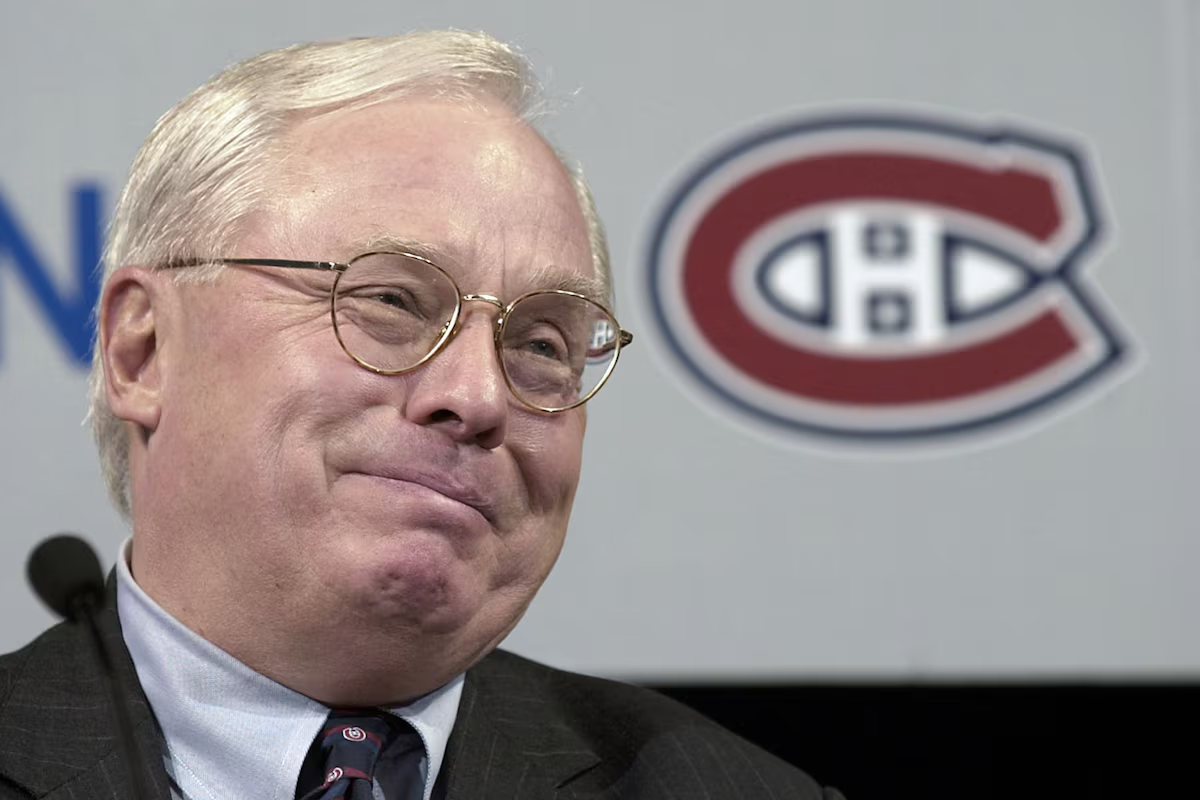

Open this photo in gallery:
George Gillett Jr. smiles during the press conference where it was announced he purchased 80.1 per cent controlling interest in the Montreal Canadiens and 100 per cent of the Molson Center in a deal valued at US$180-million, 2001.CHRISTINNE MUSCHI/The Globe and Mail
When the Colorado-based interloper George Gillett Jr. purchased hockey’s Montreal Canadiens, many fans feared that he was out to pillage a beloved part of Quebec’s heritage.
The wheeler-dealer, who made – and lost – fortunes from meatpacking, television and professional sports, had earlier sought to purchase at least five other National Hockey League teams.
The availability of hockey’s most successful and prestigious franchise was too good an opportunity to pass. In 2001, he paid US$180-million for an 80.1-per-cent stake in the team, as well as ownership of the 21,273-seat Molson (now Bell) Centre, according to Forbes.
The sale created anxiety and apprehension that the Canadiens – a club as integral to Quebec culture as tourtière, Mon pays and the Fête nationale – would be moved south to the new owner’s native land.
Open this photo in gallery:
George Gillett Jr. is presented with a Habs sweater by Guy Lafleur, left, and Daniel O’Neill, President of Molson after announcing the sale of the hockey team and the Molson Centre.CHRISTINNE MUSCHI/The Globe and Mail
Those fears turned out to be unfounded, as Mr. Gillett’s tenure as owner marked a revitalization of a storied franchise. The owner built on the club’s rich legacy. Like so many introduced to Montreal, he was smitten by the city, handling the hockey team almost as a public trust.
The chaos that critics feared from his ownership did later manifest itself in another business deal, as Mr. Gillett’s participation in a heavily leveraged takeover of the famous Liverpool Football Club of the English Premier League ended with public demonstrations and a forced sale.
Mr. Gillett, who has died at the age of 87, owned parts of several other sports franchises in his career, including football’s Miami Dolphins, a Nascar auto-racing team and the touring Harlem Globetrotters basketball troupe. He described each as a business opportunity, insisting he was “no jock sniffer,” a derogatory term for those who seek to hang out with professional athletes.
He also owned several ski resorts, indulging a personal passion for downhill skiing.
An unorthodox approach to business – his family described him as “a visionary, a disrupter” in a paid death notice – kept him in the headlines for nearly six decades.
Instead of buying low and selling high, he bought high and sold higher.
“The so-called experts have said I’ve paid too much for just about everything I’ve bought, then turn around and say I stole it a couple of years later,” he told the Baltimore Sun in 1986.
His maxim: “Every market has an unexploited niche.”
George Nield Gillett Jr. was born on Oct. 22, 1938, in Racine, Wis., to the former Alyce Herbert and Dr. George Nield Gillett Sr., a physician and surgeon. He grew up on a 1,200-acre farm with 130 head of dairy cows. As a young man, he attended Lake Forest Academy and Amherst College before graduating with a liberal arts degree in 1961 from the Dominican College of Racine. He was rejected by Harvard Business School.
After working in sales for the Crown Zellerbach forest products conglomerate, he became a consultant with McKinsey & Company.
Open this photo in gallery:
Gillett wore a Canadiens sweater in public and was often photographed wearing casual clothes including the team’s crest.CHRISTINNE MUSCHI/The Globe and Mail
In 1966, he joined Racine land developer Willard (Bud) Keland in buying a minor share in the year-old Dolphins, his own participation approved in part because National Football League commissioner Pete Rozelle mistakenly thought he was from the wealthy Gillette safety-razor family. Mr. Gillett served briefly as the team’s business manager. He would later be thwarted in trying to purchase the NFL’s Dallas Cowboys, Seattle Seahawks and New Orleans Saints.
Two years later, he sold his share in the football team and joined with two other partners to purchase the Globetrotters, a moribund barnstorming team on the brink of failure after the death of founder Abe Saperstein. More of an entertainment than a sports team, the Trotters were no longer filling arenas with their athletic performances since television made professional basketball readily available.
Mr. Gillett revived the Globetrotters through dramatic marketing, including a Saturday morning animated cartoon on CBS created by Hanna-Barbera in 1970, introducing the team and such stars as Curly Neal and Meadowlark Lemon to a new generation. The cartoon series was the first to air on U.S. television with a predominant cast of Black characters.
Back in his home state, he bought a failing meatpacking plant. He also purchased three small local television stations. A believer in the financial benefits of consolidation, he continued to add to his portfolios, accumulating more stations and meatpacking plants, as well as automobile dealerships and ski resorts, the industry closest to his heart.
Open this photo in gallery:
Like so many introduced to Montreal, Gillett was smitten by the city, handling the hockey team almost as a public trust.SHAUN BEST/Reuters
He had fallen in love with skiing in 1963 on a visit to a year-old resort in Vail, Colo. He purchased it in 1985, as well as the Beaver Creek ski resort. He skied at Vail for 135 days in his first-year as owner, wearing a name tag that read, “George, Racine, Wisconsin,” speaking frankly with customers, employees and others doing business with the resort.
He expanded Vail until it became the largest single-mountain resort in the United States. He also attracted the Alpine World Ski Championships to the resort in 1989, 1999 and 2015.
In a two-year period, Mr. Gillett became owner of the largest group of television network affiliates in the United States through Gillett Holdings Inc. He owned 17 stations, including several in major markets, generating substantial cash flow. His approach was to allow his radio and television stations to improve their local coverage even as they were more closely scrutinized for savings.
“If you build on quality and commitment to the community,” he told the New York Times in 1988, “the cash flow will follow.”
By then, though, his empire was in deep trouble, as purchases partly financed by junk bonds and notes became precarious and vulnerable following the Black Monday stock-market crash in 1987.
The following recession and junk-bond collapse led to a personal bankruptcy after his holding company defaulted on nearly US$1-billion in loans, and he was stripped of the Vail resort and the television stations. He rebuilt by buying other ski resorts and expanding his ownership of pork and beef processors. As well, he was hired to operate the Vail resort by the new owners.
His fortunes were on the upswing by the time Molson Breweries put hockey’s Canadiens on the market. No bids came from Canadian sources.
Mr. Gillett had recently been frustrated in trying to purchase the NHL’s Colorado Avalanche and basketball’s Denver Nuggets, as well as their shared Pepsi Centre arena, in a partnership including retired quarterback John Elway, so the availability of the Montreal team after several months on the market was a welcome opportunity.
He pledged to bring the franchise back to its former glory.
“Our vision is to restore the franchise as the greatest team in hockey,” he told a news conference in 2001. “Our vision is a 25th Stanley Cup in Montreal.”
A condition of the sale was that the team was not to be moved.
Mr. Gillett wore a Canadiens sweater in public and was often photographed wearing casual clothes including the team’s crest. The Canadiens’ famed bleu, blanc et rouge logo fit well with an owner who flew the red, white and blue.
The Canadiens were Mr. Gillett’s second NHL franchise. He had earlier been a minor owner of the troubled Oakland Seals in 1968.
Open this photo in gallery:
Gillett’s tenure as owner marked a revitalization of a storied franchise, building on the club’s rich legacy.PAUL CHIASSON/The Canadian Press
While he did succeed in revitalizing the team and its reputation, notably promoting the team’s rich history, especially during centennial celebrations, as well as making peace with an estranged Patrick Roy, the championship remained elusive. In 2009, he sold the team and the arena to three Molson brothers – Geoff, Andrew and Justin – for a reported US$575-million. The club returned to a family ownership originally established in 1957 when the brothers’ grandfather Thomas Molson and great uncle Hartland Molson acquired the Canadian Arena Company.
“The numbers don’t show the pride we had in owning this marvellous asset nor the heartbreak we suffered in selling it,” Mr. Gillett told Forbes magazine, which estimated the financier had pocketed about US$340-million on the deal, money which he desperately needed to shore up his investment in England.
The takeover of Liverpool Football Club faltered when Mr. Gillett fell out with American partner Tom Hicks, known for his leveraged buyouts of such brands as Weetabix and Dr. Pepper. Once again, a global financial crisis, this one in 2008, made it impossible to sustain the cost of loans. Liverpool FC was sold for less than the estimated total debt, and Mr. Gillett was stuck with paying interest on loans for a club which he no longer owned.
His other sports ventures included ownership of Evernham Motorsports, which merged with another team owned by a legendary driver to become Richard Petty Motorsports.
Mr. Gillett died on Sept. 22 at the Highline Place Memory Center in Denver several years after receiving a diagnosis of Alzheimer’s disease. He leaves the former Rose Dye Foster, his wife of 59 years. He also leaves their sons George (Geordie) Gillett III, Alexander Gillett and Foster Gillett; eight grandchildren; a step-granddaughter; and his 97-year-old stepmother, Ida Gillett. He was predeceased by his parents; a sister, Penelope Ann Harper, who died in 2020, aged 78; and a son, Andrew, who was Foster’s twin brother and who died in 2011, aged 35.
“George Gillett’s passion for the Montreal Canadiens and commitment to the city of Montreal were demonstrated throughout his tenure as owner,” NHL commissioner Gary Bettman said in a statement following Mr. Gillett’s death.
The tycoon once spoke of his legacy at the request of a Baltimore journalist. “All I know,” he said, “is that I want my epitaph to read, ‘He owned the best, not the most.’”
You can find more obituaries from The Globe and Mail here.
To submit a memory about someone we have recently profiled on the Obituaries page, e-mail us at obit@globeandmail.com.