
The wrecks of the last ships of famed explorers Sir Ernest Shackleton and Capt. Robert Falcon Scott have been replicated using 3-D imagery in minute detail, creating “digital twins” to preserve them for posterity.
The 3-D digital replicas, created by knitting together tens of thousands of images captured on the ocean floor during an expedition this summer, are to be unveiled Wednesday at the Royal Canadian Geographical Society’s Ottawa headquarters for viewing by the public. And the replicas will later be made available to schools across the country.
In 2024, the RCGS discovered the wreck of Sir Ernest Shackleton’s last ship, Quest – on which the renowned polar explorer died suddenly during an Antarctic voyage in 1922 – at a depth of 390 metres, off the coast of Newfoundland and Labrador.
This summer, an international expedition led by the RCGS went back to view the wreck up close in the Labrador Sea and, using a remotely operated vehicle, captured the first clear images of the sunken vessel. A three-man team – including RCGS chief executive John Geiger – became the first to directly set eyes on the historic wreck through the portholes of a submersible. (The mini-submarine they used was the same one that in 1986 captured the first pictures of the Titanic, which sank off the coast of Newfoundland in 1912.)
The Canadian-led RCGS expedition then set sail to waters off Greenland’s coast to survey Terra Nova, the last vessel of famed Antarctic explorer Capt. Scott, who perished with his entire team while returning from a much-vaunted expedition to the South Pole in 1912.
During the Second World War, Terra Nova was chartered to carry supplies to Greenland. The ship, built in Dundee, Scotland, and launched in 1884, was damaged in 1943 while at sea and was deliberately sunk after the crew were rescued.
Digital twins of both wrecks, as well as models being made of them, will preserve them for posterity, Mr. Geiger said.
Open this photo in gallery:
Royal Canadian Geographical Society expedition leader John Geiger became the first to set eyes on the historic wreck this summer.Martin Hartley/ Royal Canadian Geographical Society/SUPPLIED
The expedition used photogrammetric technology from Voyis Imaging, a company based in Waterloo, Ont., to capture detailed portraits of both ships. Tens of thousands of high-resolution images of the shipwrecks have now been knitted together “into a complete lucid picture” of both vessels, he said.
The RCGS has also made a film of the expedition and a gallery of still photographs, including underwater images of the wrecks, for the exhibition.
“These wrecks are going to eventually disappear – they’re deteriorating, and there will come a point where they won’t exist at all,” Mr. Geiger said. “They’ll just have been subsumed into the seabed. And so what we’ve been able to do is capture – almost as if in amber – this moment, what these ships are like today.”
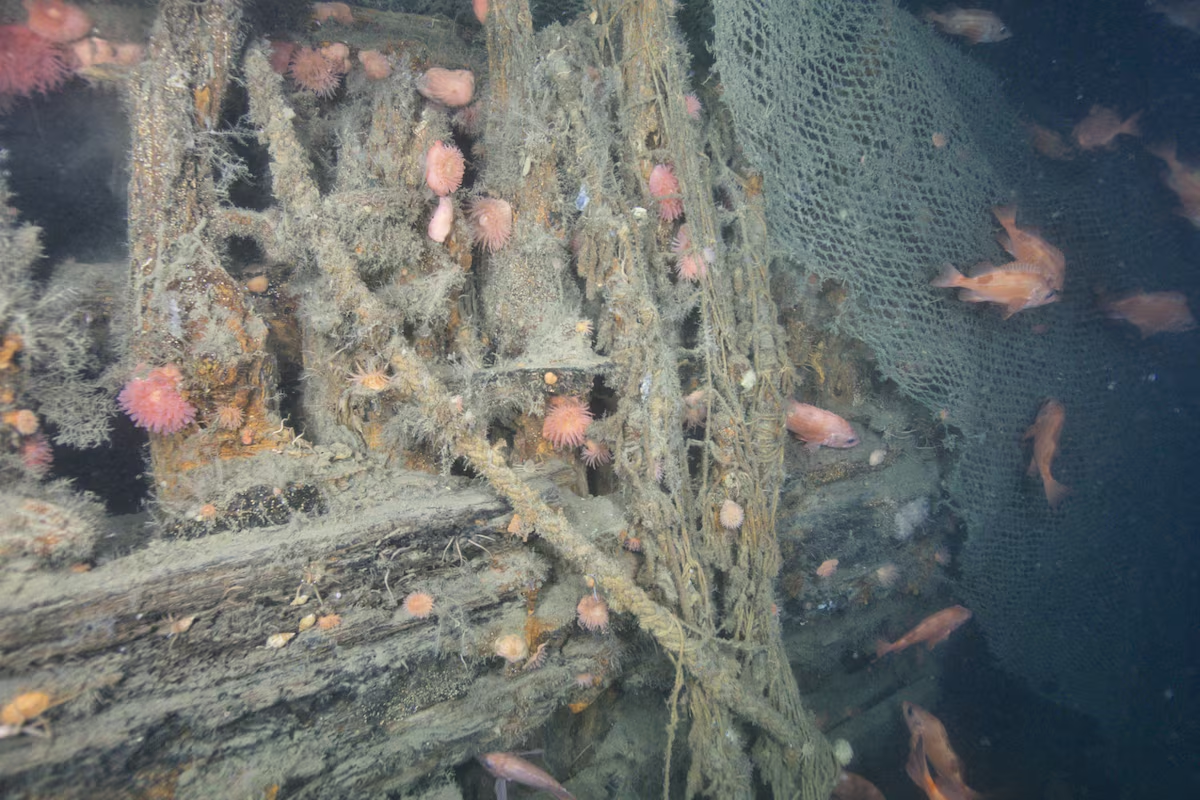
Underwater images of Quest, found at a depth of 390 metres off the coast of Newfoundland and Labrador.
Royal Canadian Geographical Society/SUPPLIED
Underwater images of Terra Nova, found at a depth of 179 metres in waters off the coast of Greenland.
Royal Canadian Geographical Society/SUPPLIED
The RCGS-led expedition, which included the non-profit Massachusetts-based Woods Hole Oceanographic Institution, found that Quest had suffered considerable damage when she sank. Her masts were down, her nameplate – which dated back to Shackleton’s last expedition – was lost and the vessel was covered in sea life and abandoned fishing nets.
After the explorer’s death aboard the ship, it was used in several daring adventures, including helping to rescue a Danish crew marooned on ice floes off the coast of Greenland, Mr. Geiger said, speaking from London last week, where he was launching a book he wrote about Shackleton.
Open this photo in gallery:
Sir Ernest Shackleton, centre, aboard his ship Quest in 1921.Library of the Royal Canadian Geographical Society viaTHE CANADIAN PRESS
Open this photo in gallery:
The monument to explorer Sir Ernest Shackleton on the remote South Atlantic island of South Georgia. He died of a heart attack and was buried there in 1922, having returned to the spot on Quest, six years after his famous Antarctic expedition.Hulton Archive via Getty Images
According to Mr. Geiger’s book, Quest, Shackleton’s Last Ship and the End of the Heroic Age, the vessel was chosen in 1930 by 23-year-old British Arctic explorer Gino Watkins to investigate the feasibility of an air route linking London with Winnipeg, via several hops from Scotland to the Faroe Islands, Iceland, Greenland and to Baffin Island.
After its career as an exploration vessel ended, Quest returned to its original vocation as a sealing ship. It sank off the coast of Labrador after suffering damage in 1962.
Open this photo in gallery:
British explorer Captain Robert Falcon Scott’s ship Terra Nova in Antarctica, in an undated archive photograph.Royal Canadian Geographical Society Archives via REUTERS
Mr. Geiger said Terra Nova, found in waters at a depth of 179 metres, off the coast of Greenland, was “a much more beautiful ship than Quest, which was a small, kind of stubby little workman-like vessel.”
The Terra Nova wreck was also better preserved than Quest, and the expedition discovered navigation equipment used during Capt. Scott’s ill-fated expedition to the Antarctic. Although Terra Nova’s hull had split in two, its original rudder, propeller, two masts, as well as its wheel and ceramic mugs abandoned by its crew when she sank in 1943, were visible.
Mr. Geiger said “the imagery is absolutely striking” and will be closely studied, including to gain more insight into the sea creatures that have made them their homes.
He said the 3-D images are “extremely powerful” and make the viewer “feel like you’re basically swimming over the wrecks.”