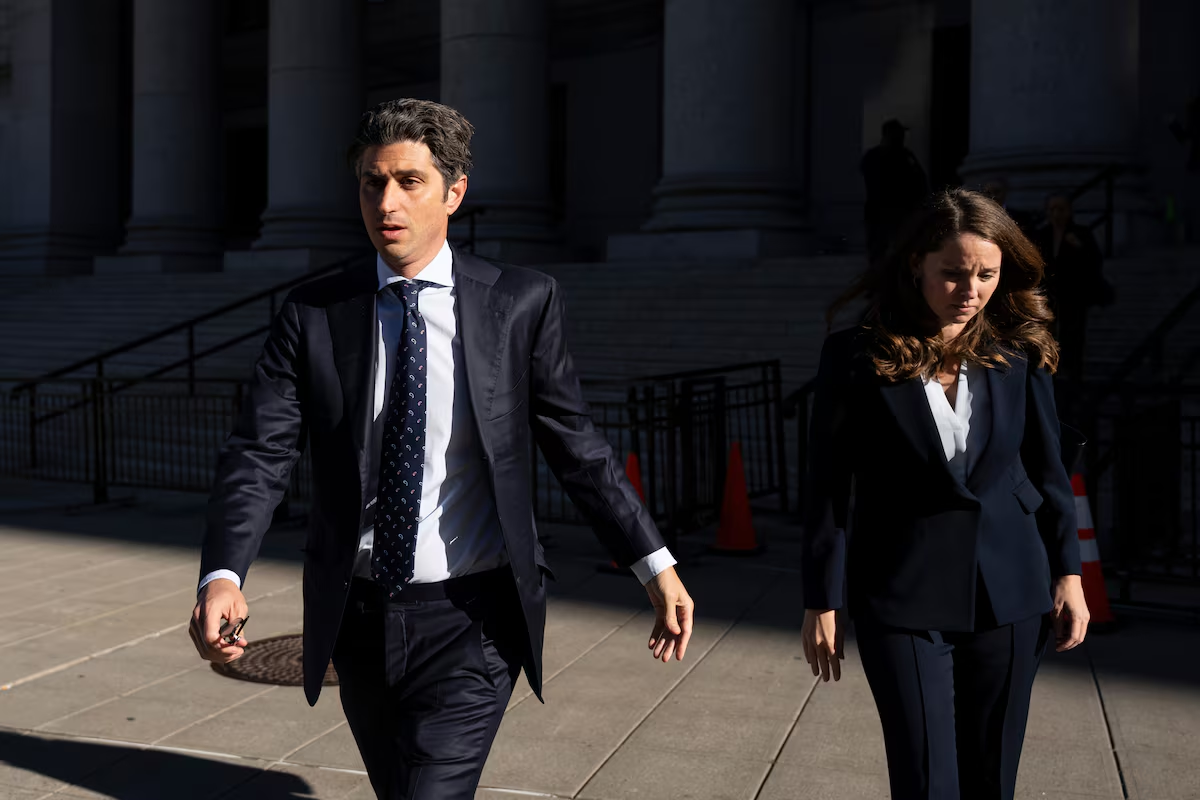

Open this photo in gallery:
Joshua Wander, left, leaves federal court in New York on Thursday. Prosecutors say Wander, the co-founder and former CEO of 777 Partners, used his company to steal money from private creditors and investors.Yuki Iwamura/The Associated Press
The Miami investor who backed the rapid expansion of Flair Airlines in 2021 has pleaded guilty to fraud in a scheme that prosecutors said bilked investors and lenders out of hundreds of millions of dollars.
Joshua Wander, the co-founder and former chief executive officer of 777 Partners, agreed to forfeit US$500-million as part of his plea to the charges of wire fraud and securities fraud, the United States Attorney for the Southern District of New York said in a statement. Each charge carries a maximum sentence of 20 years in jail. Mr. Wander is scheduled to be sentenced on March 1.
“As he has now admitted, Josh Wander used his company, 777 Partners, to steal hundreds of millions of dollars from private creditors and investors,” U.S Attorney Jamie McDonald said in a statement.
Prosecutors said Mr. Wander, 45, defrauded investors and lenders by double-pledging assets, creating fake assets, lying about the financial state of 777 Partners financial state and creating bogus bank statements, “all to gain access to his victims’ funds.”
“He then put those funds to uses that his lenders never permitted, including footing the bill for 777’s collection of professional soccer teams,” the U.S. Attorney said. “Over time, Wander began investing capital in new sectors, including airlines and professional sports teams.”
Planes leased to Flair were bought with money from fraud scheme, U.S. prosecutors allege
In 2004, Mr. Wander pleaded no contest to a charge of trafficking cocaine in Florida and received 16 years’ probation.
Mr. Wander’s company, 777 Partners, was an underwriter and financier of insurance payouts but began borrowing money to invest in sectors outside the normal realm of structured settlements.
The company did not have the money to pay for these acquisitions, so Mr. Wander used restricted funds from the company’s insurance businesses, the U.S. Attorney said. “To steal these funds from lenders, Wander pledged to his lenders hundreds of millions of dollars of structured settlement assets that 777 Partners had never purchased or had previously pledged to other lenders.”
Mr. Wander then concealed the fraud by telling employees to falsify bank statements to show balances worth millions of dollars.
His investments included Edmonton’s Flair Airlines, Bonza airline of Australia, streaming services and European soccer teams Sevilla FC and Genoa CFC. The company’s attempt to buy Everton Football Club of the English Premier League fell through two years ago.
Mr. Wander’s company bought a 25-per-cent stake in privately held Flair in 2019, and would go on to lease 13 new Boeing 737 Max planes to the carrier, with announced plans to build a fleet of 50.
With Mr. Wander and two other 777 Partners executives controlling the airline’s board of directors, Flair would use these planes to launch an ambitious expansion, adding routes across Canada and the United States.
The company cut its stake in Flair to less than 10 per cent in 2024 as Mr. Wander’s legal and financial troubles mounted.
Kim Bowie, a Flair Airlines spokeswoman, said the carrier has had no business relationship with 777 Partners for more than a year. “Accordingly, we are in no position to comment on 777 or its principals,” she said.
In 2022, the Canadian Transportation Agency investigated the involvement of 777 Partners with Flair Airlines, alleging the foreign investor was exerting control over the carrier in violation of Canadian law. Flair Airlines kept its operating licence after agreeing to reduce its dependence on 777 Partners’s financing and plane leases, while adding more Canadians to the board of directors.
By 2023, the U.S. Attorney said, Mr. Wander’s scheme began to fall apart. A lender accused him of using the same assets twice as collateral, and Mr. Wander variously blamed a computer error and an inadvertent slipup.
Around the same time, an aircraft leasing company seized four of Flair Airlines’s 19 passenger planes for late payments in Edmonton, Toronto and Waterloo, Ont.
The financial troubles of Flair Airlines resurfaced in 2024, when The Globe and Mail reported that the federal government obtained a court order to seize and sell the airline’s property to recoup more than $67-million in taxes.
The airline settled the dispute by agreeing to a payment plan of the taxes, which were related to the import of 20 Boeing 737 Max aircraft beginning in 2021, the same time Mr. Wander began driving the airline’s expansion.