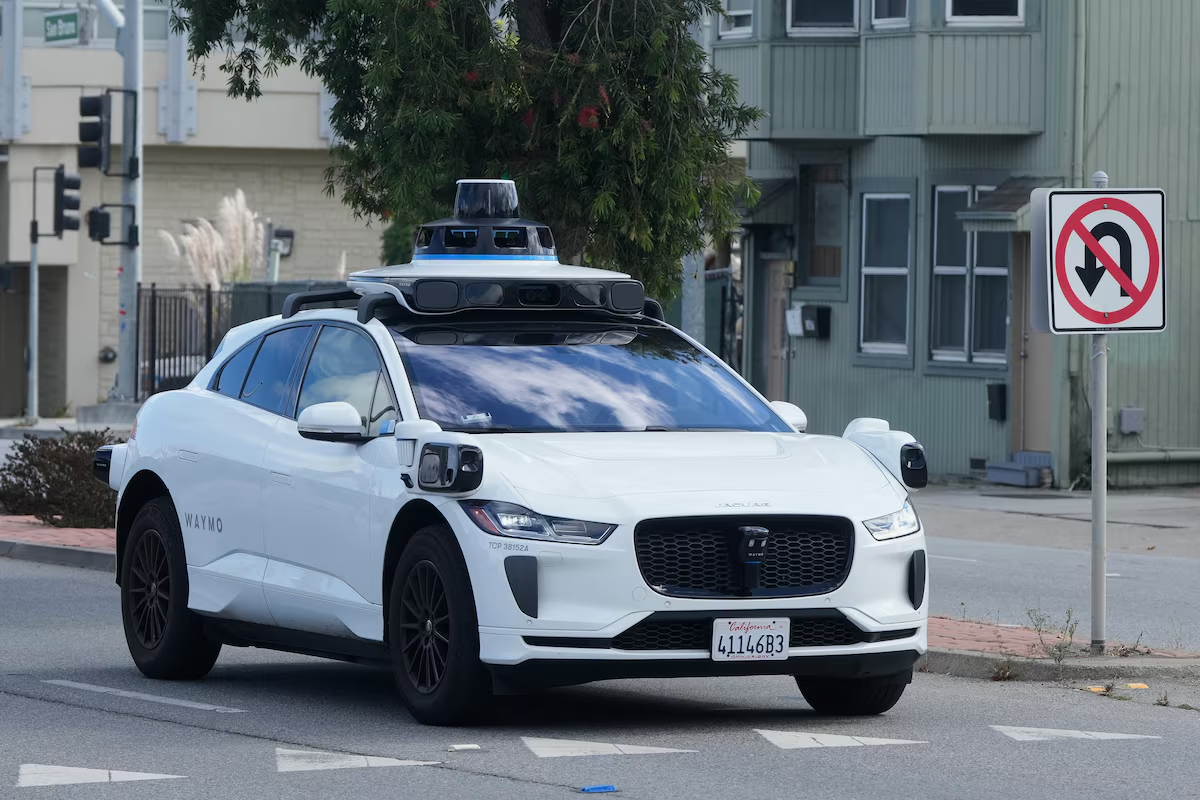

Open this photo in gallery:
California-based Waymo is partnering with Element Fleet Management with the aim to start carrying passengers in Toronto in 2028.Jeff Chiu/The Canadian Press
Waymo, the American self-driving taxi company owned by Alphabet Inc. GOOGL-Q, is entering Canada and launching a pilot program in Toronto as it seeks to become a first mover in the country’s robotaxi market.
The California-based company announced on Friday that it had received approval from the Ontario government to test its fleet of driverless vehicles through the province’s autonomous vehicle pilot program. It will begin operations in the coming days, with the aim of carrying its first passengers in 2028.
Waymo taxis are already popular in a slew of global cities, including San Francisco, Singapore, Tokyo and London. The company operates a fleet of 4,000 fully autonomous vehicles servicing more than 30 cities, mostly in the United States.
Waymo will partner with Element Fleet Management EFN-T, a Toronto-based logistics company, to organize its operations in Toronto. In a joint press release, the two companies said Waymo’s entry into Canada will create hundreds of jobs, including in fleet maintenance, customer service and testing vehicles.
Waymo will start by mapping the streets of Toronto with trained human drivers behind the wheels, the company said. More than a dozen cars will be part of the company’s initial testing.
Opinion: A warning to Canada: Self-driving taxis won’t be a traffic cure-all, and they ignore the real disease
Waymo has existing ties to Canada. The Canada Pension Plan Investment Board was one of the company’s earliest investors, participating in two funding rounds in 2020 and 2021 worth more than US$3-billion in total. Magna International MG-T was also one of the company’s early investors and is a key manufacturing partner in the construction of an autonomous vehicle plant in Arizona, which will build Jaguar and Zeekr electric vehicles for Waymo’s fleet.
But the robotaxi giant’s entry to Toronto could prove challenging.
The city’s private transportation market is dominated by ride-hailing companies – Uber and Lyft – that are themselves making big investments in autonomous vehicles with the aim of operating their own fleets. Uber has partnerships with more than 30 autonomous vehicle companies, including Waabi Innovation Inc., a Toronto-based startup that raised US$750-million earlier this year.
In a statement to The Globe and Mail, Laura Miller, Uber Canada’s head of policy and communication, said autonomous vehicles have the potential to make transportation “safer, more accessible and more affordable” but “how we introduce the technology matters.”
She speculated that driverless rides for paying passengers are still at least two years away in Ontario, and urged the government and industry to set safety standards and prepare for the impact on workers.
Uber has said that autonomous vehicles will never fully replace the need for human drivers because people are still required during peak demand hours, for emergencies and in areas where autonomous vehicles cannot operate.
“Combining humans and autonomous vehicles improves reliability while letting autonomous vehicles scale gradually, preserving earning opportunities and giving workers and governments time to adapt,” Ms. Miller said. She declined to respond specifically to a query about when Uber plans to bring driverless taxis to Toronto.
‘No common sense’: Ride in a robotaxi shows the promise – and limits – of driverless cars
Uber also has a relationship with Waymo, partnering with the company in Austin, Tex., and Atlanta. But there has reportedly been friction between the two Silicon Valley companies. A report in the Financial Times from June said Uber raised concerns about Waymo’s routing and the unavailability of its vehicles during bad weather. The report also speculated that the Uber-Waymo partnership was financially unsustainable.
Both Uber and Waymo did not respond to The Globe and Mail’s request for comment about the nature of the partnership.
Ontario began allowing companies to test autonomous vehicles in 2016, but success stories are limited.
Gatik, a Silicon Valley autonomous vehicle startup, completed a 10-month testing run in Toronto at the end of 2020 and subsequently partnered with Loblaw Inc. to provide autonomous delivery trucks.
Magna began piloting driverless three-wheel delivery devices in Toronto last May, but ended the test early because of technical difficulties. Its vehicles were often confused when encountering construction sites, according to a City of Toronto report from December 2025.
Adam Motaouakkil, one of the co-founders of Technologists for Democracy, a Toronto-based advocacy group, said he is concerned that Waymo’s entry will worsen congestion issues and pose a safety risk.
“Waymo is operating in cities with sprawl, which don’t have massive snow banks or streetcars. Waymo cars in Toronto will have to navigate blizzards, heavy rain and flooding. I’m not sure if the company, or governments, are equipped to address this,” he said.
Waymo spokesperson Amanda Galbraith told The Globe in an e-mail that the company has spent years testing in diverse snowy and icy environments and already operates at below-freezing temperatures in multiple cities, including during frost and hail conditions.
The company began operating in Denver – a city that receives a moderate amount of snow – in September, after a successful pilot project. It also operates in Detroit.
Mr. Motaouakkil said Waymo’s arrival could upend the lives of thousands of Toronto-based gig workers who depend on ride-hailing jobs for extra income, and noted that labour groups’ opposition to Waymo has been growing in multiple American cities.
Waymo paused its testing in New York earlier this year after opposition from the New York Taxi Workers Alliance, a group that has been publicly backed by New York Mayor Zohran Mamdani.