Istiak Rahaman steps up to the microphone, clicks it on and clears his throat.
In a clear, resonant voice, he begins reciting the adhan — the Islamic call to prayer.
Soon, the musalla — the prayer hall — inside the Islamic Association of Saskatchewan (IAOS) mosque in Regina begins to fill with people.
Rahaman and his friend Yasir Khan, both 18, are deeply committed to their faith. They’ve grown up connected to Islam and often volunteer their time in Regina’s Muslim community.
Rahaman says his religion gives him a sense of “being able to fall back onto something.”
“When we see all these issues and struggles of other people happening, we question ‘Where is the justice in all of this?'” he said. “I think my religion has truly given me that understanding.”

Istiak Rahaman, left, and Yasir Khan both feel a deep connection to Islam and volunteer within Regina’s Muslim community. (Kirk Fraser/CBC)
Rahaman and Khan spend some of their time in the mosque studying the Qur’an. Khan says he couldn’t imagine a life without Islam.
“It’s about having that baseline,” he said.
“In human civilization there’s never been a society that’s so connected to the entire world like we are now. And religion is that thing that stays constant.”
The pair represent a trend found in a study published in late 2025 by Angus Reid and Cardus, a Canadian Christian think tank.
The study, which surveyed 5,000 Canadian adults, found people in the youngest age cohort — 18 to 24 — to be the most “religiously committed” of all age groups.
That age demographic fits into what is generally considered to be Gen Z.
The study defines someone being religiously committed as — among other things — believing in a higher power, regularly attending religious services and viewing religion as important to their daily lives.
WATCH | Religion could be on the rise among young adults. Some are seeing it in Sask.:
Religion could be on the rise among young adults. Some are seeing it in Sask.
A recent study shows Gen Z is the most religiously committed age demographic in Canada. Some faith leaders in Saskatchewan say more young people are showing up at their places of worship. But not everyone is convinced religion is on the rise.
Imam Mohamed Abdelsatar of the IAOS Regina mosque says he’s noticed more young people at the mosque — some of whom are even converting to Islam.
He says young adults seeking out religion are often trying to find purpose in life.
“Any young man, any young woman — you see them in the mosque here — they have something special about them. You just have to find it and then give them some role to play,” said Abdelsatar.
“They are trying to find meaning.”
Shenay Weyers, the young adults director at Regina Apostolic Church, sees it the same way.
She says members of her young adults group are more often inviting their non-religious peers, who are open to the idea of a higher power.
“The young people are really hungry for something that is real and that makes sense of the world around us,” Weyers said.

Shenay Weyers, young adults director at Regina Apostolic Church, says more and more young adults at her church are inviting their non-religious peers to come to its young adults group. (Kirk Fraser/CBC)
Research has shown Canadians have become less religious over the last few decades. Some research also shows young people have negative views of religion.
Weyers believes some people her age — in the Millennial generation — may have left Christianity because of these views and have not raised their children religious as a result.
“But now that those kids are starting to get old enough to make a decision for themselves, it’s like they’ve seen this thing that they’ve been missing,” she said.
Trend may extend to even younger Canadians
Alpha Canada, an organization that introduces people to the basics of Christianity, partnered with OneHope Canada, a Christian mission organization, on a study released in late 2025.
Of 422 pre-teens surveyed between the ages of 11 and 13, 68 per cent said their faith, religion or spiritual journey is an important part of who they are.
Shaila Visser, Alpha Canada’s national director, said 306 Network — a Saskatchewan Christian youth organization that trains young people to run Alpha meetings — has seen a huge influx of youth who had no prior knowledge of Christianity.
“Last year they gave out 250 Bibles,” Visser said.
“I do wonder what it is about secularity that has left them wanting. There is an unsettled feeling amongst people that are younger with the kind of world that we have right now.”
Lorrin LeBlanc was somewhere in between the religious and secular worlds growing up.
LeBlanc, 22, grew up in a Catholic family in Wakaw, Sask. He said he would “go through the motions” during mass as a child and wasn’t particularly invested in his faith.
It wasn’t until he graduated high school that he sought a deeper connection.
He began reading the Bible and also came across a video of a Christian influencer on social media talking to a group of young men.
“He was saying some things that I didn’t really know about Jesus and Christianity,” said LeBlanc. “It kind of flipped a switch in my mind.”

Regina Thunder defensive back Lorrin LeBlanc says he reconnected with Christianity on a deeper level once he graduated high school. (Ethan Williams/CBC)
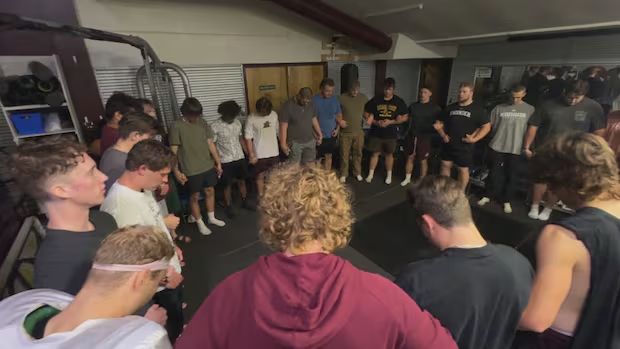
LeBlanc, a defensive back for the Regina Thunder Football Club, brought his newfound connection to religion to the locker room.
He would often kneel to pray in the end zone before games. He’s also helping to lead the team’s chapel nights, which began this season.
Between 20 and 30 players gather once a week after practice in the team’s clubhouse to read scripture and hear a sermon from the team’s new chaplain. LeBlanc and his teammates also occasionally attend mass when they’re able to with their busy football schedules.
“It’s another thing to draw yourself closer to Christ,” LeBlanc said.
He feels it gives young people like him a sense of community.
“That group of people really hold you accountable to being a better person and having good morals.”
Not a religious ‘revival’ yet: researcher
Sam Reimer, who studies the sociology of religion at Crandall University in Moncton, N.B., isn’t convinced the data is showing a religious revival among Gen Z.
He says a revival would, among other things, mean high numbers of religious conversion and lasting religious commitment.
“We would want to wait to see what kind of lasting effects we would have here,” said Reimer. “And the research is, at least I would say, not completely convincing that we’re seeing this en masse.”

Experts caution that just because one study shows a potential religious revival among young people, that doesn’t mean it’s actually happening. (Kirk Fraser/CBC)
Reimer says one possible explanation for the statistics is what he’s dubbed an “emerging adulthood” phenomena.
“What could be happening partly is that young people are staying at home longer,” he said.
“And they’re sort of maintaining their parents’ religiosity simply because there’s some degree of pressure to meet mom and dad’s expectations if they’re still staying in the basement of the house.”
Reimer believes the fact that polling around the issue is largely conducted online may also be a factor. He said older age groups may prefer polls by phone or by mail instead. That could be skewing the data younger.
Regardless of the outcome, Lorrin LeBlanc said he isn’t worried about having a place to practice his faith in the future.
“You see empires fall all the time, but religion has outlasted time itself, pretty much.”